
Is AI face search accurate enough for wedding photo sharing?

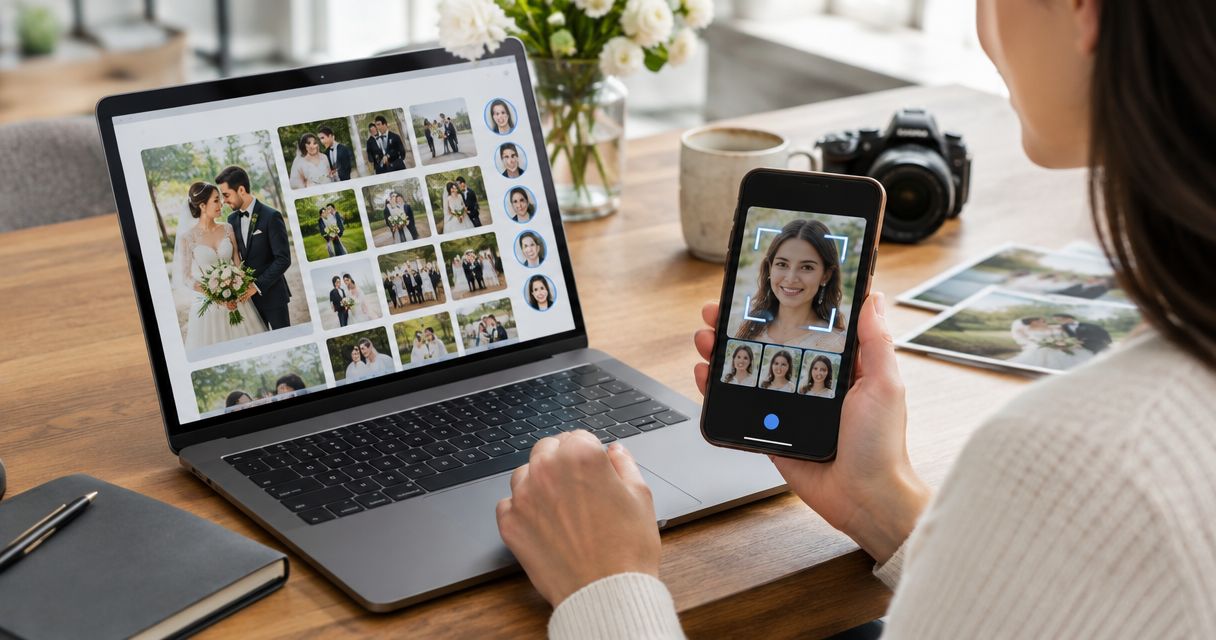
AI face search is suitable for assisted wedding photo discovery, not a guarantee that every guest will find every photograph. For your 2026 delivery workflow, use it only after checking results against known photos, and keep a browsing or photographer-assisted fallback. A correct face match also does not establish permission to view everyone else in the photograph.
TL;DR
- AI face search accuracy wedding checks must examine wrong matches and missed photos separately.
- Fotoowl provides face-recognition galleries for professional wedding photographers; validate results against your own event photographs.
- Test portraits, crowded groups and difficult lighting before making face search your main discovery route.
- Keep photo discovery separate from access permissions, and provide a fallback when matching fails.
Why this matters
Your guests judge the delivery experience by whether they can find their photographs. A polished search screen does not resolve an incorrect result or a missing family portrait.
At an Indian wedding, your gallery can span the haldi, sangeet, ceremony and reception. Assess those conditions separately rather than treating a successful portrait search as proof that the entire collection works equally well. For the implementation workflow, see how to use face recognition to sort wedding photos.
Make face search a discovery aid, not your promise of complete coverage. That distinction keeps your delivery claims aligned with what you have actually checked.
Is AI face search accurate enough for wedding photo sharing?
It is accurate enough for your wedding workflow when your checks show that the returned photographs identify the intended person and recover the photographs you expect to find. These are separate tests. Neither proves the other.
Use this comparison to decide what each result means before releasing a 2026 wedding gallery:
| Check | What you examine | What success establishes | What it does not establish |
|---|---|---|---|
| Correct matches | Whether returned photos show the intended guest | Search is returning relevant photographs | Every relevant photo was found |
| Missed photos | Whether known photographs are absent | How much of the known set search retrieves | That all returned results are correct |
| Access permissions | What the guest can open or download | Whether access follows your sharing decision | Whether face matching is accurate |
| Fallback discovery | Whether a guest can find photos without matching | Whether unsuccessful searches have another route | Whether face search itself improved |
A useful test starts with photographs whose subjects you already know. Compare the search results with that reference set, including both the obvious portraits and less straightforward candid images.
Do not accept a result merely because the person looks similar at thumbnail size. Open questionable photographs and confirm the identity before recording them as correct.
What does a wrong match mean?
A wrong match returns a photograph as relevant to someone who is not pictured. This is a false positive. It matters because the guest receives an incorrect result, and because that result might expose a photograph you did not intend to share with them.
What does a missed photo mean?
A missed photo contains the intended guest but does not appear in the search results. This is a false negative. The guest still needs another way to find the image, even if every photograph that search did return was correct.
Record both error types. A clean-looking results page can still omit important photographs.
How should you test wedding face search before sharing?
For your 2026 release checklist, use the following steps as an acceptance process, not as a claim about any platform's accuracy. Test the photographs you intend to deliver rather than relying only on demonstration images.
- Build a reference set. Choose consenting participants whose identities you can confirm. Include photographs from different wedding functions, camera angles and lighting conditions, and record which images contain each participant.
- Run the search. Follow the platform's supported search process. Where it accepts a reference photograph, use a clear, current image of the intended person rather than an obstructed or heavily filtered one.
- Review the results. Check returned photographs for incorrect identities. Then compare the results with your reference set to identify photographs that were missed.
- Check guest access. Examine the gallery from the intended recipient's perspective. Confirm what they can browse, open and download instead of assuming a face match restricts access.
- Provide a fallback. Decide how a guest will request a missing photograph. Use an approved browsing route or a photographer-assisted lookup, depending on the event's privacy requirements.
Keep a simple review sheet with the participant, wedding function, known photographs, incorrect results and missed photographs. This creates a repeatable record without reducing every issue to a single accuracy label.
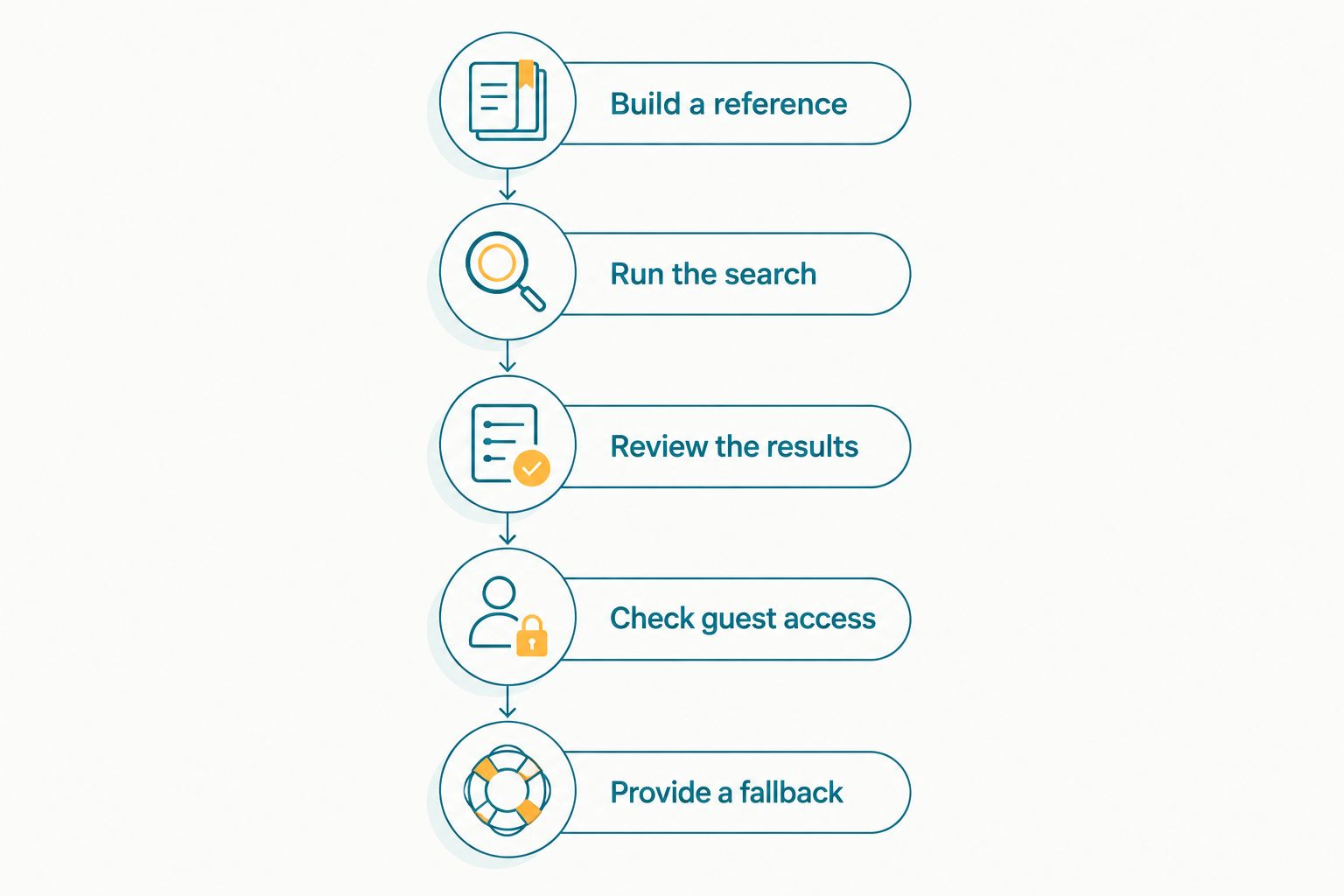
Check matching results and guest access before releasing the gallery.
Test difficult photographs, not just flattering portraits
Include side profiles, dancing photographs, crowded family groups and faces partly covered by hands or clothing. These are relevant tests because facial visibility, pose and image quality affect face-recognition performance.
Include guests across the ages and appearances represented in the wedding. Do not generalise from a successful search for the couple to every person in the collection.
Keep the test conditions consistent
When you compare search attempts, change one input at a time. For example, keep the gallery unchanged while testing a clearer reference image, so you can distinguish an input problem from a change in the collection.
If you change the delivered files or add another function's photographs, review the affected results again. Your original check covered the earlier collection, not the revised gallery.
Why AI face search accuracy varies at weddings
These 5 factors belong in your wedding-gallery checks. They describe established face-recognition challenges, not a performance score for a particular product.
- Facial visibility: A face hidden behind another guest, a hand, sunglasses or clothing supplies less visible facial information. Include partially obstructed faces in your review.
- Head angle: A frontal portrait and a strong side profile show different facial information. Test candid angles alongside posed photographs.
- Image quality: Blur, small faces within wide frames and poor exposure affect the detail available for recognition. Inspect the delivered files, not only the camera originals.
- Lighting: Backlighting, deep shadows and coloured reception lighting change how facial features appear. Test across functions rather than assuming daylight results cover the dance floor.
- Reference image quality: Where search uses a supplied reference image, its clarity and facial visibility matter. Give guests clear instructions for that input.
Do not treat clothing colour or a matching outfit as proof of identity during manual review. Confirm the face itself. This is particularly important when family members wear coordinated clothing.
For 2026 wedding delivery, write guest instructions around actions they can take: provide a clear reference where requested, review the results, and contact the studio if photographs are missing. Avoid promising that another attempt will necessarily recover every image.
Which wedding photo discovery workflow should you use?
Use face search with a fallback when you want self-service discovery without making completeness depend on matching. Use photographer-assisted retrieval when the sharing decision requires you to review the photographs before sending them.
| Workflow | Best for | Advantage | Limitation |
|---|---|---|---|
| Face search | Guests looking for photographs of themselves | Searches by the person rather than requiring manual browsing | Can return wrong matches or miss photographs |
| Approved gallery browsing | Guests exploring a collection cleared for their access | Does not depend on successful face matching | Requires manual searching and exposes the approved collection |
| Photographer-assisted retrieval | Sensitive requests or unresolved searches | Adds a human identity and sharing check | Requires studio involvement |
| Face search with fallback | Studios supporting self-service wedding discovery | Gives unsuccessful searches another route | Still requires matching checks and access decisions |
Fotoowl is for professional wedding photographers who want face-recognition galleries for client delivery. Its AI Gallery supports photo and video delivery with face recognition; assess that fit through the same event-level checks you would apply to any delivery workflow.
The benefit is person-based discovery within the gallery. The limitation is that a face-recognition feature does not, by itself, establish complete retrieval or appropriate access. Keep those acceptance decisions with your studio.
Can you promise that every guest will find every photo?
No. Do not promise complete retrieval unless you have verified the specific collection and the claim you intend to make. A successful search demonstrates that particular result, not every possible search across the wedding.
Use a narrower service description: guests can use face search to look for their photographs, and the studio provides help when results are incomplete. That describes the process without presenting search as an identity guarantee.
Also distinguish missing search results from missing photographs. Before troubleshooting recognition, confirm that the image was selected for delivery and is present in the intended collection.
Does an accurate face match make photo sharing private?
No. An accurate match identifies a relevant photograph; privacy depends on what the recipient is allowed to access. A group photograph can contain the intended guest alongside people whose images require a separate sharing decision.
Before releasing a gallery, review access, download permissions and the agreed use of guest photographs. For a separate treatment of these controls, read whether face-recognition galleries protect guest privacy.
For your 2026 delivery process, document the sharing decision separately from the matching test. Do not use a successful face search as evidence that permission has been obtained.
What should you do when a guest cannot find their photographs?
Start by confirming that the photographs are in the delivered collection. Then check whether the guest followed the supported search process and supplied a suitable reference image, if required.
If the photographs remain absent from the results, use the fallback you agreed before delivery. Ask for the wedding function, approximate scene and accompanying people to help your studio locate the image without asking the guest to search unrelated private photographs.
Record the failure against the actual file and conditions. A note such as side profile during the reception is more actionable than a general complaint that search did not work.
FAQ
Is AI face search accurate enough for Indian wedding photo sharing?
AI face search is suitable as an assisted discovery route when you validate results on the wedding collection and provide a fallback. Test across functions, lighting conditions and group photographs rather than relying only on portraits.
Does Fotoowl offer face recognition for wedding photo galleries?
Fotoowl offers face-recognition galleries for professional wedding and event photographers. Evaluate matching on your own wedding photographs and check access permissions separately.
Can face search find every person in a large wedding group photo?
Do not assume face search will find every person in a group photograph. Small, obscured or strongly angled faces need particular attention during your checks.
What's the difference between a wrong match and a missed wedding photo?
A wrong match returns a photograph that does not contain the intended person; a missed photo contains them but is absent from the results. Record both because correct results do not establish complete retrieval.
Should I remove gallery browsing after enabling face search?
Keep an approved fallback rather than making discovery depend entirely on face search. Whether that fallback is browsing or studio-assisted retrieval depends on the event's sharing requirements.
Is a guest selfie enough to prove they can access a photograph?
A reference selfie is a search input, not proof of permission to access a photograph. Confirm the platform's access controls and your sharing decisions independently.
How should I check wedding face search accuracy in 2026?
Compare search results with a known set of wedding photographs, recording incorrect results and missed images separately. Include difficult lighting, side profiles and group photographs, then test the fallback route.
One last thing
Test a search that returns nothing. A useful delivery process must explain an empty result without telling the guest that no photographs of them exist.
Before your next wedding release, write the empty-results instruction and assign the studio contact who handles it. That is a practical acceptance check: your workflow should help the guest even when recognition does not.