
How long should you keep client photos after a wedding?


Keep client wedding photos for the period you promise in writing, with separate deadlines for RAW files, finished images and online gallery access. Gallery expiry is not the same as archive deletion, and neither should happen while agreed album work, revisions or a dispute remains unresolved. Choose retention periods your studio can support rather than promising permanent storage.
TL;DR
- How long to keep client wedding photos depends on written commitments, unfinished work and the file type.
- Separate RAW retention, edited-photo archives and online gallery access in your wedding photography contract.
- Fotoowl AI Gallery supports face-recognition photo delivery; keep archive retention decisions separate from gallery access.
- Use the established 3-2-1 backup approach, and test restoration before deleting working copies.
How long should you keep client photos after a wedding?
Use a written retention schedule, not a single deletion date for the entire wedding. Your schedule should identify what you keep, what starts the retention clock and what must happen before deletion. Put those commitments in your photography contract for event clients before the booking is confirmed.
| File or access type | Keep it through | Benefit of retaining it | Limitation |
|---|---|---|---|
| RAW originals | Editing, agreed revisions and any promised source-file retention period | Preserves scope for further editing | Requires storage and the tools needed to reopen the files |
| Finished high-resolution images | The archive period stated in your agreement | Supports replacement delivery and agreed print work | Does not preserve every editing decision or source detail |
| Album selections and layouts | Album approval, production and unresolved corrections | Keeps the agreed album work traceable | Selections alone do not replace the underlying image files |
| Online gallery access | The access period communicated to the client | Gives clients a place to view and retrieve delivered images | Access expiry does not establish whether an independent archive exists |
| Rejected frames and temporary exports | Human review and completion of the relevant production checks | Allows correction of mistaken exclusions | Keeping everything creates more material to organise and protect |
These are workflow checkpoints, not fixed industry retention periods. For your 2026 bookings, assign an actual end date or clearly defined trigger to each category before accepting the work.
Why this matters
A client asking for their photographs again is asking a different question from a client opening an old gallery link. Your answer depends on whether the finished files still exist, whether you can restore them and whether retrieval remains part of your agreement.
For an Indian wedding covering an engagement, mehendi, sangeet, ceremony and reception, check completion across every commissioned function. Delivering the ceremony photographs does not close unfinished reception edits or an outstanding album.
Your retention policy should describe what your studio will actually do. A promise that nobody tracks is not a dependable service commitment.
RAW originals: retain through editing and agreed revisions
RAW files preserve editing flexibility that a finished JPEG does not. Keep the source files needed to complete your contracted work, including outstanding corrections and agreed album changes.
Best for: unfinished editing and source-dependent revisions. The trade-off is a larger archive and a need to preserve usable editing records alongside the photographs.
Before deleting originals, check whether the client has raised an unresolved issue involving exposure, colour, cropping or image selection. Do not treat the first export as permission to discard everything behind it.
Keep your editing catalogue and relevant sidecar files with the project where your workflow uses them. A folder of originals without the corresponding editing records is not equivalent to a recoverable editing project.
Finished images: retain through the promised archive period
The final high-resolution export is the set you delivered, not a mixture of previews, alternate edits and test exports. Keep that approved set clearly separated so another team member can identify it without reconstructing the job.
Best for: replacement downloads and agreed future printing. Finished images are easier to retrieve than an entire editing project, but they do not offer the same scope for changing the original edit.
Record which version the client received and whether later corrections replaced any files. Your archive should make the final version obvious.
For your 2026 policy, define whether retention starts at final delivery, written acceptance or another agreed milestone. Use the same trigger in your agreement, delivery message and internal job record.
Online galleries: state access expiry separately
A delivery gallery is not a promise to keep photographs forever. State when access ends, what clients should download and whether a separate studio archive continues after the gallery closes.
Best for: client viewing and photo delivery. The limitation is that an accessible gallery does not, by itself, demonstrate a separate recoverable backup.
Fotoowl AI Gallery is for professional wedding photographers who need face-recognition photo delivery, not a substitute for a written retention policy. Keep the delivery benefit separate from any archive commitment your studio makes.
When using Fotoowl AI Gallery, communicate your studio's access and retention terms without assuming that a delivery feature determines either period. Verify the current account terms before promising an access window to a client.
Why wedding photo retention varies
Set retention around the work you owe and the copies you can maintain. These factors deserve separate decisions:
- Contract commitments: An explicit archive promise needs a matching storage process and a tracked end date.
- File type: RAW originals, finished images, album layouts and temporary exports serve different purposes.
- Outstanding deliverables: Unfinished albums or revisions keep the relevant files in active use.
- Client access: Gallery closure and archive deletion are separate actions with separate consequences.
- Storage design: Your retention promise must account for backup copies, restoration and eventual deletion.
- Unresolved issues: Complaints, disputed delivery or deletion requests need review before routine disposal proceeds.
Do not extend every file's life simply because one deliverable remains open. Identify the files required for that work and record why they remain in the archive.
How do you turn a retention policy into a studio process?
Build your 2026 retention process around job milestones. Give each wedding a named owner who checks the record before changing access or deleting files.
Establish scope
List the commissioned functions, deliverables and file categories. Separate photographer-created originals from client-supplied material so the team knows what each folder contains.
Set deadlines
Record the gallery access deadline, archive end date and source-file review trigger. Avoid vague descriptions such as long-term storage unless the agreement defines what that means.
Verify delivery
Check that the promised final files are present and usable. Ask the client to confirm receipt and download, while keeping that confirmation separate from approval of any outstanding album work.
Check obligations
Review revisions, album production and unresolved issues before disposal. If something remains open, document the exception and the next review trigger rather than leaving the job indefinitely unclassified.
Close the archive
Notify the client as promised, complete the required checks and record the disposal decision. Make the record specific enough that another team member can answer a later retrieval request accurately.
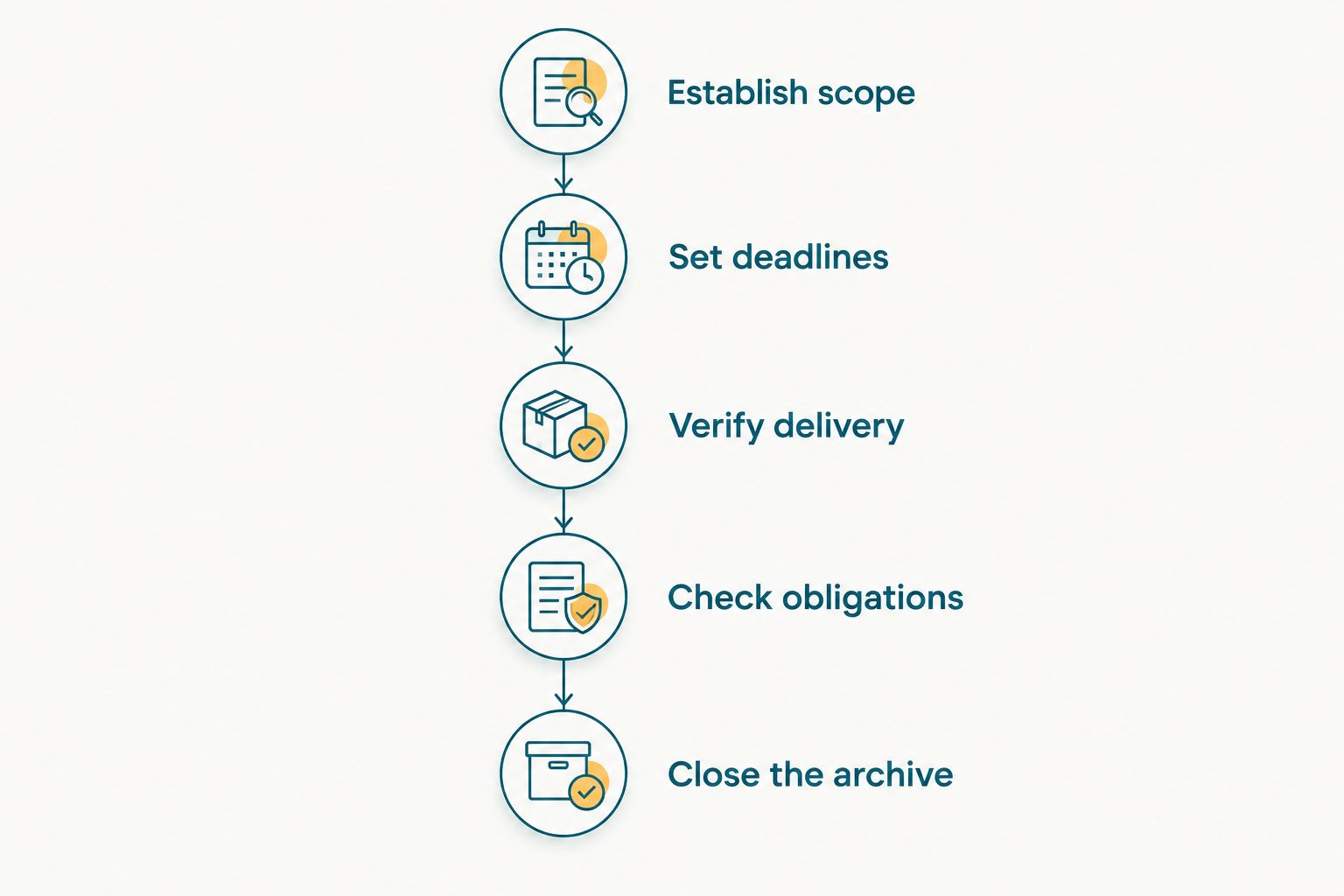
Check delivery and unfinished obligations before closing a wedding archive.
A clear record also helps when an editor, album designer and studio owner handle different parts of the same wedding. Each person should see the same retention decision rather than rely on a message buried in a chat.
Does keeping photos in the cloud count as a backup?
Cloud storage can be part of your backup plan, but a single uploaded copy is still a single copy. Synchronisation also needs scrutiny: if deletion propagates between locations, those locations do not provide independent protection against that deletion.
Use the established 3-2-1 backup rule: maintain 3 copies, use 2 different media types and keep 1 copy offsite. Treat it as a backup design principle, not a wedding photo retention period or a guarantee against every failure.
The cloud storage guide for wedding photographers covers the storage side of this workflow. Your retention policy still needs to explain which files remain and when their retention ends.
Test restoration by retrieving archived files and opening them in the software you use. A successful upload notification does not prove that you can recover the complete job.
Include backup behaviour in your 2026 deletion procedure. Record whether removed files remain in version history or backups, and avoid promising immediate erasure unless your process supports that promise.
What should your wedding photo retention clause include?
Define the promise before describing the exceptions. Your client should understand what remains accessible, what the studio retains privately and when each commitment ends.
Include these points in the agreement:
- Covered files: Identify whether retention includes finished photographs, originals, video, album files or only specified deliverables.
- Starting trigger: State the event that begins each retention period.
- Access deadline: Give the client a clear deadline for downloading the delivered set.
- Archive boundary: Explain whether gallery closure leaves a separate archive and how long that commitment lasts.
- Retrieval process: Explain how clients request retained files without implying that deleted files remain recoverable.
- Deletion procedure: Describe notice, unresolved-work checks and how the studio handles applicable exceptions.
Have a qualified adviser review the clause for your business and the requirements that apply to it. Keep photo retention separate from accounting-record retention; an invoice and a wedding image are different records.
For 2026 contracts, check that the delivery message does not promise more than the signed agreement. Staff should not casually offer permanent backup when the studio operates a limited archive.
Can you delete RAW files after delivering the edited photos?
Delete RAW files only after completing the work that requires them and meeting your written retention commitments. Delivery alone does not establish that revisions, album work or unresolved issues are closed.
Before deletion, open the final exports and verify the required backup copies. Check that the client-facing agreement does not include source-file retention or delivery that remains outstanding.
Should you keep wedding photos forever?
Do not promise permanent retention unless your studio can maintain that commitment. An indefinite archive requires continuing organisation, access control, file checks and storage maintenance.
A defined retention period gives clients a clear expectation. If you retain selected portfolio images separately, document that purpose and the permissions relevant to their use rather than silently treating the client archive as a marketing library.
What if a client asks for photos after the retention period ends?
Check the archive before promising recovery. Confirm that the correct finished set exists and opens successfully, then explain what you can provide under the agreement.
If the files were deleted under the stated policy, answer directly. Do not describe an expired gallery as proof that all copies are gone, or imply that a missing gallery can always be restored.
FAQ
How long should I keep client wedding photos as an Indian photographer?
Keep client wedding photos for the period stated in your agreement, with separate rules for originals, finished images and gallery access. Complete outstanding deliverables and review unresolved issues before deletion.
When should my wedding photo retention period start?
Start the retention period at the milestone defined in your agreement. Final delivery and client acceptance are different triggers, so identify which one governs each file category.
Can I delete the photos when the client gallery expires?
Gallery expiry alone is not a sufficient deletion trigger. Check your separate archive commitment, outstanding work and any unresolved issue before deleting photographs.
Do I need to retain rejected wedding photographs?
Keep rejected frames through human review and any production checks that require them. Set a separate disposal rule rather than assuming rejected frames need the same archive period as finished photographs.
Is a wedding photo gallery the same as an archive?
A wedding photo gallery provides access to delivered photographs; an archive preserves the files your studio has committed to retain. Fotoowl AI Gallery supports face-recognition delivery, while your studio must define its own retention commitment.
What is the 3-2-1 rule for wedding photo backups?
The 3-2-1 rule means keeping 3 copies across 2 different media types, with 1 copy offsite. It describes backup design, not how long you must retain wedding photographs.
Should I notify clients before deleting their wedding photos?
Build a pre-deletion notice into your policy and follow any notice commitment you make. State the affected files, the deadline and the action the client needs to take.
One last thing
Preserve an archive record even when the image-retention period ends. Record the wedding identifier, delivery status, applicable policy, notices sent and disposal decision, while applying an appropriate retention policy to that record too.
That record helps your team distinguish files deliberately removed under an agreement from files that are simply misplaced. Before your next wedding delivery, assign an owner to maintain it.