
How to prevent duplicate enquiries in your photography CRM


Prevent duplicate photography CRM enquiries by checking both the person and the booking before creating a new record. Keep repeat messages against the existing enquiry, record additional family members as separate contacts, and confirm uncertain matches before merging anything; a shared phone number does not prove that two bookings are the same.
TL;DR
- Prevent duplicate photography crm enquiries by matching contact details and event context before creating records.
- Fotoowl Studio Manager suits photographers managing WhatsApp and Instagram leads, follow-ups, quotations and contracts.
- Keep separate contacts for family members, but avoid separate enquiries for the same confirmed booking.
- Review uncertain matches manually; never merge records using a name or wedding date alone.
Why this matters
A repeat message is not necessarily a new sales opportunity. If your studio treats every WhatsApp conversation, Instagram DM and forwarded enquiry as a fresh booking, staff can send overlapping follow-ups or work from different versions of the brief.
The opposite mistake matters too. Combining unrelated enquiries can attach the wrong event details, quotation or payment history to a client. Your goal is accurate booking records, not the smallest possible contact list.
For your 2026 studio workflow, make identity checks part of intake rather than a cleanup task after quotations go out. The wider WhatsApp leads-to-signed-contracts workflow helps place this check before the booking progresses.
How to prevent duplicate enquiries in your photography CRM
Use a repeatable intake sequence: search, compare, classify, assign and review. Apply it whether you enter enquiries manually or use software to capture conversations.
- Search existing contacts. Look for the phone number, email address and known social handle before adding someone.
- Compare the booking. Check the event date, city, venue, event type and people involved.
- Classify the message. Decide whether it is a repeat conversation, another contact for an existing enquiry, or a genuinely new booking request.
- Assign responsibility. Keep a named enquiry owner and a clear next action.
- Review uncertain matches. Ask the client or check the conversation history before consolidating records.
Do not let a matching phone number finish the decision. A returning client can enquire about a different event, and a wedding planner can represent unrelated clients.
Decide what the incoming message represents
| Incoming message | Best action | Best for | Benefit | Limitation |
|---|---|---|---|---|
| Same person, same confirmed booking | Update the existing enquiry | Repeat follow-ups | Preserves the conversation history | Requires checking the booking context |
| Different family member, same confirmed booking | Keep a separate contact associated with the enquiry | Shared wedding decisions | Preserves individual identities | Staff must confirm the relationship |
| Same person, different event | Create a separate enquiry under the existing contact | Returning clients | Keeps bookings distinct | Shared contact details will still match |
| Similar name or date, identity uncertain | Hold for manual review | Ambiguous matches | Avoids an incorrect merge | Needs a human decision |
| Same enquiry imported again | Reconcile against the existing record | Repeated data imports | Avoids duplicate intake | Requires a reliable source reference |
These are handling rules, not promises that every CRM provides the corresponding controls. Where your software lacks contact relationships or review queues, record the relationship and review status in a consistent note.
Separate contacts from booking enquiries
A contact identifies a person. An enquiry identifies a potential booking. Keeping that distinction clear prevents a returning customer from being mistaken for a duplicate.
Use these record rules in your 2026 intake checklist:
- 1 contact record per confirmed person: retain their verified phone numbers, email addresses and social handles together where your CRM supports them.
- 1 enquiry record per confirmed booking request: keep repeat conversations about that request together.
- 1 accountable owner per enquiry: name the staff member responsible for the next response, even when others contribute.
These are recommended operating rules, not industry benchmarks. Adjust the record structure to your software without losing the distinction between the person and the booking.
For an Indian wedding enquiry, the couple, a parent and a planner can all be legitimate contacts for the same assignment. Do not erase those identities by merging everyone into the person who first messaged.
Likewise, decide what counts as a booking before consolidating wedding functions. If the engagement, sangeet and reception belong to the same agreed assignment, record their separate dates within that enquiry; if they are independently commissioned, preserve the separate booking requests.
Make contact matching consistent
Search works better when staff enter identifiers consistently. Keep the original details alongside any standardised search value so you can check what the client actually supplied.
Standardise phone numbers without guessing
For Indian numbers, use a consistent country-code format, including +91 where confirmed. Remove presentation differences such as spaces or hyphens from the matching value, but do not assume every number belongs to India.
A shared family number deserves a relationship check. Ask who is messaging and which event they mean before attaching the conversation to an existing person.
Keep email addresses and social handles distinct
Trim accidental spaces from email addresses and preserve the address the client provided. Do not remove dots, rewrite domains or assume differently written addresses belong to the same inbox.
Record an Instagram handle separately from the display name. Display names alone are weak evidence because different people can use the same name, and a person can change how their name appears.
Use names as supporting evidence
Names help staff find a possible match, but they should not trigger a merge by themselves. Initials, spelling variations and shared surnames need context.
Compare the name with the event details and a confirmed identifier. If those details conflict, stop and verify rather than choosing whichever record looks more complete.
Check the booking before joining conversations
A contact match answers who is speaking. It does not answer which job they are discussing.
Before adding a message to an existing enquiry, compare the event type, dates, city, venue and client relationship. Treat a changed venue or postponed date as something to confirm, not automatic proof of a new booking.
Use the same sequence across your 2026 intake channels:
- Contact check: identify the person using confirmed details.
- Event check: compare the requested assignment with existing enquiries.
- Owner check: identify who already handles the conversation.
- Record update: add the message or create a separate enquiry after classification.
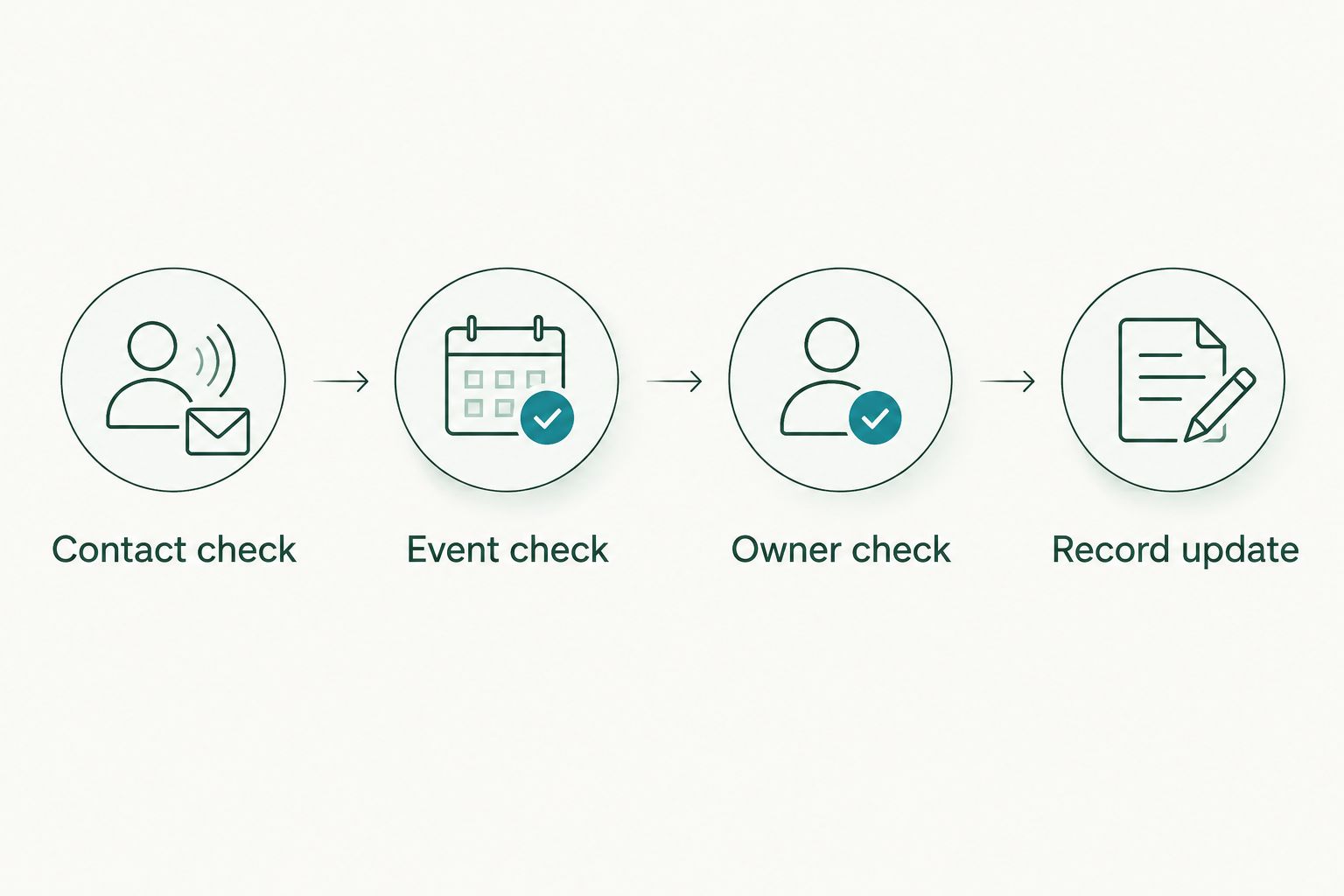
Confirm both the person and the booking before updating an enquiry.
When the match remains unclear, ask whether the message concerns the booking already discussed with your studio. Record the answer so another team member does not repeat the investigation.
Do not collect unnecessary personal information just to make matching easier. Use the contact and event details needed to manage the enquiry.
Keep overlapping replies out of the workflow
Duplicate records are only part of the problem. Staff can also send duplicate responses from a correctly consolidated enquiry if responsibility is unclear.
Name the enquiry owner, record the last response and leave the next action visible. A handover should explain what the client requested, what your studio promised and who responds next.
Before activating a follow-up on a suspected duplicate, check whether the existing enquiry already has an active task. Pause redundant tasks during review rather than letting both records continue independently.
Fotoowl Studio Manager is best for professional photographers who want WhatsApp and Instagram lead management alongside quotations, contracts and project administration. It captures and analyses leads from those conversations and manages follow-ups, but that is not a reason to assume automatic duplicate detection or safe automatic merging.
When evaluating Fotoowl Studio Manager as a photography CRM, check how the current workflow handles repeat contacts, separate events and staff handovers. Software capture and your studio's matching policy need to work together; neither replaces confirmation of an uncertain identity.
Clean existing duplicates without losing booking history
Start with active enquiries where overlapping responses or conflicting documents would affect a live conversation. Before changing records, export or otherwise preserve the relevant information using your system's available controls.
Compare candidate records side by side. Check contact details, event scope, latest client instructions, quotation references, contract status, invoices, payments and pending tasks before selecting the record to retain.
Use this consolidation order:
- Confirm identity and booking. Establish that both records describe the same person and the same enquiry.
- Choose the retained record. Prefer the record that preserves the verified booking history, not simply the newest entry.
- Preserve useful information. Retain source details, conversation notes and valid documents before removing anything.
- Resolve conflicting tasks. Keep the correct next action and stop redundant follow-ups.
- Document the decision. Note which record was consolidated, why, and who reviewed it.
Do not merge issued invoices, payment entries or signed documents merely because the enquiry names match. Reconcile those records through the appropriate administrative process, preserving their references and history.
If your CRM does not support a safe merge, mark the redundant enquiry clearly and stop using it while retaining the required history. Deleting first and reconstructing later is the wrong sequence.
Why duplicate photography CRM enquiries happen
For a 2026 prevention policy, address the intake conditions that allow duplicates rather than relying only on periodic searches:
- Separate channels: a WhatsApp message and an Instagram DM are entered without checking whether they concern the same request.
- Different contact formats: staff save the same phone number or email address inconsistently.
- Multiple decision-makers: family members or planners enquire separately about a shared assignment.
- Unclear booking boundaries: different wedding functions are treated inconsistently as separate jobs or one assignment.
- Repeated imports: a previously processed enquiry list is entered again without reconciliation.
- Unclear ownership: staff create another record instead of continuing the existing conversation.
Assign a correction to each cause. Formatting needs an entry convention; multiple decision-makers need relationship notes; overlapping staff activity needs an owner and a handover rule.
A cleanup that removes records without changing intake leaves the same route open for the next duplicate.
Should enquiries from the same phone number be merged?
The same phone number is a reason to review records, not an instruction to merge them. Confirm the person and booking first, especially when a family shares a number or a planner handles multiple clients.
Should different wedding functions have separate enquiries?
Different wedding functions need separate enquiries when they are separate booking requests. Keep functions within the same confirmed assignment together, while recording each function's dates, scope and requirements clearly.
Can automation prevent every duplicate enquiry?
Automation does not remove the need to verify ambiguous identities and bookings. In your 2026 workflow, let confirmed identifiers support matching, and keep uncertain cases subject to human review before consolidation.
FAQ
What's the first thing I should check before creating a photography enquiry?
Search for the person's phone number, email address and known social handle first. Then compare the event details, because an existing contact can have a genuinely new booking request.
Is the same wedding date enough to identify a duplicate enquiry?
The same wedding date is not enough to identify a duplicate enquiry. Confirm the contact, venue, client relationship and requested assignment before joining records.
How do I handle a parent and a couple enquiring about the same wedding?
Keep the parent and couple as distinct contacts and associate them with the same enquiry after confirming the booking relationship. Record who makes decisions and who should receive the next response.
Should I delete a duplicate photography CRM record immediately?
Do not delete a suspected duplicate before reviewing its history. Preserve relevant conversations, documents, payments and tasks, then consolidate or mark the redundant record according to your system's controls.
Can Fotoowl Studio Manager manage WhatsApp and Instagram leads?
Fotoowl Studio Manager captures and analyses leads from WhatsApp and Instagram chats and manages follow-ups, quotations, contracts and projects. Verify how its current workflow handles duplicate candidates rather than assuming automatic merging.
How should I record a returning photography client?
Reuse the existing contact after confirming their identity, but create a separate enquiry for a different booking request. Keep the new event's scope, documents and follow-ups distinct from previous work.
How do I stop two staff members following up with the same client?
Assign an accountable enquiry owner and keep the latest response and next action visible. During a handover, confirm who replies next and stop redundant follow-up tasks.
One last thing
A repeated enquiry can contain a genuine update. Before closing it as a duplicate, check whether the client changed the venue, added coverage or introduced another decision-maker.
Preserve that update in the retained enquiry. The correct outcome is a complete booking history with a clear next action, not merely fewer records.