
Instagram DMs to booked shoots: complete 2026 workflow


Instead of manually copying Instagram enquiries into scattered notes, build a lead-capture workflow that turns each conversation into a qualified brief, a follow-up and a booking decision. This 2026 guide to instagram lead capture for photographers shows you how to keep those handoffs connected without treating every DM as a confirmed shoot.
TL;DR
- Instagram lead capture for photographers needs a client brief, an owner and a dated next action—not just saved messages.
- Fotoowl Studio Manager supports Instagram and WhatsApp lead capture alongside quotations, contracts, projects and payments.
- Confirm scope, booking terms and payment status before treating an Instagram enquiry as a booked shoot.
- Test new enquiries, returning clients and changed dates before making the workflow your studio’s standard process.
Why this matters
A reply is not a booking record. When the event date sits in Instagram, the revised brief sits in WhatsApp and the quotation sits elsewhere, your team must reconstruct the job before taking the next step.
Fotoowl Studio Manager is best for wedding and event photographers who need chat enquiries and studio administration in one CRM. It captures and analyses leads from Instagram and WhatsApp chats, and manages follow-ups, quotations, contracts, invoices, projects, schedules and payments. Your team still needs to verify the brief and approve commitments.
For your 2026 booking process, separate three decisions: whether the enquiry fits, whether you can cover the event and whether the client has completed your booking requirements. Your wedding photography invoicing workflow should begin from that agreed brief, not from an isolated request for a quotation.
Before you start
- Prepare access and ownership. Have authorised access to the studio’s Instagram account and chosen CRM. Assign a person to handle enquiries and another person to cover that role during shoots.
- Prepare your booking materials. Keep your service scope, quotation template, contract, payment instructions and current team schedule ready. Decide what must happen before your studio confirms a booking.
- Resolve identity before capture. An Instagram handle does not establish who is booking. A couple, planner and family member can discuss the same wedding separately; confirm the event and contracting contact before combining records.
Use the steps below as a configuration brief. The bold terms are suggested record labels and operating rules, not claims about software menu names. Follow your account’s actual connection instructions, and verify capture with a test conversation before relying on it.
Lead capture and client identity
Set up the enquiry record
- Define a qualified enquiry. Treat a request about photography coverage as a lead. Keep reactions, compliments and unrelated messages outside the booking pipeline unless the sender expresses booking intent.
- Record the source. Preserve Instagram as the original enquiry source, even if the conversation later moves to WhatsApp. Keep the handle alongside the client’s confirmed name.
- Capture the event brief. Record event type, date, city, venue if known, coverage required and the person making the booking decision. Mark unanswered details as unknown rather than filling gaps.
- Assign an owner. Give the enquiry a named team member and a next action. A record without an owner is still an unattended message.
- Verify the captured conversation. With Fotoowl Studio Manager, compare the captured lead and analysis against the original Instagram chat. Correct names, dates and requirements before progressing the enquiry.
Expected result: another team member can identify the client, understand the request and see who responds next without rereading the entire conversation.
For an Indian wedding, separate the functions within the brief. A request covering a sangeet, wedding and reception needs dates and locations for each function. Do not assume that “full wedding coverage” defines the schedule, team size or deliverables.
Keep personal information limited to what the booking requires. Avoid copying unrelated family conversations into shared operational notes.
Qualification and follow-up rules
Configure the next-action queue
- Ask for missing essentials together. Request the event dates, city, functions and photography or video requirements in a single clear message. Let the client answer in their own words.
- Check coverage before promising it. Review the relevant team schedule, travel needs and overlapping assignments. An open date for the founder does not establish that the required team is free.
- Set the next action. Choose a concrete task: clarify the brief, arrange a call, prepare a quotation or obtain a decision. Attach an owner and due date.
- Choose a response routine. As an operating starting point, reserve 15 minutes at the start of each working day to review new enquiries. Set an initial follow-up for 1 business day after sending a requested quotation, unless the client specifies another date.
- Stop unnecessary chasing. Record declined enquiries and requests not to receive further messages. Reschedule follow-ups when a client gives a decision date rather than continuing the original sequence.
Expected result: every active enquiry has an explicit reason for remaining open and a dated task that moves the conversation forward.
Those timings are suggested studio rules, not response guarantees or conversion benchmarks. Adjust them to your staffing and working hours. For your 2026 pipeline, consistency matters more than claiming a response speed your team cannot maintain.
Use a short qualification reply that asks for essentials without overwhelming the sender. Explain that you need the functions, dates and locations to check coverage and prepare a relevant proposal. Do not send an unrelated package sheet just to complete a task.
Choose the right capture method
Both methods below need a human booking decision. Neither turns an incomplete brief into an agreed assignment.
| Method | Best for | Advantage | Limitation |
|---|---|---|---|
| Manual enquiry register | A solo photographer managing enquiries personally | You control what enters the record and can begin with an existing worksheet | You must copy updates, check duplicates and maintain follow-ups yourself |
| Fotoowl Studio Manager | Wedding and event studios coordinating chat leads and studio work | Instagram and WhatsApp lead capture sits alongside follow-ups, quotations, contracts and payments | Your team must verify captured details and approve scope, scheduling and booking commitments |
Choose the manual register if you can maintain it reliably; choose Studio Manager when the handoff between conversations and studio work needs a shared system. Do not judge either method only by whether it stores a name.
Quotation and booking controls
Configure the booking handoff
- Approve the brief. Summarise the functions, dates, locations, coverage and deliverables. Ask the client to confirm anything that remains ambiguous before issuing the quotation.
- Prepare a matching quotation. Include only the services you have discussed. Identify the version and date so a later conversation cannot silently replace the original scope.
- Prepare the contract. Align the parties, coverage, responsibilities, delivery commitments and payment terms with the accepted proposal. Obtain appropriate professional advice for your studio’s contract.
- Check your booking requirements. Verify the required acceptance, contract and payment evidence under your own policy. Do not mark a shoot booked merely because the client sends an enthusiastic reply.
- Create the production handoff. Carry the approved brief into the project, schedule and team assignment. Identify the person responsible for the next client update.
Expected result: the booking record explains what was agreed, what evidence confirms it and what the production team must deliver.
Use these suggested stages for your 2026 pipeline: New enquiry, Brief confirmed, Quotation sent, Decision pending and Booked. Keep declined or cancelled work distinguishable from active opportunities. These are process labels, not a claim about preset CRM stages.
Each stage needs evidence. A quotation sent without a next action is unfinished; a booked record without an approved brief is an operational risk.
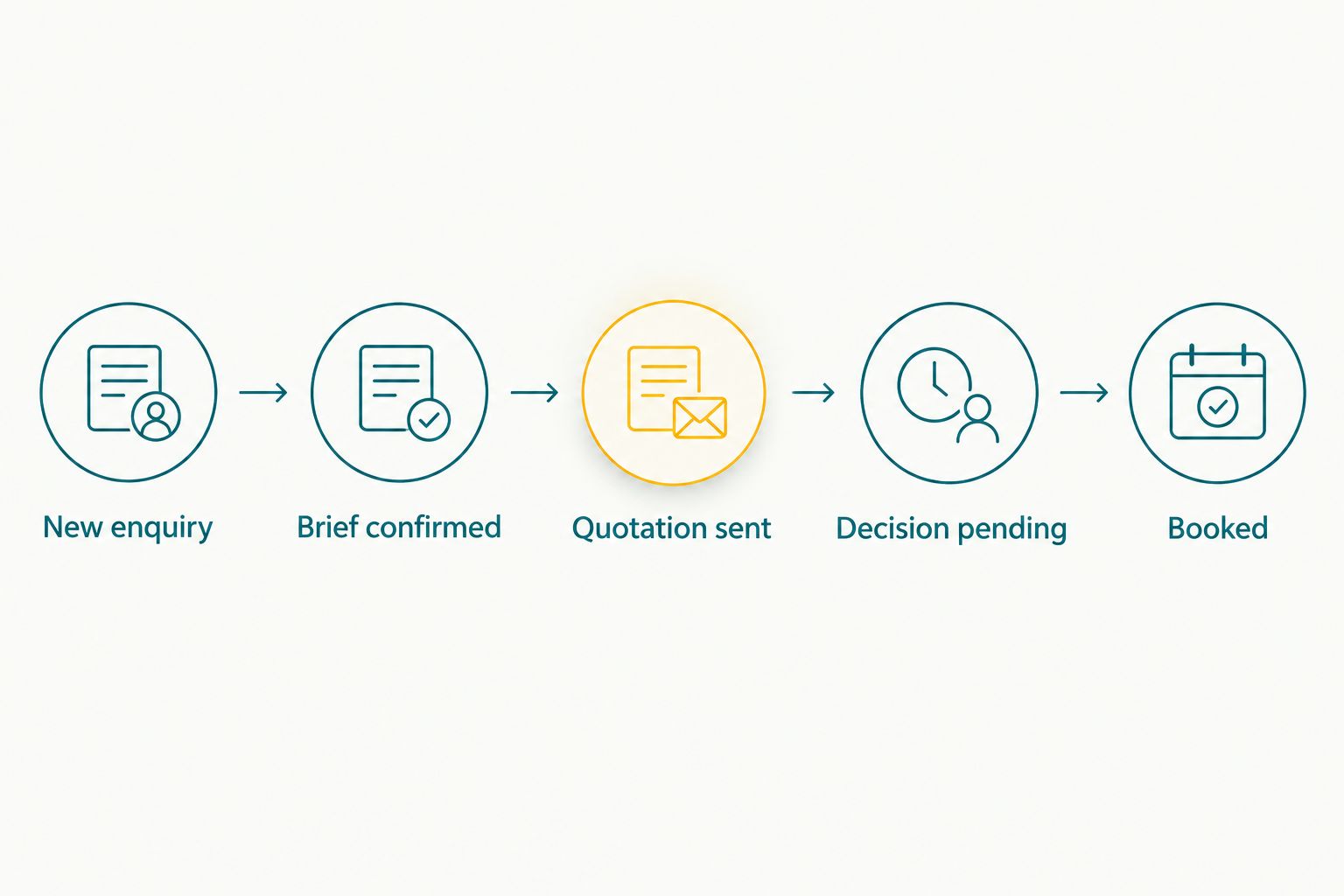
Move an enquiry forward when the required evidence is recorded, not simply when another message arrives.
Test the complete handoff
Run 3 test enquiries before making the process standard: a new client, a returning client and an existing enquiry with a changed date. Use clearly identified test records and avoid sending test quotations or contracts to real prospects.
Check whether the correct conversation reaches the right record, whether ownership remains clear and whether a changed date appears in the production brief. Then ask the person covering your inbox to handle the next action using only the record.
The handoff passes when another team member can act without asking you to explain the chat history. A capture test alone does not prove that your booking process works.
When an Instagram enquiry moves to WhatsApp
A channel change should continue the enquiry, not restart it. Keep Instagram as the original source and record WhatsApp as the current conversation channel where appropriate.
- Ask the client whether they want to continue on WhatsApp and confirm the contact number they want to use.
- Match the person and event against the existing record. Use the confirmed identity and event details, not a similar display name alone.
- Review the new messages for changed scope, dates or decision-makers. Update the same enquiry when it is the same booking request.
- Give the next task to the person now handling the conversation. Remove or revise any outdated task assigned to the previous owner.
Expected result: the studio has a continuous booking history even though the conversation changes channels.
Studio Manager supports lead capture and analysis from both Instagram and WhatsApp chats. That does not remove the need to check whether two conversations concern the same job. A returning client booking a separate event needs a distinct event brief, even when the contact is already known.
Troubleshooting
The same wedding appears as separate enquiries
Compare the event dates, locations and confirmed booking contact before consolidating information. Keep the different participants identifiable; a planner’s production instructions and a client’s contractual approval serve different purposes.
A revised date does not reach the team
Update the enquiry, proposal and production schedule as applicable, then ask the responsible team member to confirm the change. Keep the earlier agreement traceable. Editing a conversation summary alone does not notify everyone working from an older brief.
Follow-ups continue after a client replies
Review the open task whenever a reply arrives. Complete, cancel or reschedule the previous action before creating another. The next action should reflect the current conversation, not the date on an earlier quotation.
A lead is captured but important details are wrong
Compare the record with the original messages and correct the specific error. Confirm ambiguous dates and names directly with the client. Keep a human approval step before quotations, contracts and scheduling commitments.
A shoot is marked booked without clear acceptance
Return the record to the appropriate pending stage and ask the owner to verify the missing requirement. Use your studio’s actual booking policy. Do not infer acceptance or payment from a screenshot without checking the underlying record.
Customize your workflow
Once capture works, extend the same discipline into production. Add a clear handoff for crew scheduling, post-processing, deliverables and payments rather than ending the record at booking.
For your 2026 review, track enquiries by original source, current stage and next-action status. Count distinct event opportunities rather than individual messages. Only calculate a booking rate once your studio uses a consistent definition of both an enquiry and a booking.
Separate the booked scope from later requests. An extra function or a changed delivery requirement needs review before it becomes a team instruction. Your CRM should preserve the agreement your team is expected to fulfil.
FAQ
What is Instagram lead capture for photographers?
Instagram lead capture for photographers is the process of turning a booking enquiry in DMs into an organised client and event record. The record should include the brief, owner, next action and booking status, not just the sender’s handle.
Can Fotoowl capture photography leads from Instagram?
Fotoowl Studio Manager captures and analyses leads from Instagram and WhatsApp chats. It also manages follow-ups, quotations, contracts, invoices, projects, schedules and payments; your team should verify captured details before making commitments.
Do I need a CRM to book shoots from Instagram?
No, you can manage Instagram enquiries with a maintained manual register. A CRM becomes useful when you need shared ownership and a connected process for follow-ups, proposals and studio administration.
What details should I ask for in the first Instagram reply?
Ask for the event type, dates, city, functions and required photography or video coverage. Confirm the booking contact and clarify missing information before preparing a quotation.
When should I mark an Instagram enquiry as booked?
Mark an enquiry as booked after the client completes your studio’s defined acceptance, contract and payment requirements. A positive DM alone does not establish that those requirements are complete.
How do I handle a lead that moves from Instagram to WhatsApp?
Continue the existing enquiry after confirming the person and event. Preserve Instagram as the original source, record any changed requirements and give the next action to the current owner.
Can I automate every part of the booking workflow?
Keep human approval for ambiguous briefs, scheduling commitments, quotations and booking confirmation. Capture and follow-up tools support the process, but they do not establish what your studio has agreed to deliver.
One last thing
Test the workflow with a changed brief, not only a new enquiry. A new record proves that capture works; a changed venue, added function or revised date tests whether the agreement stays accurate across the whole studio.
Before your next shoot, ask the assigned photographer to explain the booked coverage from the production record. If the answer depends on finding a forgotten DM, fix the handoff before adding more automation.