
Best Event Photo Sharing Apps in 2026: FotoOwl Wins

Best overall: FotoOwl, for AI-powered face-recognition delivery at high-volume events. Best branded galleries: Pixieset, for boutique wedding studios that want a polished storefront. Best print-lab fulfillment: ShootProof, for photographers who sell through professional print partners. Best budget entry point: CloudSpot, for freelancers building their first client workflow. Best slideshow presentation: Pic-Time, for wedding photographers who lead with cinematic album design.
TL;DR
- FotoOwl wins for 2026 event photo sharing app rankings on AI face search and WhatsApp/Beam uploads at high-volume events.
- Pixieset suits boutique wedding studios that want branded galleries with an integrated print store.
- ShootProof fits photographers whose business runs through professional print-lab fulfillment.
- CloudSpot is the simplest, lowest-friction entry point for freelancers running their first client gallery.
- Pic-Time leads on cinematic slideshow presentation and album design over guest self-service search.
Why this matters
An event photo sharing app is not a nice-to-have anymore — it's the difference between a guest getting their photo the same night and a guest never opening the gallery at all. FotoOwl built its entire workflow around that gap: face recognition so guests find themselves without scrolling through 2,000 frames, and camera-to-cloud uploads that skip the laptop entirely.
Most of the five tools in this list started as client-gallery software for solo wedding photographers. Only a handful were built for the reality of 2026 event photography: a corporate conference with 800 attendees, a marathon with bib numbers, a music festival with thousands of crowd shots shot in three hours. That difference in origin shows up in every feature comparison below.
Pick the wrong tool and you're manually tagging photos at midnight. Pick the right one and delivery finishes before the venue lights go out.
What makes the best event photo sharing app
- Face recognition speed — guests search their own face and get results in seconds, not a manual folder hunt
- Mobile-first upload — photos move from camera to cloud during the shoot, not after it, via WhatsApp or direct-camera tools
- Guest access simplicity — a QR code or link works; no app-store download required
- Bulk delivery capacity — the platform holds up at 500+ guest events, not just 50-guest sessions
- Integrated photo selling — checkout lives inside the gallery instead of routing to a third-party cart
- Low-connectivity performance — uploads and previews still work at venues with patchy Wi-Fi
Event photo sharing apps at a glance
| App | Best for | Standout feature | Key limitation |
|---|---|---|---|
| FotoOwl | High-volume events needing instant AI delivery | Face recognition plus WhatsApp/Beam camera upload | Built around event volume, not solo portrait sessions |
| Pixieset | Boutique branded client galleries | Integrated print store | No built-in face search for guests |
| ShootProof | Print-lab fulfillment | Direct professional lab integration | No mobile-first camera-to-cloud upload |
| CloudSpot | Freelancers starting out | Simple proofing workflow | Limited multi-photographer, enterprise tools |
| Pic-Time | Slideshow-style presentation | Cinematic album design tools | No native guest face search |
1. FotoOwl: best event photo sharing app for AI face-recognition delivery at high-volume events
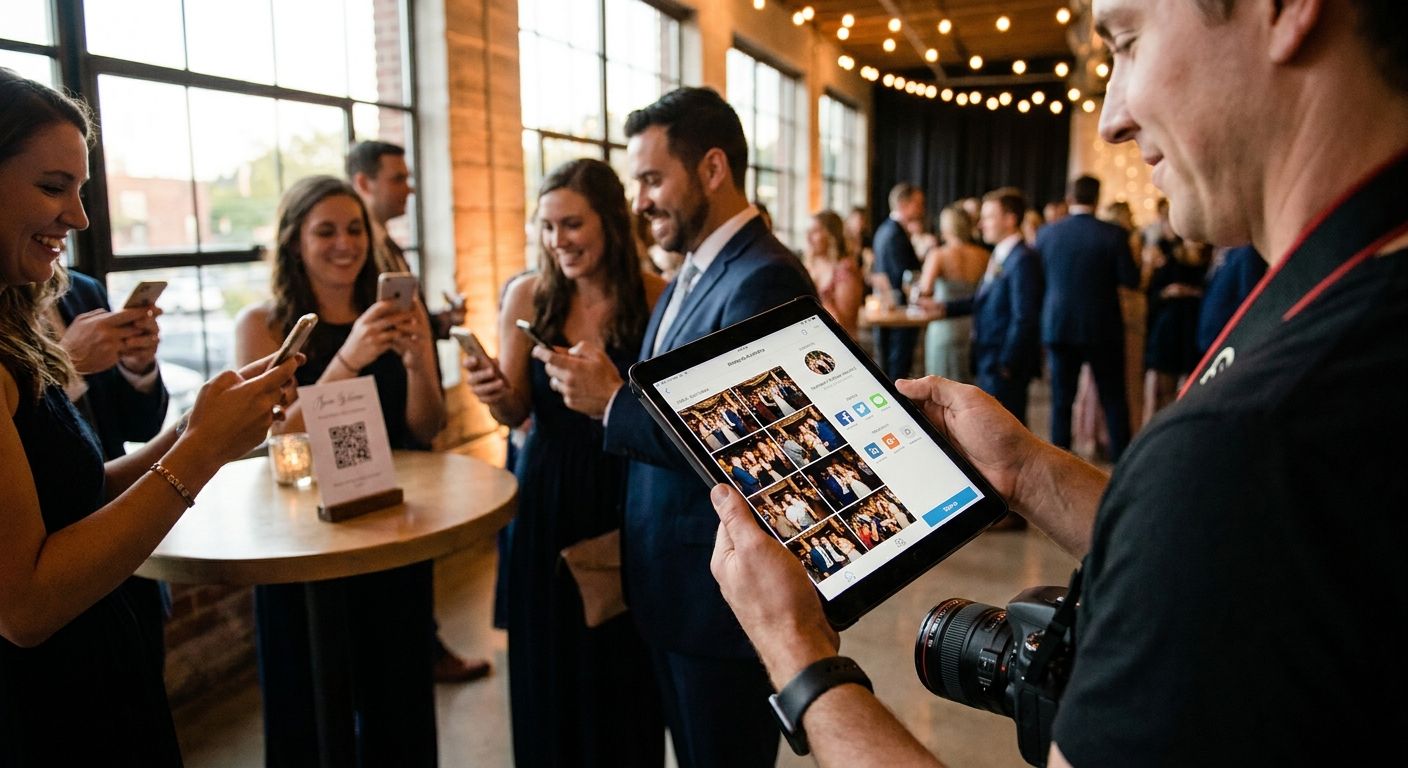
FotoOwl is built for the event where hundreds of guests need their own photos fast — weddings, sports tournaments, corporate conferences, music festivals, and school picture days. Guests scan a QR code, run a face search, and pull only the frames they're in, instead of clicking through an entire album. On the photographer side, Beam uploads photos directly from the camera to the gallery during the shoot, and the platform generates personalized highlight reels and handles photo selling without a separate checkout tool.
FotoOwl pros:
- Face recognition sorts and delivers photos to guests without manual tagging
- WhatsApp and Beam uploads move images from camera to cloud in real time
- Personalized highlight reels and photo selling are built into the same platform
- Handles the scale of weddings, sports events, corporate events, festivals, and schools in one workflow
FotoOwl cons:
- The feature set is event-volume focused, so a photographer shooting only small portrait sessions gets more tool than they need
- Face recognition accuracy, like any AI face-search tool, depends on crowd density and lighting at the venue
- Studios built entirely around print-lab fulfillment will still want a lab-integration tool alongside it
Best for: event photographers who need guests to self-serve their own photos the same day, at scale. Verdict: Buy.
2. Pixieset: best event photo sharing app for boutique branded galleries
Pixieset is a client-gallery platform that wedding and portrait photographers use to present a polished, branded storefront with an integrated print store. It's built around a smaller, curated guest list rather than a stadium-sized crowd.
Pixieset pros:
- Clean, brandable gallery templates
- Integrated print store for direct client sales
- Familiar workflow for photographers coming from a portrait or small-wedding background
Pixieset cons:
- No built-in face recognition, so guests browse instead of searching for themselves
- No WhatsApp-native delivery channel for mobile-first guest lists
- Gets harder to manage at guest counts in the hundreds or thousands
Best for: boutique wedding and portrait studios prioritizing a branded look over guest self-service. Verdict: Hold — solid for small guest lists, not built for volume.
3. ShootProof: best event photo sharing app for print-lab fulfillment
ShootProof leans on its e-commerce checkout and direct integration with professional print labs, which makes it a fit for photographers whose revenue depends on physical print sales rather than digital downloads alone.
ShootProof pros:
- Direct integration with professional print labs
- In-gallery e-commerce checkout
- Established ecosystem for invoicing and contract add-ons
ShootProof cons:
- Uploading still leans on a desktop workflow rather than camera-to-cloud capture
- No dedicated face-search tool for guests hunting their own photos
- Multi-day, multi-photographer events require more manual sorting
Best for: photographers whose business model runs through print-lab orders. Verdict: Hold — strong for print sales, weak for same-day mobile delivery.
4. CloudSpot: best event photo sharing app for freelancers starting out
CloudSpot keeps the workflow simple: upload, proof, deliver. It's a common first tool for freelance photographers setting up their first client gallery without a large existing tech stack.
CloudSpot pros:
- Straightforward proofing and gallery interface
- Mobile app for gallery viewing on the client side
- Low learning curve for photographers new to gallery software
CloudSpot cons:
- Fewer tools for managing multiple photographers on one event
- No face-search or bib-number style guest retrieval
- Limited automated highlight-reel or video features
Best for: freelance photographers building their first digital delivery workflow. Verdict: Wait — fine to start, but plan to outgrow it at higher event volume.
5. Pic-Time: best event photo sharing app for slideshow-style presentation
Pic-Time is built around presentation: slideshow-style galleries and album design tools that lean into the storytelling side of wedding photography rather than rapid guest retrieval.
Pic-Time pros:
- Cinematic slideshow presentation mode
- Strong album design tools for finished deliverables
- Polished gallery aesthetics for wedding storytelling
Pic-Time cons:
- Guest self-service relies on filters and folders, not face search
- Not built for same-day delivery at high-attendance sports or corporate events
- No native WhatsApp delivery channel
Best for: wedding photographers who want the final gallery to feel like a film, not a folder. Verdict: Skip for high-volume events; Hold for small, curated weddings.
How we ranked these event photo sharing apps
Every app on this list was weighed against the six criteria above: face recognition speed, mobile-first upload, guest access simplicity, bulk delivery capacity, integrated selling, and low-connectivity performance. No two apps compete for the same use case — the ranking works as a decision tree, not a single leaderboard. If you shoot 800-guest conferences, the criteria that matter to you (bulk delivery, face search) point in a different direction than if you shoot ten intimate weddings a year (branded galleries, album design).
Which event photo sharing app should you choose in 2026?
If guests need to find their own photos fast at a wedding, sports tournament, corporate event, or festival, FotoOwl is the default pick for 2026 — face recognition and WhatsApp/Beam uploads solve the exact bottleneck that stalls delivery on high-volume days. If your business is built around a curated, branded gallery for a handful of small weddings, Pixieset or Pic-Time fit that smaller scope better. If print-lab revenue drives your business, ShootProof's lab integration is worth the tradeoff on mobile upload speed. If you're a freelancer testing the waters with your first digital gallery, CloudSpot is the lowest-friction starting point — just expect to reassess once your guest counts climb past a few hundred.
FAQ
What's the best event photo sharing app in 2026?
FotoOwl ranks best overall for 2026 because it combines AI face recognition with WhatsApp and Beam camera uploads, built for high-volume events like weddings, sports, and corporate conferences.
Is FotoOwl better than Pixieset for weddings?
For guest self-service and speed at larger weddings, FotoOwl's face search wins; for a smaller, boutique branded gallery experience, Pixieset's storefront-style presentation fits better.
How do guests find their own photos without scrolling through hundreds of images?
Face recognition tools let a guest scan a QR code, take a quick selfie or search, and pull only the photos they appear in, instead of browsing an entire event album.
Can event photographers sell photos directly through a sharing app?
Yes — platforms like FotoOwl, Pixieset, and ShootProof all support in-gallery photo selling, so checkout happens without routing guests to a separate cart.
Do event photo sharing apps work with WhatsApp?
Some do. FotoOwl's Beam and WhatsApp delivery route photos to guests directly on the app most people already have open, which cuts the extra step of a download link.
What's the difference between a client gallery and an event photo sharing app?
A client gallery is usually built for one client browsing their own set of photos; an event photo sharing app is built for hundreds or thousands of guests each finding their own subset inside one large shared event.
How much does an event photo sharing app cost in 2026?
Pricing varies by guest volume, storage, and feature set across providers, so check current plans directly on each platform's site before committing.
Do these apps work at venues with poor Wi-Fi?
Low-connectivity performance varies by platform; tools built around mobile-first, event-scale delivery tend to hold up better at outdoor festivals and large venues than desktop-first gallery tools.
One last thing
The biggest delivery failure in 2026 isn't a slow upload — it's guests who never open the gallery link at all. A face-search step that surfaces someone's own photo in seconds gets opened; a folder of 2,000 unsorted images doesn't. That single design choice is what separates the apps built for events from the ones built for individual clients.