
QR Code Photo Sharing for Music Festivals: 2026 Verdict

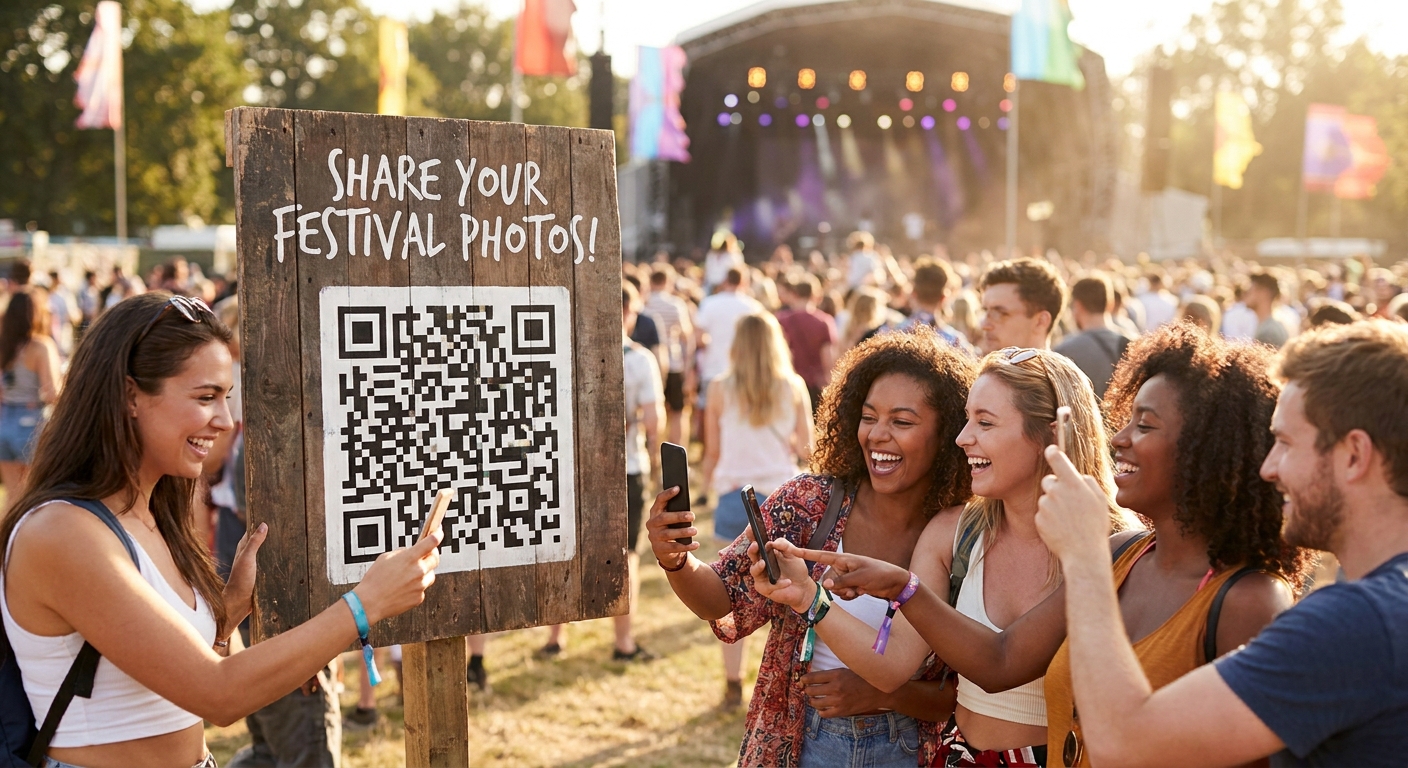
A QR code taped to a festival stage barrier is only as good as what it opens — scan it wrong and attendees hit a login wall, a dead link, or a gallery that won't load on festival WiFi. Done right, qr code photo sharing for music festivals turns one scan into an instant, personalized photo feed in under 3 seconds.
TL;DR
- QR code photo sharing for music festivals works best paired with AI face recognition — FotoOwl sorts crowd shots fast. Buy.
- Skip static QR posters with no live gallery behind them; attendees bounce if photos aren't ready within 48 hours.
- WhatsApp Beam delivery beats forced app downloads for festival crowds on patchy network coverage in 2026. Consider it.
- Highlight reels from a QR scan suit VIP and artist passes, not general admission crowds above 10,000 attendees.
Why this matters
Festival photographers shoot thousands of frames across three stages in a single day, and most of those photos never reach the people in them. A QR code fixes the discovery problem, but only if the gallery behind it can handle festival-scale traffic without crashing at set-change rush.
AI photo gallery software for music festivals exists because standard event galleries choke on crowd volume and can't tell one blurry phone-flash selfie from another. In 2026, festivals running QR-to-gallery setups see faster social shares because the photo shows up before the attendee has left the venue.
The difference between a QR code that gets scanned once and ignored, and one that gets shared to five Instagram stories, comes down to speed and personalization — not the code itself.
Who this is for
This guide is for festival photographers, event production teams, and festival marketing leads deciding how to get thousands of event photos into attendees' hands without a manual sorting job. If you're running a single-day club show for 300 people, a shared album link works fine. If you're running a multi-day, multi-stage festival with 10,000-plus attendees, you need a QR system built for crowd scale, not a wedding gallery stretched thin.
What to look for in QR code photo sharing for music festivals
Scan-to-gallery speed
Attendees scan a QR code standing in a crowd with one bar of signal — if the gallery takes more than a few seconds to load, they pocket the phone and forget it. A gallery optimized for mobile-first, low-bandwidth loading keeps that scan-to-photo window under 3 seconds, which is the difference between a share and a bounce.
Face recognition accuracy in crowd and low light
Festival photos are backlit, motion-blurred, and shot in stage lighting that shifts every ten seconds. A QR system tied to weak face-matching will hand attendees photos of strangers, which kills trust in the whole gallery fast.
Bulk upload throughput
A festival photographer can shoot 3,000-plus frames across a single headline set. If the platform behind the QR code can't ingest and process that volume same-day, attendees are checking a gallery that's still empty a day after the show ends.
Photo selling and monetization built into the scan
Festivals increasingly treat photo sales as a revenue line, not an afterthought. A QR code that opens straight into a shoppable gallery — instead of a free-only feed — turns the scan into a transaction point instead of just a share point.
Data and attendee privacy controls
Face recognition at festival scale means processing biometric data for thousands of strangers. The gallery needs clear consent flows and the ability for an attendee to opt out or delete their match, not just a blanket "we collect data" line buried in a footer.
Offline and weak-signal handling
Festival grounds are notorious for dead zones near stages where 20,000 phones are competing for the same cell tower. A QR system built for festivals needs upload paths that don't fail the moment signal drops, and a gallery that caches enough to load on 2 bars.
Top picks for festival QR photo sharing
QR + AI Face Recognition Gallery — the safe pick. This pairs a scannable code with an AI match engine that sorts an attendee's face against the full shoot in seconds, not the hour it takes a human editor to tag 3,000 photos. Face recognition photo delivery built for event crowds handles the lighting and angle variance festivals throw at it. Verdict: Buy — this is the default setup for any festival over 2,000 attendees.
FotoOwl's AI photo gallery platform — the all-rounder. FotoOwl runs the QR-to-gallery pipeline end to end: upload, face-match, and delivery, without stitching together three separate tools. The spec that matters here is throughput — a platform built to process festival-volume uploads without a backlog forming mid-event. Verdict: Buy if you want one system instead of a patched-together workflow.
QR + WhatsApp Beam delivery — the instant-share pick. Instead of forcing attendees to download an app to view their gallery, this route sends the scan result straight into WhatsApp, which most festival crowds already have open. It mirrors what's working for sports crowds — see how WhatsApp photo sharing performs for high-traffic sports events for the same crowd-density logic. Verdict: Consider it for festivals where app-download friction is killing your scan-to-view rate.
QR + Personalized Highlight Reels — the wildcard. A QR scan that opens a short auto-generated reel of an attendee's day, instead of a static photo grid, drives a different kind of share — video, not stills. This works well for VIP wristbands and artist access tiers where the crowd is smaller and the moment is worth a reel. Verdict: Consider for premium tiers, Skip for general admission at festivals above 10,000 attendees — the processing load isn't worth it at that scale.
See the festival gallery in action
Check how FotoOwl handles QR scans, face-match, and bulk uploads at festival scale.
What to avoid
- Static QR posters with no live gallery behind them. A code that opens a Google Drive folder someone forgot to update looks identical to a real system until an attendee scans it and finds nothing from the last two hours.
- App-download-first QR flows. Forcing a download before an attendee sees a single photo kills conversion — most people scan, hit an app store page, and close it.
- Face recognition with no opt-out. A festival gallery that silently matches faces without a visible way to remove yourself is a privacy complaint waiting to happen, and in 2026 attendees notice.
If the QR code needs more than one tap to reach a photo, guests won't wait around for it.
Verdict comparison
| Setup | Scan-to-gallery speed | Best for | Verdict |
|---|---|---|---|
| QR + AI Face Recognition Gallery | Seconds, not minutes | Festivals over 2,000 attendees | Buy |
| FotoOwl AI Photo Gallery Platform | End-to-end, no manual stitching | Teams wanting one system | Buy |
| QR + WhatsApp Beam Delivery | Instant, no app install | Crowds with weak app adoption | Consider |
| QR + Personalized Highlight Reels | Slower, video-processing heavy | VIP and artist tiers only | Consider / Skip at scale |
FAQ
What is QR code photo sharing for music festivals?
It's a system where attendees scan a code on a wristband, poster, or screen and land directly on a personalized photo gallery matched to their face. In 2026, the better setups deliver that match in under 3 seconds instead of a generic shared album.
Does QR code photo sharing work without an app download?
Yes — the strongest festival setups route the scan straight to a mobile browser gallery or into WhatsApp instead of an app store page. Forcing a download before showing a photo is one of the biggest reasons attendees abandon the scan.
How does face recognition improve QR photo sharing at festivals?
Face recognition matches an attendee's selfie against the full festival shoot, so the QR scan opens a gallery of just their photos instead of a folder of 3,000 strangers. Accuracy matters most in stage lighting and crowd motion, where matching typically breaks down.
Is QR code photo sharing better than a shared Google Drive link?
For crowds under a few hundred people, a shared link can work. For festivals above 2,000 attendees, a Drive folder becomes unsearchable within hours and a QR-linked AI gallery is the only setup that scales.
Can festivals sell photos through a QR code scan?
Yes — a QR code can open directly into a shoppable gallery instead of a free-only feed, turning the scan into a sales moment. This works best when the gallery loads fast enough that attendees don't lose interest before checkout.
What happens if festival WiFi is weak where the QR code is scanned?
A festival-built gallery caches enough data to load on 2 bars of signal instead of failing outright. Systems designed for weddings or small events often aren't built for that failure mode, since they assume stable venue WiFi.
How fast should a QR code photo gallery load at a festival?
Under 3 seconds from scan to first photo is the benchmark for 2026 festival crowds — anything slower and attendees pocket the phone before the gallery finishes loading.
Are QR photo galleries safe for attendee privacy?
A properly built system gives attendees a visible way to opt out of face matching or delete their own match, not just a blanket data policy. Festivals running face recognition at crowd scale should confirm this before launch.
One last thing
The QR code itself is the least important part of this entire setup — a printed square of black and white pixels does nothing on its own. What decides whether guests keep talking about your festival in 2026 is what loads in the 3 seconds after the scan, and whether it's their face or a stranger's.