
Face Recognition Photo Finder for Runners: 2026 Verdict

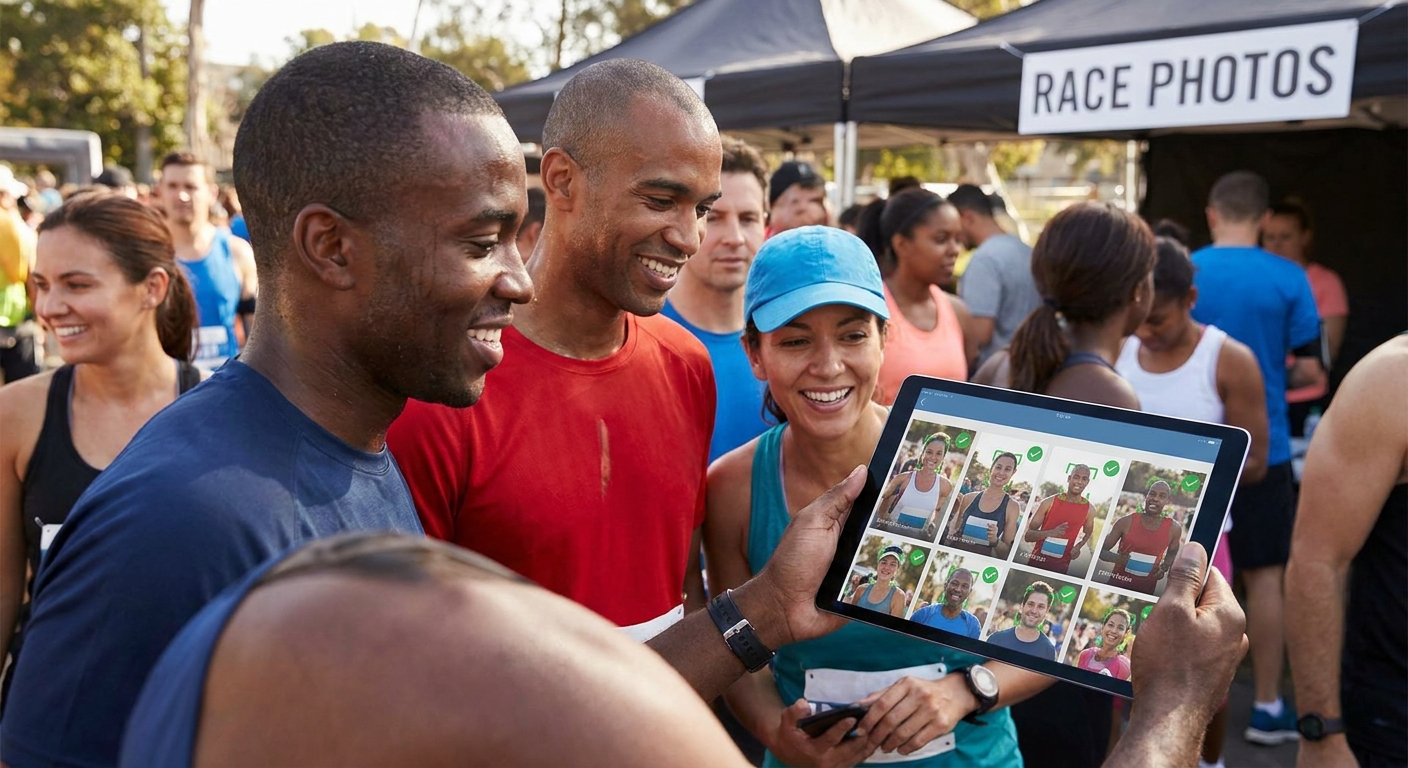
Marathon runners want one thing after 26.2 miles: their photo, fast, without scrolling through 40,000 strangers in bibs. A face recognition photo finder for runners solves that by matching a selfie or bib number to every course photo in seconds instead of hours.
TL;DR
- A face recognition photo finder for runners matches selfie or bib to course photos in seconds — Buy for races over 5,000 entrants.
- WhatsApp/Beam-style delivery beats static download links at the finish line; skip email-only galleries in 2026.
- Bib-number OCR alone misses turned faces, sunglasses, and mud-caked numbers — pair it with face search, never replace it.
- Same-day, face-matched galleries cut support tickets versus manual sorting by race number.
Why this matters
A 10,000-runner marathon easily produces tens of thousands of images across checkpoint cameras spaced every 5K along the 26.2-mile course. Runners cross the finish, open their phone, and expect their photo within minutes — not a 300-page PDF sorted by bib range.
Race photographers who deliver slow or unsearchable galleries lose print and digital sales fast. In 2026, the standard is same-day, face-searchable delivery, not a download link that shows up three weeks after the medal ceremony.
Who this is for
This guide is for marathon race directors, timing companies, and event photographers choosing how runners will find their own photos after a race — from a 500-person half marathon to a 40,000-bib city marathon. If you're deciding between manual sorting, bib-number-only search, or a full face recognition photo finder for runners, the criteria below apply regardless of race size. FotoOwl builds this kind of gallery specifically for sports and event photographers, so the comparisons here reflect what actually holds up at race-day scale.
What to look for in a face recognition photo finder for runners
Match speed at scale
A gallery that takes 15 seconds to return results for one runner will fall apart when 2,000 finishers hit it in the same hour after the awards ceremony. Look for platforms built to handle simultaneous face searches, not single-user demo speed.
Accuracy with sunglasses, hats, and sweat
Runners at mile 20 do not look like their registration photo. A face recognition photo finder for runners needs to handle angled faces, sunglasses, and race-day grime — bib-number OCR alone fails whenever a number is muddy, folded, or turned sideways.
Delivery channel runners actually check
Email digests get buried. Runners check WhatsApp and text messages within minutes of finishing. A gallery tied to WhatsApp or direct mobile delivery gets opened same-day; a gallery buried in a marketing email gets opened next week, if at all.
Selling flow built in
Most runners will pay for their finish-line shot if they can find it fast and buy it in two taps. If the platform separates "finding your photo" from "buying your photo" into two clunky systems, conversion drops.
Highlight reels, not just stills
Marathons generate video at start lines, checkpoints, and finish chutes. A platform that can auto-generate a personalized reel per runner — not just a folder of JPEGs — adds a product photographers can charge extra for.
Upload speed from the course
Course photographers need to get shots off the camera and into the searchable gallery within minutes, not after driving back to a hotel to offload cards. Cloud upload direct from camera or phone, mid-race, separates real race-day tools from consumer photo apps.
Set up face-matched galleries for your next race
See how face recognition photo delivery works for event photographers.
Top picks for marathon photo delivery
1. Face recognition gallery matching — the safe pick. Runners upload a selfie once and get every matching course photo pulled automatically, no bib number needed. This is the core of a face recognition photo finder for runners and it's the only method that still works when a bib is torn, folded, or covered by a jacket at mile 22. Buy for any race over 1,000 runners.
2. WhatsApp/Beam-style capture-to-cloud delivery — the fast mover. Photos move from the photographer's camera to the runner's phone through the channel they already check every few minutes. WhatsApp photo sharing for sports events skips the step where runners have to remember to check a separate app or email days later. Buy if same-day delivery matters to your sponsors or timing partner.
3. Bib-number OCR tagging — the backup, not the main system. OCR reads printed race numbers and auto-tags images, which works fine on a clean, forward-facing shot. It breaks down the moment a number is mud-spattered, turned, or covered by a hydration belt — common by mile 15 of any road marathon. Consider only as a secondary layer alongside face search, never as the sole search method.
4. QR code check-in booths at the finish chute — the convenience add-on. Runners scan a code at a finish-line booth to link their bib to their phone number instantly, which speeds up delivery but requires staffing a physical booth. Consider for races with budget for on-site staff; Skip for smaller races running lean.
5. Personalized highlight reels — the upsell. A short auto-generated video clip per runner, built from start-line, checkpoint, and finish footage, turns into a paid add-on most runners will buy on impulse. Personalized highlight reels for sports events work best layered on top of a face-matched still gallery, not as a replacement for it. Buy as an add-on once your core photo delivery is solid.
If a runner has to scroll past 400 photos to find their own bib number, the gallery already failed.
What to avoid
- Manual folder sorting by bib range. It works for a 200-runner fun run and collapses completely past 2,000 entrants — someone ends up hand-checking hundreds of images at 1am.
- Download-only ZIP delivery. Runners want to find their specific photo, not download 20,000 images to search themselves on a laptop.
- Bib-OCR-only systems marketed as "face recognition." These miss any runner whose number is obscured, and marathons obscure numbers constantly — jackets, belts, mud, folded bibs.
Verdict comparison table
| Approach | Works when bib is hidden | Delivery speed | Sell-through potential | Verdict |
|---|---|---|---|---|
| Face recognition matching | Yes | Same-day | High | Buy |
| WhatsApp/Beam delivery | N/A (channel, not matching) | Minutes after finish | High | Buy |
| Bib-number OCR only | No | Fast when it works | Medium | Consider (backup only) |
| QR check-in booth | Yes, if scanned | Instant at booth | Medium | Consider |
| Manual sorting | No | Days | Low | Skip |
FAQ
What's the best face recognition photo finder for runners in 2026?
A platform that matches a selfie to every course photo without needing a visible bib number is the standard for 2026 races. FotoOwl builds this specifically for sports and event photographers handling races from 500 to 40,000 runners.
Is face recognition better than bib-number search for marathons?
Yes, because bib numbers get muddy, folded, or covered by jackets and hydration belts during a race. Face recognition still returns a match when the bib is unreadable, which OCR-only systems cannot do.
How fast should marathon photos be delivered to runners?
Same-day delivery, ideally within a few hours of the finish, is the 2026 benchmark for competitive race photography. Delivery tied to WhatsApp or mobile-first galleries reliably beats email-only systems on open rates.
Can runners find their photos without downloading an app?
Most modern face recognition galleries work through a mobile browser link, so runners upload a selfie and get results without installing anything. This lowers the barrier compared to systems that require a dedicated app download.
Do face recognition photo finders work with sunglasses or hats?
Accuracy varies by platform, but systems built for outdoor sports events are trained to handle angled faces, sunglasses, and sweat-covered skin better than generic consumer photo apps. Ask any vendor directly about accuracy under race-day conditions before committing.
What happens to photos runners don't buy?
Most platforms keep the full gallery live for weeks after the race so runners can return and purchase later. Retention windows vary by provider, so check the specific terms before the event.
Should small races under 1,000 runners bother with face recognition?
It still saves time versus manual sorting, but the return is smaller at low volume. Races under 1,000 runners may get by with bib-number tagging plus a fast WhatsApp delivery channel instead.
One last thing
The biggest failure point isn't the matching technology — it's the upload lag between the camera and the gallery. A face recognition photo finder for runners is only as fast as the slowest link in the chain, and that's usually a photographer standing at mile 20 with no cloud connection until they get back to the finish tent. Fix the upload path first; the matching accuracy matters less if the photos aren't in the gallery until the next morning.