
Is AI face search worth it for wedding photographers in 2026?

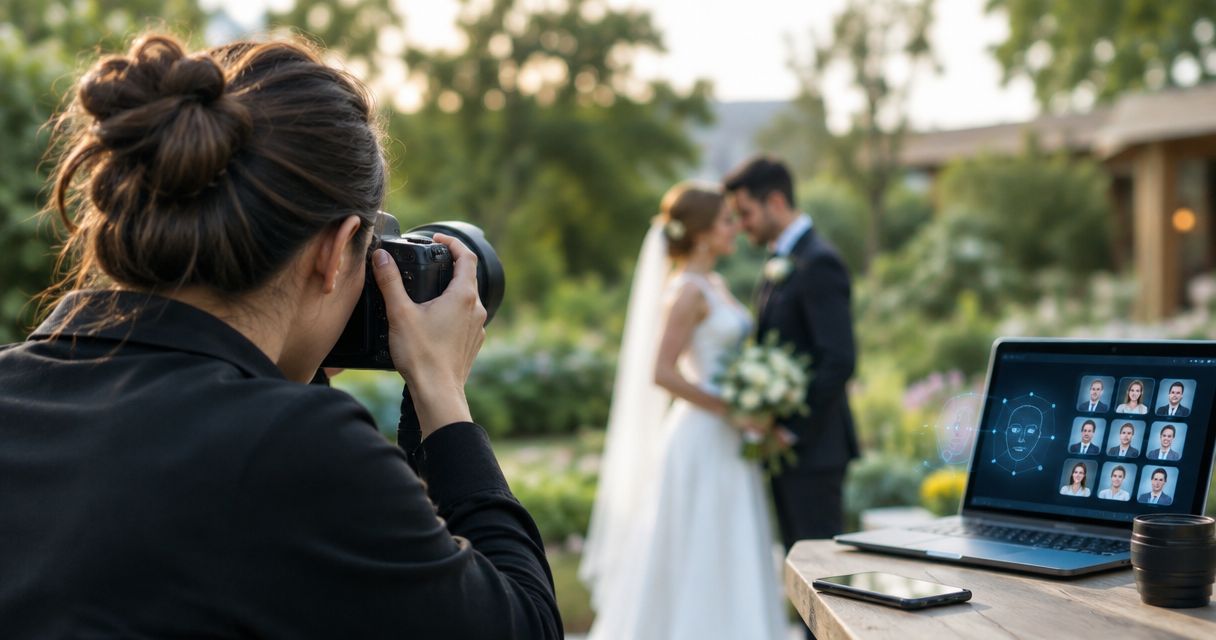
Yes, AI face search is worth it for wedding photographers in 2026 when guests need to find their own photos in a large delivered gallery. It is less useful for a small, tightly edited gallery, and it does not replace culling, gallery organisation or a check of incorrect matches.
TL;DR
- AI face search is worth it for wedding photographers delivering large guest galleries in 2026.
- Fotoowl AI Gallery is best for wedding studios that want face recognition inside their photo-delivery workflow.
- Keep human review: missed faces and incorrect matches still affect the guest experience.
- For a small, tightly edited gallery, clear sections and direct sharing can be enough.
Is AI face search worth it for wedding photographers in 2026?
Yes, if the gallery serves guests as well as the couple. At a large Indian wedding, photos from different functions, photographers and cameras can end up in one delivery. A guest wants to find their own appearances; the couple wants to browse the full story. Those are different jobs, and face search addresses the first one.
If you need to decide how to prepare the files before delivery, start with how to use face recognition to sort wedding photos. Face search works best as a way into an organised gallery, not as a substitute for deciding which images belong there.
| Delivery approach | Best for | What works | What you still handle |
|---|---|---|---|
| Guest face search | Large galleries where guests want photos of themselves | Gives each guest a direct way to look for their appearances | Review missed or incorrect matches; decide how guests should access the gallery |
| Function-based gallery sections | Multi-function weddings where viewers know the ceremony or event | Keeps the wedding story understandable to the couple and families | Guests still browse to find themselves within each section |
| Directly shared selections | Small, edited sets for named recipients | Lets you control exactly which images each recipient sees | Preparing and sending separate selections takes your time |
The strongest setup uses face search alongside function-based sections. Guests can look for themselves, while the couple can still move through the wedding in the order it happened. For a small engagement shoot or a deliberately short wedding edit, face search solves a smaller problem; a clear gallery and direct sharing can do the job.
Why this matters for your wedding delivery
A wedding gallery has more than one audience. The couple, both families and individual guests do not necessarily look for the same photographs. When everyone receives one undifferentiated collection, finding a particular face becomes a browsing task, even if the editing is excellent.
The value of face search is access, not better photography. It helps guests look for images featuring them. You still choose the frames, edit the photographs, organise the functions and decide what the client receives. In 2026, that distinction matters when you assess a gallery feature: judge the guest-finding experience separately from the quality of your final edit.
For Indian wedding studios, the question becomes sharper when you cover several functions. A person photographed at a pre-wedding event, ceremony and reception might otherwise have to browse each section. Face search gives that person another route through the delivered work, while sections preserve the event context.
How should you use face search in a wedding workflow?
Treat face search as the guest-access stage of delivery, after you have made the editorial decisions. This sequence keeps the gallery useful even when a face is missed.
- Cull the shoot. Remove duplicate and weak frames before you build the client gallery. Face search should not turn an unedited camera dump into the final deliverable.
- Organise by function. Keep ceremonies and other event parts understandable to someone who wants to browse the wedding, not just search for a person.
- Check what is shareable. Review images, client expectations and access decisions before inviting guests into the gallery.
- Enable guest finding. Give guests a way to find appearances while retaining the wider gallery structure for the couple and families.
- Review the experience. Try searches using different photographs from the event, inspect questionable results and retain a clear way to browse when a face is not found.
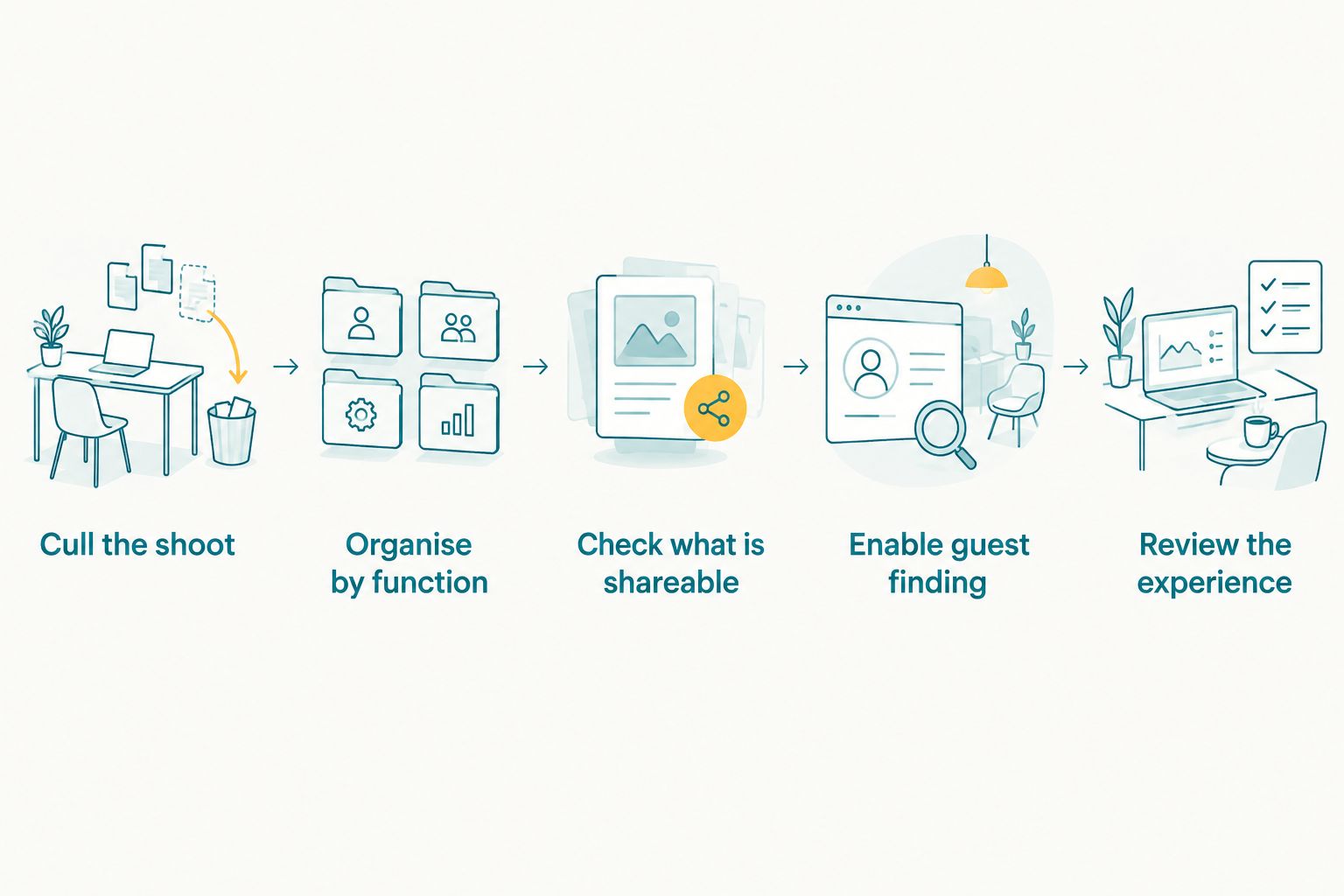
Face search belongs after editing and organisation, not in place of them.
The order matters. If you publish first and organise later, guests can reach photographs you did not intend to deliver. If you organise but never test guest finding, the couple's gallery can look tidy while guests still struggle to locate their images. In 2026, make both experiences part of your delivery check.
Why does the value of AI face search vary?
The feature is useful when it removes a real discovery problem. Judge it against the work you deliver, not against a generic feature list.
- Gallery size and editing. A large guest gallery creates more browsing work than a short, curated selection. Neither format removes your responsibility to cull.
- Number of functions. A multi-function wedding benefits from clear event sections whether or not guests also use face search.
- Who receives access. Search matters more when individual guests need to find their own photographs, rather than when you deliver only to the couple.
- Image conditions. Faces that are obscured, turned away or difficult to distinguish can affect what a guest finds. Keep ordinary browsing available.
- Delivery timing. If guests receive photos during an event, decide which images are ready to share before making them accessible.
- Client expectations. Agree on who should see the gallery and how it will be shared. Face search does not settle access decisions for you.
These are workflow questions, not a promise that every face will be found. A useful test is straightforward: can a guest find relevant images, and can the couple still browse the full wedding without searching? If either answer is no, adjust the gallery structure or sharing plan before delivery.
When is face search the right choice?
Use face search when you deliver a substantial guest-facing gallery and expect people to look for themselves. It is especially relevant when coverage spans multiple functions or several photographers, because the final collection has more than one path through it.
Fotoowl AI Gallery is best for wedding studios that want face recognition inside their photo-delivery workflow. Its advantage is that guest finding sits with gallery delivery rather than becoming a separate manual sorting task. Its limitation is the same as face search generally: you must still cull, organise and check what guests can access. Do not choose it on the assumption that recognition makes every match correct.
A wedding studio should test the experience with actual event images before treating face search as the main way guests find photos. Look at clear portraits, group photographs and less straightforward frames. Then check whether the gallery remains usable when someone prefers to browse by function instead.
When should you skip face search?
Skip it as a priority when your deliverable is small, tightly edited and meant mainly for the couple. In that case, your time is better spent on selection, sequencing and a clear handover. Adding another search route does not fix an unclear edit or a confusing set of gallery sections.
Face search is also the wrong answer to a culling backlog. Fotoowl AI Culling is an offline desktop application for rejecting duplicate and weak frames, grouping similar images and ranking by composition, exposure and blur before a human second pass. That is preparation work. Fotoowl AI Gallery handles delivery and guest finding; the products address different stages.
Do not use guest search as your only organisation method for a multi-function wedding. The bride and groom might want a complete ceremony sequence, while a guest wants only photographs featuring them. A function-based structure serves the first request. Face search serves the second. Neither has to erase the other.
What should you check before publishing a face-search gallery?
Start with the images and access rules, then test the search. This is more useful than judging a feature from a demonstration gallery built with different photographs.
- Final selection: Are the photographs you intend to deliver the ones in the guest gallery?
- Event structure: Can the couple browse the functions in a sensible order without using face search?
- Search results: Do searches return useful images, and are any visible matches clearly wrong?
- Missing results: Can a guest still browse when search does not surface a photograph?
- Sharing decisions: Have you agreed with the client who receives access to which delivered images?
- Guest instructions: Does the invitation explain how to search and how to browse?
A search feature can reduce the effort of finding a face, but it cannot make the editorial decisions behind the gallery. In 2026, publish only after the conventional browse path works. That gives guests an alternative when their search comes up short and gives the couple a gallery that still tells the story of the day.
Is face search better than WhatsApp photo delivery?
No; they answer different questions. Face search helps a guest locate relevant photographs within a gallery. WhatsApp is a way to share access or deliver photographs. A wedding studio can use a message to tell guests where their gallery is without expecting the message itself to organise every guest's images.
The practical choice is not face search versus WhatsApp. Decide how guests discover that photos are ready, then decide how they find their own images once they reach the gallery. If you only send separate selections to a small group, a searchable guest gallery is less important. If many attendees receive access to the wider collection, search has a clearer role.
Can face search replace manual photo selection?
No. Face search finds appearances; photo selection decides what belongs in the deliverable. A guest can appear in a duplicate, blurred or unflattering frame. A match does not make that frame ready to publish.
Keep the photographer's second pass in the workflow. Review similar frames, choose the images that represent the event well and check the delivered gallery before sharing it. In 2026, the goal is not to remove judgement from wedding photography. It is to stop making every guest browse the whole gallery to find themselves.
Should guests rely only on face search to find their wedding photos?
No. Give guests face search and a browsable gallery. A missed result should not make a delivered photograph effectively invisible. Function-based sections are a useful fallback and give families a way to see the event beyond photographs of any one person.
This is also a clearer promise to make to clients. Tell them guests can search for appearances, not that every photograph of every guest will be found. Show how to browse when search does not return what someone expects.
FAQ
Is AI face search worth it for wedding photographers in 2026?
Yes, for wedding photographers delivering large galleries that guests need to search for themselves. For a small, tightly edited gallery, clear sections and direct sharing can be enough.
Does face search replace culling wedding photos?
No. Cull and review the images before delivery; finding a face does not make a duplicate or weak frame suitable for the client gallery.
Is face search better than organising photos by wedding function?
No. Face search helps individual guests find appearances, while function-based sections help couples and families browse the wedding as an event. Use both when the gallery serves both audiences.
Can guests find every photo of themselves with face search?
Do not promise every match. Obscured or less distinct faces can make a search less useful, so keep a browsable route through the gallery.
Should I use face search for a small wedding gallery?
Face search is a lower priority for a small, tightly edited gallery. Start with strong selection and clear delivery; add search when guest discovery is a real problem.
What does Fotoowl offer wedding photographers who need face search?
Fotoowl AI Gallery includes face-recognition galleries for photo delivery. Photographers still need to choose their final images, organise the gallery and check the guest experience.
Can I use WhatsApp instead of a searchable wedding gallery?
WhatsApp can share photographs or tell guests where to access them, but it does not replace the guest-finding role of face search in a large gallery. Choose the sharing method and the finding method separately.
One last thing
Test the fallback, not just the successful search. Before you send a wedding gallery in 2026, try finding a photograph without face search. If the function sections make that easy, the gallery works for the couple and for guests whose searches miss an image. Face search then adds a useful route through your work instead of becoming the only route.