
Best camera bags for wedding and event photographers

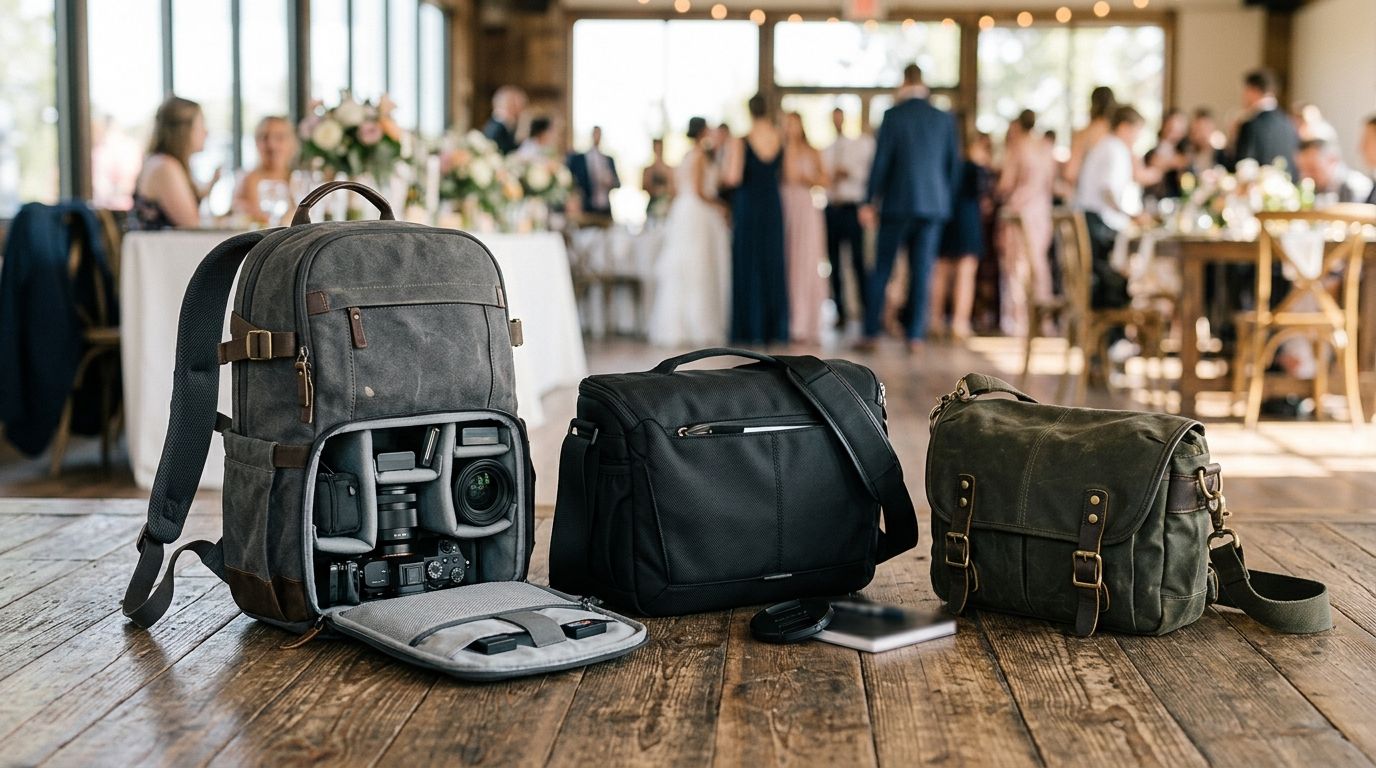
Best overall: a camera backpack for long venue walks. Best for fast lens changes: a modular camera belt. Best budget option: a padded insert in a bag you already own. These are the best camera bags for event photographers in 2026 because each solves a different problem between arrival, active shooting and departure.
TL;DR
- A camera backpack is the best overall choice among camera bags for event photographers covering large venues.
- Choose a modular camera belt when fast lens changes matter more than carrying your full kit.
- A padded insert is the budget choice if your existing bag passes a loaded carry test.
- Fotoowl handles event photo delivery after the shoot; it does not replace a camera bag.
Why this matters
The wrong bag forces a choice during an event: leave a lens behind, carry unnecessary weight or stop shooting to reach equipment. For Indian wedding photographers moving between ceremonies, portraits and reception spaces, that choice changes throughout the day. Corporate events, sports venues and festivals create different routes, but the same question applies: what must stay on your body, and what can remain at a secure base?
Start with the gear you actually use. If you are still deciding what earns a place in the kit, read the event photography lens guide before choosing compartments. A bag should fit your working kit, not persuade you to carry every lens you own.
The best bag is the one that lets you reach the next required item without setting your camera down in the wrong place. In 2026, judge that with your own bodies, lenses and venue route—not an empty-bag photograph.
What makes the best camera bag for event photographers?
- Access while working: Can you retrieve a lens, battery or card at the moment you need it? A bag that opens only when laid flat belongs at a safe staging point, not in the middle of a crowd.
- Comfort under your real load: Pack the bodies and lenses you intend to take, then walk for 15 minutes. An empty bag tells you little about shoulder pressure or balance.
- Protection in transit: Check padding between items, closure security and whether loose accessories can strike a lens or camera body.
- Venue fit: Stairs, tight aisles, outdoor ground and access restrictions change which bag is practical. A roller that works across a conference floor can become awkward on steps.
- Separation of working and reserve gear: You do not need every item within arm’s reach. Decide which camera and lens stay ready, then pack the rest for retrieval at planned stops.
- Card and battery discipline: Give used cards, fresh cards and spare batteries distinct places. A divider helps only if you follow the same placement throughout the event.
Best camera bags for event photographers at a glance
| Bag type | Best for | Standout feature | Key limitation |
|---|---|---|---|
| Camera backpack | Long venue walks | Carries a working kit together | Slower access unless the opening suits your shooting routine |
| Modular camera belt | Fast lens changes | Keeps selected gear at your waist | Limited space for a full kit |
| Rolling camera case | Heavy transport | Moves equipment without carrying it on your shoulders | Poor fit for stairs and crowded routes |
| Camera messenger bag | Compact coverage | Side access to a smaller kit | Load rests primarily on one shoulder |
| Padded camera insert | Using an existing bag | Adds separation inside a bag you own | Outer bag may lack suitable protection or closures |
This is a ranking of bag formats, not unverified claims about particular models. Check the fit of any individual bag with your own equipment before buying it.
1. Camera backpack: best camera bag for long venue walks
A camera backpack is the default for photographers who carry reserve lenses, a second body and accessories across a large venue. Its main advantage is organisation: the working kit can travel together rather than spreading across loose pouches. For a multi-function Indian wedding, that matters when your route moves from preparation to ceremony to portraits.
The opening design decides whether a particular backpack works for you. Some layouts require you to remove the bag before reaching a lens; others put frequently used compartments closer to hand. Load your kit, close every compartment and rehearse an actual lens change before treating a backpack as your on-body solution.
Camera backpack pros:
- Keeps multiple types of equipment in separate compartments.
- Lets you carry reserve gear between shooting locations.
- Leaves your hands free while walking with the bag closed.
Camera backpack cons:
- A lens at the bottom can interrupt a fast-paced shoot.
- A bulky pack is awkward to open in a crowded aisle.
- Carrying everything encourages overpacking.
Best for: Photographers covering large wedding venues, campuses or event sites where the base location changes.
Verdict: Buy a camera backpack if you need to move your full working kit and its loaded access test passes. Keep your active camera out of the pack while shooting.
2. Modular camera belt: best camera bag for fast lens changes
A modular camera belt holds a deliberately small selection of gear at your waist. It is the strongest active-shooting choice when you need another lens or battery without returning to a table or opening a backpack. Think of it as a working layer, not a substitute for transporting your entire kit to the venue.
Set up the belt around the changes you actually make during a ceremony, sports match or stage performance. Put each item in a predictable position and check whether the pouches obstruct movement when you crouch, turn or pass through a tight aisle. A full belt can become as distracting as an overfilled shoulder bag.
Modular camera belt pros:
- Gives quick access to selected lenses and accessories.
- Keeps frequently changed items in consistent positions.
- Pairs with a separate bag left at a secure base.
Modular camera belt cons:
- Cannot comfortably replace a full transport bag for most multi-item kits.
- Poor pouch placement can interfere with movement.
- Exposed pouches need careful closing between changes.
Best for: Photographers who work from a secure equipment base and need selected gear within reach.
Verdict: Buy a modular camera belt for active coverage if you can leave reserve equipment elsewhere. Skip it as your only bag when every item must travel with you.
3. Rolling camera case: best camera bag for heavy transport
A rolling camera case makes sense when moving a larger kit from vehicle to setup point is harder than carrying it during the shoot. It gives that equipment a defined home while you work with a smaller on-body selection. This distinction matters at conferences, school productions and events with a fixed team position.
The venue route is the deciding test. Walk it before committing: look for stairs, uneven surfaces, tight entrances and places where a case can remain secure. If the case must follow you through a crowded wedding floor, its transport advantage disappears.
Rolling camera case pros:
- Moves a larger kit without keeping its full load on your shoulders.
- Creates a single place for reserve equipment at a fixed base.
- Makes it easier to see what remains packed when the case is open.
Rolling camera case cons:
- Steps and rough routes can force you to carry it.
- It is unsuitable for retrieving gear while moving through a crowd.
- You need an appropriate place to leave it during coverage.
Best for: Photographers with a substantial transport load and a dependable equipment base.
Verdict: Buy a rolling camera case when your venue route supports it. Skip it if the job requires constant movement through stairs or dense crowds.
4. Camera messenger bag: best camera bag for compact coverage
A camera messenger bag suits a short list of equipment that you want beside you rather than on your back. It offers an accessible middle ground between a full backpack and a belt. For a focused corporate session or smaller event, that can be enough.
Keep the load disciplined. If you routinely fill every compartment with reserve gear, the one-shoulder carry becomes the main limitation. Test how the bag sits while you hold a camera, pass through doorways and move among guests; the strap should not dictate how you shoot.
Camera messenger bag pros:
- Gives side access to a compact selection of gear.
- Is straightforward to set down and reopen at a safe point.
- Keeps accessories grouped instead of loose in pockets.
Camera messenger bag cons:
- Places the load primarily on one shoulder.
- Has less room for reserve gear than a larger transport bag.
- A swinging bag can get in the way when you move quickly.
Best for: Photographers covering a compact assignment with a restrained working kit.
Verdict: Buy a messenger bag when your loaded kit remains comfortable on one shoulder. Hold if you must carry substantial reserve gear throughout the event.
5. Padded camera insert: best budget camera bag option
A padded insert separates camera equipment inside a bag you already own. It is the budget choice because it starts with an existing outer bag rather than requiring a dedicated camera bag. But the insert protects only what it covers; it does not fix a weak closure, poor strap or unsuitable outer fabric.
Test the whole combination, not just the padding. Put your packed bag down as you would at an event, check whether equipment shifts and confirm that you can identify each item without rummaging. If the outer bag fails that test, choose a purpose-built format instead.
Padded camera insert pros:
- Reuses an existing bag that already suits your travel routine.
- Gives camera bodies and lenses separate spaces.
- Can be removed when the outer bag serves another purpose.
Padded camera insert cons:
- Protection depends partly on the outer bag.
- Access can be slow if the outer opening is narrow.
- The bag may become poorly balanced once loaded.
Best for: Photographers with a suitable existing bag and a small, predictable kit.
Verdict: Buy a padded insert only after the loaded outer bag passes the walk and access tests. Skip it if the bag does not close securely around your gear.
Pack for the event, not the product photo
In 2026, run one packing rehearsal before a paid assignment. Put the exact equipment you plan to carry into the bag and move through the actions below. If a step forces you to empty a compartment or place gear on an unsafe surface, change the layout before the event.
- Pack bodies: Decide which body stays in use and where the reserve body sits. Do not bury an item you expect to reach during coverage.
- Secure lenses: Put the lenses you switch between most often in the easiest appropriate positions. Confirm that each compartment closes without pressure on the gear.
- Walk venue: Take a 15-minute loaded walk that includes the kind of stairs, doors or crowds on your route. Adjust the load, not just the straps, if movement is awkward.
- Change lenses: Rehearse a change while standing in a safe place. You should know where the removed lens goes before taking it off the camera.
- Offload cards: Keep used cards separate from unused cards. Decide where each card goes before the first one leaves a camera.
The bag stops being the main workflow once you return with the files. Fotoowl’s AI Culling is an offline desktop application for reviewing duplicate and weak frames, with a human pass before export. Fotoowl’s AI Gallery handles delivery to clients; it is not a camera bag or an in-camera storage system. Treat physical gear transport and digital delivery as separate decisions.
How we ranked these bag formats
This 2026 ranking puts access, loaded comfort, protection and venue fit ahead of appearance. The backpack wins overall because it can move a varied working kit across locations; the belt wins only when quick access to a smaller selection is the priority. The roller, messenger and insert each make more sense under the narrower conditions in their Best for labels.
No individual bag model earns a recommendation here. Size, openings and carrying comfort vary between models, so test the exact bag with your own equipment rather than transferring a format-level verdict to every product on a shelf.
Which camera bag should you choose?
Choose a camera backpack if you need one default bag for a varied event kit in 2026. Add a modular belt only when fast changes justify keeping selected items on your body. Choose a rolling case for transport to a fixed base, a messenger for compact coverage or an insert when your existing bag passes the loaded test.
Fotoowl fits a different part of an event photographer’s workflow: selecting and delivering the images after capture. Do not let delivery software influence a bag choice that should be decided by your gear and venue route.
FAQ
What are the best camera bags for event photographers in 2026?
A camera backpack is the best overall format for event photographers moving a varied kit across a venue. Choose a modular belt instead when quick access to selected gear matters more than full-kit transport.
Is a backpack or messenger bag better for wedding photography?
A backpack is better for moving a varied kit between wedding locations. A messenger bag suits a smaller load that you want beside you during compact coverage.
Should I use a rolling camera case at an event?
Use a rolling camera case when you have a substantial transport load and a secure equipment base. Check stairs, ground surfaces and crowds along the venue route first.
Is a camera belt enough for an entire wedding shoot?
A camera belt is best for selected working gear, not as the default transport solution for a varied kit. Pair it with a bag at a secure base when you need reserve equipment.
Can I use an ordinary bag with a camera insert?
Yes, if the packed outer bag closes securely, carries comfortably and lets you reach gear without rummaging. The insert cannot compensate for an unsuitable outer bag.
How do I test a camera bag before an event?
Pack your actual kit, take a 15-minute walk and rehearse a lens change. Include the kinds of doors, stairs and crowded spaces you expect on the job.
Where should used memory cards go during an event?
Used cards need a separate, consistent place from unused cards. Assign those spaces before shooting so a card change does not become a search through the bag.
One last thing
A bag can pass every storage check and still fail at the decisive moment: the lens you need is under everything else. For your next 2026 assignment, rehearse that one retrieval with the bag fully loaded. If it interrupts your shooting position, repack it or choose a different format.