
Is there a reliable free AI face search tool for photographers?


A free AI face search tool is suitable for professional photography only if it finds the right people in your own event photos, keeps access under your control, and supports the delivery you promised. Do not choose one on the strength of a successful portrait match: test group shots, difficult lighting, missing matches, and the guest download journey before using it for a client in 2026.
TL;DR
- Choose a free AI face search tool by testing event-photo retrieval, not a portrait demonstration.
- Fotoowl serves professional event photographers who need face recognition within a photo-delivery workflow.
- Face recognition, reverse image search, and client galleries solve different problems.
- Check access controls and deletion terms before uploading identifiable guest photos.
Is there a reliable free AI face search tool for photographers?
The reliable choice is a tool that passes your event-specific checks, not simply one labelled free. A successful face match proves that a system found a face in that example. It does not prove that guests will find their photographs across an entire wedding, sports meet, or conference.
Start by separating the search methods below. If your job is guest delivery, the relevant comparison is between ways of finding photographs inside the collection you control. The guide to AI face recognition photo sharing covers that delivery context.
| Search method | Best for | Useful capability | Limitation |
|---|---|---|---|
| Event-gallery face search | Guests finding themselves in your event collection | Matches a reference face against the uploaded photographs | Requires checking recognition results and gallery access separately |
| Reverse image search | Looking for copies or visually similar images | Searches for image similarity rather than a guest's event collection | Does not establish a complete guest-delivery workflow |
| Manual folder browsing | Small, clearly organised deliveries | Gives you direct control over the files you share | Requires guests or your team to inspect photographs individually |
None of these methods replaces the others. Choose the method that answers your actual question: finding a guest's photographs, finding a reused image, or delivering a curated folder.
Why this matters for your photography business
Your client experiences the delivery, not the recognition model. A guest who finds an unrelated person, cannot open the gallery, or cannot retrieve a known photograph still needs help from your studio.
For an Indian wedding photographer, the test collection should reflect the assignment: ceremony photographs, stage portraits, reception lighting, and crowded family groups. A clean headshot alone does not represent that work. Sports and school photographers need an equally relevant test rather than borrowing a wedding demonstration.
In 2026, treat face search as part of your delivery checklist. Keep it separate from editing quality, backup, and album approval; success in one area does not prove success in another.
What should a free tool prove before you use it?
Use a repeatable assessment rather than comparing promotional claims. Start with photographs you are authorised to process, and write down the result you expect before searching.
Search scope
Confirm exactly which collection the tool searches. You need to know whether a reference face is being compared with your uploaded event, a personal library, or images collected from elsewhere.
For client delivery, choose a clearly defined event collection. Do not assume a general face-search service is an appropriate place to upload client material just because its search box accepts a photograph.
Correct matches
Check whether returned photographs contain the intended person. Inspect group photographs closely: a plausible-looking result is not enough when the requested guest is absent.
Record unrelated matches separately from missed photographs. These are different problems, and a single overall impression hides the distinction. An incorrect result also needs an access review if it exposes material the viewer should not see.
Missing matches
Identify photographs containing the person before you run the search. Compare that known set with the results rather than judging only what appears on screen.
This catches an easy testing mistake: a polished results page can look convincing while omitting relevant frames. Include photographs where the person appears away from the centre, not only portraits composed around the face.
Guest completion
Open the delivery as a guest rather than as the photographer. Follow the actual route from invitation to search results and permitted download.
Check whether the journey requires explanations your client has not received. If your assistant must intervene, document that step before promising self-service delivery. Search quality and usability both belong in the decision.
How should you test a free AI face search tool?
Use the following sequence for your 2026 evaluation. It is a testing procedure, not an accuracy benchmark or a promise about any platform.
- Prepare the collection. Choose an authorised set containing portraits, groups, different lighting, and people appearing in several frames. Retain a separate copy of your original files.
- Record expected matches. Manually identify the photographs containing each test participant. Keep filenames so you can compare the search output with a known answer.
- Run the searches. Use reference photographs that meet the tool's stated requirements. Record wrong-person results and missing photographs separately.
- Test guest access. Use a guest session to check search, browsing, and downloads. Confirm what remains visible outside the matched results.
- Check removal. Read the deletion process and test the controls you expect to use when the assignment ends. Distinguish removing a gallery from deleting associated face data.
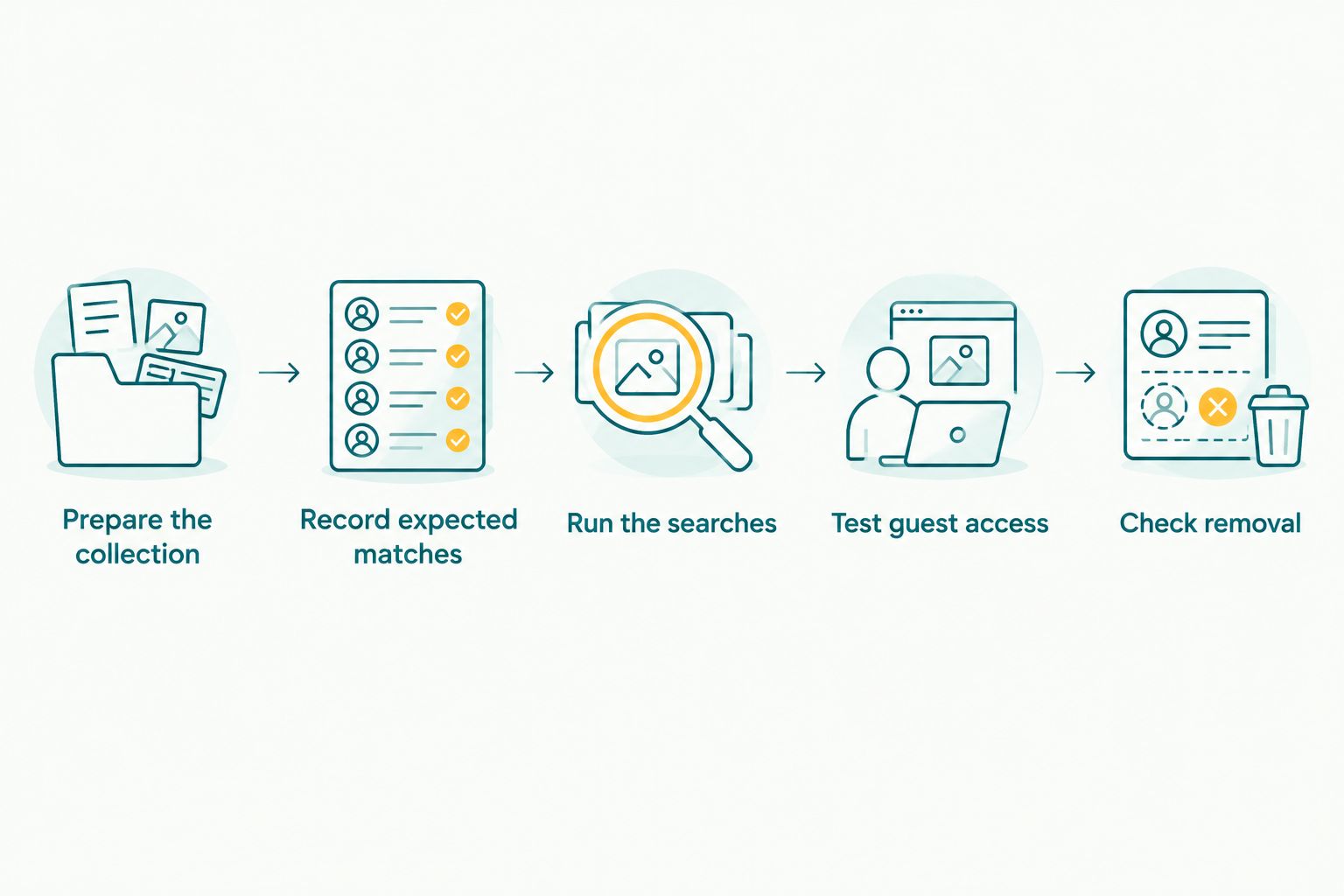
Test recognition, guest access, and removal before approving a delivery workflow.
Keep a brief test record with the collection name, test date, expected filenames, observed errors, and required follow-up. Repeat the relevant checks when you change the delivery setup. A result from another event is not evidence about the current collection.
Approve the workflow only after checking the errors, not just the successful searches. Keep a manual route for guests whose photographs do not appear.
Why face-search results vary
Facial recognition results depend on the photographs and the matching system. These factors belong in your test collection because they change the visual information available for comparison:
- Face size: A face occupying a small part of the frame contains less visible detail than a close portrait.
- Viewing angle: A side profile presents different facial information from a front-facing reference.
- Lighting and exposure: Deep shadows, strong backlight, and clipped highlights obscure detail.
- Occlusion: Another person, a hand, a mask, or headwear can hide part of the face.
- Motion and focus: Blur removes detail that a matching system needs to compare.
- Reference quality: An unclear reference photograph makes the comparison harder to assess.
Do not turn these factors into excuses for every failed search. Use them to identify the conditions under which you still need manual assistance, then explain that fallback to your team.
For a reception assignment, include stage lighting and dance-floor photographs. For a sports assignment, include action frames. Test the work you deliver, not the easiest photographs in your archive.
Does face search keep guest photographs private?
Face matching is not the same as access control. Finding photographs containing a person does not, by itself, establish who is permitted to open, browse, or download them.
A group photograph illustrates the distinction. The correct match for a guest can also contain other attendees. Face search does not make that image exclusive to the person who searched.
Before your 2026 delivery, check the actual sharing behaviour:
- Can someone with the link browse beyond their search results?
- Does opening a shared result expose the wider gallery?
- What download permissions apply to the viewer?
- What happens to uploaded reference photographs and derived face data?
- How do you remove access and request deletion?
For school assignments, agree the delivery and access process with the school before uploading children's photographs. For corporate events, confirm which material the client has approved for attendee access. These are assignment decisions, not settings to assume from a face-search feature.
Is a free face-search tool enough for wedding delivery?
A free face-search tool is enough only when its permitted use, search behaviour, and delivery controls meet the assignment. The label does not establish commercial-use permission, data handling, or the guest experience.
Check the current terms directly. Look for the rules governing professional use, collection limits, reference-image processing, downloads, retention, and removal. Do not infer them from an account creation screen or a demonstration.
Separate discovery from completeness, too. A guest finding photographs of themselves does not mean the couple's full delivery is ready. Ceremony details, décor, venue photographs, and other images without a recognisable face still need an organised place in the final collection.
Keep the complete client delivery separate from each guest's search results. This preserves the story of the assignment without making face recognition responsible for finding every kind of photograph.
Where Fotoowl fits in an event-photography workflow
Fotoowl is best for professional wedding and event photographers who need face recognition within a photo-delivery workflow. Its AI Gallery supports photo and video delivery with AI-powered face recognition, with portfolio builder, reel generator, and Beam camera-to-cloud FTP uploads as features inside the product.
That connection between search and delivery is relevant when you want to manage an event collection rather than search the public web. It does not remove the need to check your own photographs, guest access, or current terms before choosing a workflow.
Treat Fotoowl as a gallery-delivery option, not as evidence that any particular free entitlement or recognition outcome is guaranteed. Test the event conditions you shoot and confirm the controls required by your assignment.
Can a guest find every photograph they appear in?
No face-search result should be treated as proof that every relevant photograph has been found. Compare the output with known examples, especially profiles, crowded groups, and frames with partially hidden faces.
Keep a contact route for missing-photo requests. Ask for the event section, clothing, and approximate moment so your team can inspect the relevant files manually without promising that another search will resolve the request.
Is face search the same as reverse image search?
Face search compares facial information to locate potential matches; reverse image search looks for image similarity or copies. For a photographer delivering an event collection, the search scope matters as much as the matching method.
Use event-gallery retrieval for guest discovery. Use a separate image-reuse investigation when your question concerns where a photograph has appeared elsewhere.
FAQ
What's the best free AI face search tool for photographers?
The best free AI face search tool is one that passes your checks for correct matches, missed photographs, guest access, and permitted professional use. Test your own authorised event collection before choosing it for delivery.
Can I use a free face-search service for a paid wedding assignment?
Use a free face-search service for a paid wedding assignment only when its current terms permit that use and its handling of client photographs meets your requirements. The word free does not establish commercial-use permission.
Does Fotoowl provide face recognition for event photographs?
Fotoowl provides AI-powered face recognition within its event-photo gallery and delivery platform. Confirm the current terms and test your own event photographs before adopting the workflow.
Will face search find someone in every group photograph?
Face search does not guarantee finding someone in every group photograph. Small faces, hidden features, viewing angle, and blur belong in your test set.
Is uploading a guest selfie the same as verifying their identity?
Uploading a guest selfie is not, by itself, identity verification. Review the service's separate access and authentication controls before deciding who can view photographs.
Can I use face search for school event photographs?
Use face search for school event photographs only through an agreed, authorised delivery process. Confirm access, reference-image handling, retention, and removal with the school before uploading.
What should I do when a guest cannot find their photos?
Provide a manual missing-photo request route. Ask for event context and inspect the relevant photographs rather than treating an empty search result as proof that no photographs exist.
One last thing
For your next 2026 test, include a participant who does not appear in the collection, using an authorised reference photograph. Inspect whether the system returns unrelated people, and check what that participant can access regardless of the search result.
This tests a different question from successful retrieval: whether the workflow handles absence correctly. A useful evaluation must include a search that should return nothing.