
Triathlon Photo Delivery 2026: Fastest Setup That Works

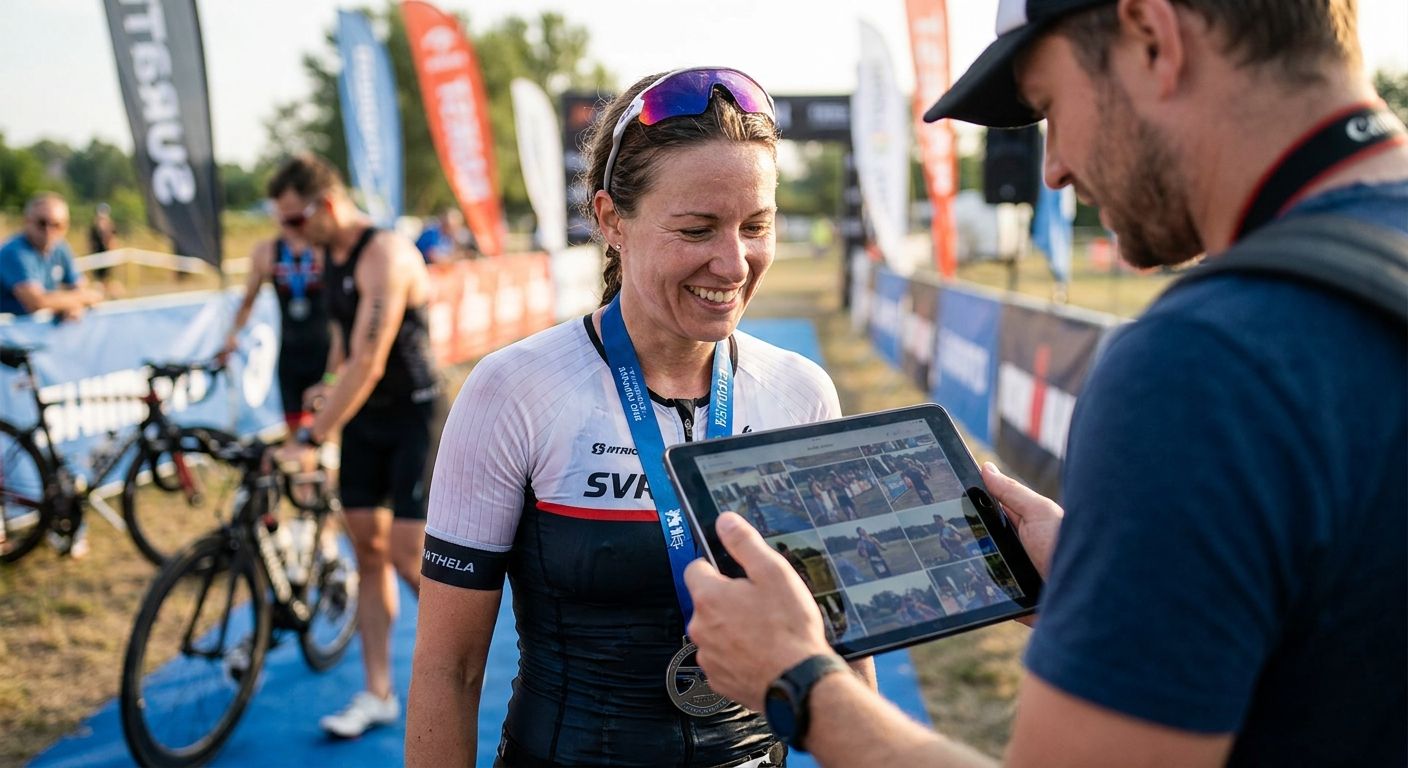
Triathlon photo delivery is the process of getting swim, bike, and run images into each racer's hands within hours of the finish line, not the following week, so athletes buy and share while the medal is still around their neck. A triathlon splits one athlete across three disciplines and often three separate camera crews, which makes sorting and delivery harder than a single-discipline race like a road marathon.
TL;DR
- Triathlon photo delivery works best when bib number search, not face recognition alone, is the primary lookup method — goggles and helmets hide faces.
- Same-day delivery for a 1,500-athlete triathlon depends on uploading during the race, not after the last finisher crosses.
- FotoOwl's Beam tool moves images from camera to gallery without a laptop step, which matters most on bike courses with no wifi.
- Selling photos from T1 and T2 transition zones, not just the finish line, captures purchase intent most photographers miss.
Why triathlon photo delivery matters for race photographers
A half-distance triathlon (70.3 miles) or a full iron-distance race (140.6 miles) spreads athletes across a swim leg, a bike leg, and a run leg, often over four to eight hours. Photographers cover multiple checkpoints — swim exit, T1, bike course, T2, run finish — and each checkpoint produces a separate batch of images that has to reconnect to the same bib number by the time delivery happens.
Most triathlon photo delivery problems trace back to one thing: waiting until after the event to sort and upload. By then the athlete has left the venue, checked out of the hotel, or stopped checking their phone for race photos. Instant race photo delivery for finish-line photographers works because it treats delivery as part of the shoot, not a task for the following week.
Cycling events add their own wrinkle — long courses, patchy cell coverage, and riders who are impossible to identify by face because of helmets and sunglasses. Bib number and race number search solve what face recognition alone cannot.
Step 1: Tag every frame with a bib number at capture
Bib tagging is the foundation of triathlon photo delivery. Skip this step and every later step gets slower.
- Shoot tight enough that the bib number is legible in at least one frame per athlete
- Use a second shooter or a spotter calling out bib numbers at chokepoints like the swim exit
- Batch-keyword images in Lightroom by bib range immediately after each card dump
- Flag blurry or obstructed bib shots for a second pass rather than discarding the frame
- Cross-check bib lists against the official timing company's race roster before final sort
Step 2: Split coverage by discipline and checkpoint
Treat swim, T1, bike, T2, and run as five separate folders, not one long shoot.
- Label folders by checkpoint name and approximate time window
- Keep a running count of frames per checkpoint to catch coverage gaps mid-race
- Assign one photographer per checkpoint on races over 1,000 athletes
- Note weather and lighting changes per checkpoint — swim starts are often shot in low pre-dawn light
Step 3: Upload from the camera without a laptop step
Manual delivery means a laptop, a card reader, and a wait until the shoot ends to start culling. On a bike course with no table and no outlet, that laptop step is the bottleneck.
This is where FotoOwl's Beam tool replaces the laptop entirely — it moves images from the camera straight to the cloud gallery over a phone connection, so upload starts the moment a card fills instead of hours later. The how-to guide on uploading directly from your camera using Beam walks through the setup for exactly this kind of remote-checkpoint shoot.
- Pair the camera to a phone hotspot at each checkpoint before the race starts, not after
- Set the camera to transfer JPEGs immediately, RAW files on a delayed batch
- Assign a backup power source for the phone acting as the hotspot
- Test the connection at the actual checkpoint location, not from the parking lot
Step 4: Let athletes search by bib number first, face second
Face recognition struggles on triathlon images — swim caps, goggles, and sunglasses hide the features the algorithm needs. Bib number search doesn't have that problem.
Face recognition photo finder tools built for marathon runners work well on run-leg shots where faces are visible, but a triathlon gallery needs both lookup methods active — bib search for swim and bike, face search for the run.
- Publish bib search as the default, front-and-center search option
- Turn on face search as a secondary filter for run-leg and finish-line photos
- Print the gallery URL and QR code on the race bib itself or the athlete's pickup packet
- Test both search methods against a sample of 20-30 real race images before the event, not after
Step 5: Push same-day delivery through channels athletes already check
Athletes check WhatsApp and text messages faster than email in 2026. A gallery link sitting in an inbox gets opened days later; one sent to WhatsApp gets opened at the finish tent.
- Send the gallery link via WhatsApp broadcast to registered participants within 2-3 hours of their finish time
- Post a QR code at the finish chute and post-race food area
- Add the link to the race's official results page if the organizer allows it
- Segment sends by discipline finish time so early finishers get their photos before late finishers even cross the line
Set up race day photo delivery
Bib search, face search, and same-day WhatsApp delivery in one gallery.
Step 6: Price and sell before athletes leave the venue
Purchase intent peaks in the two hours after an athlete sees their own photo, not two weeks later when the invoice arrives.
- Open sales the moment the first checkpoint's images are uploaded, not after the full race is sorted
- Bundle swim, bike, and run shots of the same bib into one package instead of selling per-checkpoint
- Offer a digital download tier and a print tier separately
- Watermark preview images before purchase to protect against screenshot theft
Step 7: Back up the full shoot before you leave the venue
A triathlon shoot spans hours and multiple cards. Losing a checkpoint's worth of images to a corrupted card with no backup is the single most common photographer complaint after race day.
- Run automatic cloud backup in parallel with the upload-for-delivery workflow
- Keep original RAW files separate from the delivery-ready JPEG set
- Confirm backup completion per checkpoint before breaking down that station's gear
Comparison: triathlon photo delivery options
| Option | Best for | Delivery speed | Key limitation |
|---|---|---|---|
| Manual bib sorting + USB/laptop | Small local races under 300 athletes | Same week | Bottlenecked by laptop culling time; no self-serve search |
| Generic cloud drive (Dropbox, Google Photos) | Photographers testing digital delivery for the first time | 1-2 days | No bib or face search; athletes scroll hundreds of unsorted images |
| Timing company photo add-on | Organizers who already pay for race timing services | Same day to next day | Locked into the timing vendor's gallery tools and limited customization |
| FotoOwl AI race gallery | Multi-checkpoint triathlons, cycling races, and events over 500 athletes | Same day, checkpoint by checkpoint | Requires phone connectivity at each upload point |
Verdict: for triathlons and cycling races with more than one checkpoint, an AI gallery with bib and face search beats a generic cloud drive or manual sorting on speed and athlete self-service, and it's the only option built to sell photos the same day.
Common mistakes triathlon photographers make
- Relying on face recognition alone. Goggles, swim caps, and helmets defeat facial matching on two of the three legs — bib search has to be the primary tool.
- Skipping transition zone coverage. T1 and T2 are where gear changes happen and where athletes look their most dramatic — missing these checkpoints leaves money on the table.
- Batching the whole race into one upload at the end. Waiting until the last finisher crosses before uploading anything means early finishers never see their photos while they're still on-site.
- Selling only finish-line shots. Swim exit and bike-leg images sell too, especially to family members tracking a specific athlete through the whole course.
- No backup connectivity plan. Bike courses run through dead zones — a single-carrier hotspot with no fallback stalls the entire upload chain.
If bib search doesn't work on your gallery, your triathlon photo delivery doesn't work — face recognition is a bonus feature, not the primary tool, on this kind of race.
FAQ
What's the best way to deliver triathlon photos fast?
Upload from each checkpoint during the race using a camera-to-cloud tool like Beam, then let athletes search by bib number the moment images land in the gallery. Waiting until after the race to start sorting is the main reason delivery slips to days instead of hours.
Is face recognition or bib number search better for triathlon photos?
Bib number search works better for swim and bike legs because goggles, caps, and helmets block facial recognition. Face search works fine on run-leg and finish-line shots where faces are visible, so the strongest setup runs both.
How fast should triathlon photo delivery happen after the finish line?
Same-day delivery, ideally within 2-3 hours of an athlete's individual finish time, keeps purchase intent high. Athletes who leave the venue before seeing their photos buy far less than those who see a link while still on-site.
Can athletes buy race photos directly from the gallery?
Yes, a photo selling platform built into the gallery lets athletes purchase digital downloads or prints right after finding their bib number, without a separate checkout tool.
Does WhatsApp delivery work for triathlon and cycling events?
Yes, sending gallery links over WhatsApp gets opened faster than email in 2026 because athletes already have the app open at the finish area. It works especially well for broadcasting to a full registrant list right after results post.
What's the difference between triathlon and marathon photo delivery?
Marathons are a single discipline with one course, so face recognition alone often works well. Triathlons split coverage across swim, bike, and run checkpoints, which makes bib number search and multi-checkpoint sorting necessary.
Do I need internet access on the bike course to upload photos?
You need a phone hotspot or cellular signal at each checkpoint to upload in real time. Dead zones on rural bike courses are common in 2026, so a backup carrier or delayed batch upload plan matters.
How do I stop people from downloading race photos for free?
Watermark preview images before purchase and keep full-resolution files gated behind checkout. A reverse image search tool also flags unauthorized reposting after the gallery goes live.
One last thing
Most triathlon photographers put their best shooter at the finish line and treat T1 and T2 as afterthoughts. Flip that in 2026 — transition zones are where athletes are mid-change, gear scattered, faces visible without goggles or helmets, and family members watching closely. Those frames sell as well as the finish photo, and almost nobody is covering them properly.