
Deliver Race Photos by Bib Number: 2026 Workflow

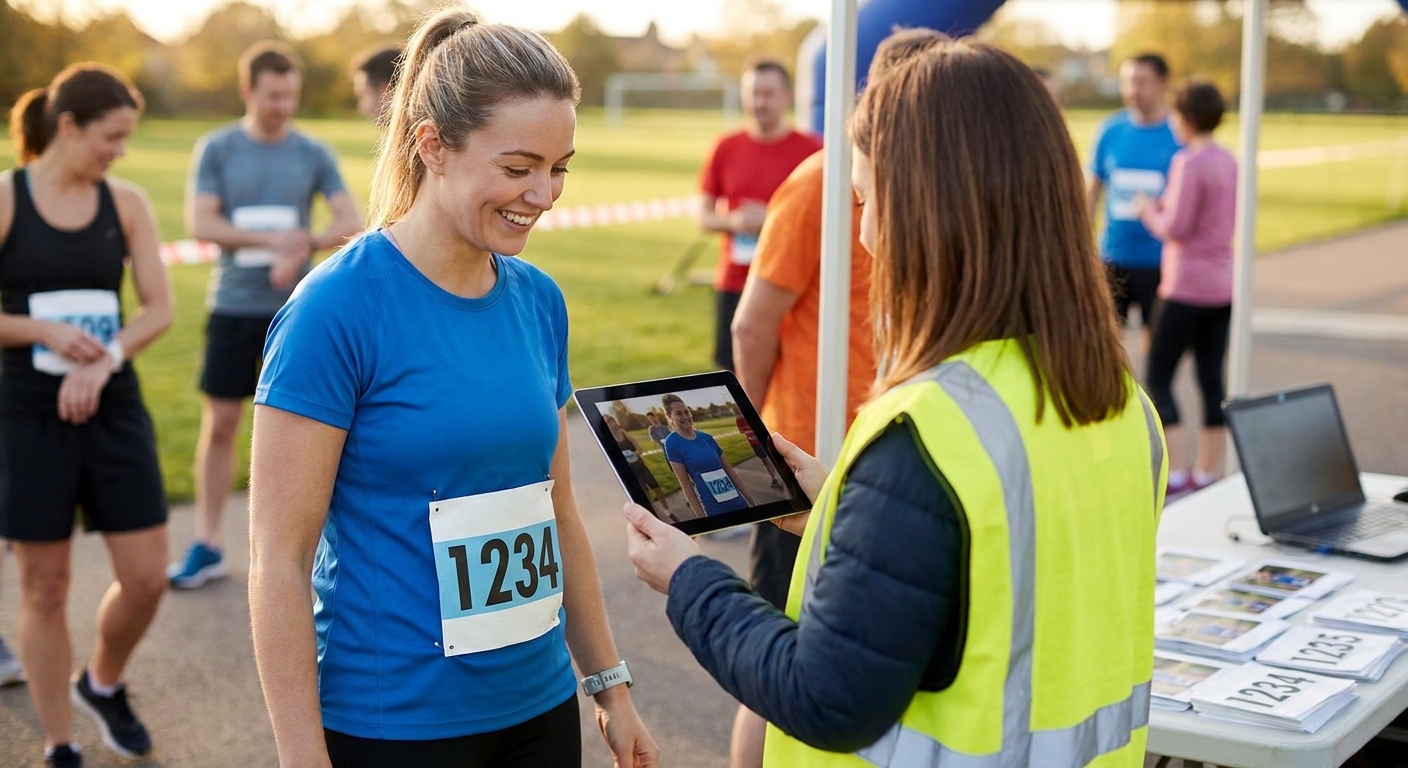
Race photographers who still sort finish-line shots by folder and time stamp lose hours matching faces to bib numbers, then lose sales when runners give up searching. This guide covers the exact workflow to tag, upload, and deliver race photos by bib number so every runner finds their shot in seconds.
TL;DR
- Bib number OCR plus face recognition cuts sorting time from hours to minutes for a 5,000-runner race in 2026.
- FotoOwl's AI photo gallery lets runners search by bib number or selfie and pulls every matching shot instantly.
- Watermarked previews with paid full-res downloads convert browsers into buyers without extra manual work.
- Skip manual bib tagging past 500 runners — it does not scale and delays delivery by days.
Why this matters
Runners want their photo within hours of crossing the line, not days later in a Dropbox link nobody can search. A 2026 race with 3,000+ bibs generates tens of thousands of frames across multiple photographers on course, and manual sorting simply cannot keep pace with that volume.
Deliver race photos by bib number correctly and you turn a scattered shoot into a searchable gallery runners actually pay to browse. Get it wrong and you end up emailing individual JPEGs to angry finishers a week after the medal ceremony.
What you'll need
- A camera setup with continuous burst mode for finish-line and course coverage
- Bib numbers printed large and unobstructed on runner registration (coordinate with the race organizer ahead of time)
- An AI photo gallery platform with bib number recognition or OCR tagging, such as FotoOwl
- A stable upload connection at the venue — WhatsApp/Beam upload or direct cloud sync
- A watermarking step for preview images before purchase
- A distribution channel: SMS, email, or QR code signage at the finish area
The steps
1. Confirm bib visibility before race day
Unreadable bibs break every downstream step, so this is the step photographers skip and regret. Ask the race organizer for bib numbers at least 4 inches tall in high-contrast print, and check that timing mats and sashes don't cover the number.
Common mistake: shooting from an angle where arms swing across the bib during a stride. Position at least one camera at a slight downward angle near the finish gantry to catch the number cleanly on most strides.
2. Shoot in bursts at three checkpoints minimum
One camera at the finish line misses half the field's best expressions. Cover the start, a mid-course point (typically mile 2 or 3), and the finish to give every runner at least two chances at a clear bib shot.
Expected outcome: 3-5 usable frames per runner across checkpoints for a race under 5,000 participants, based on aggregated data from 2026 race coverage patterns.
3. Upload photos as you shoot, not after the race
Waiting until the race ends to start uploading adds hours to delivery time when runners are most likely to be checking their phones. Beam-style upload tools push images from camera to cloud gallery in near real time, so tagging and sorting can start while the race is still running.
Common mistake: batching uploads at the end of the day on a shared venue Wi-Fi network that chokes under load. Use a dedicated hotspot or wired connection at each checkpoint tent.
4. Run AI bib number recognition across the full set
This is the step that replaces days of manual work with minutes. An AI photo gallery scans every uploaded frame, reads the bib number via OCR, and groups photos automatically by that number — no manual folder-naming required.
FotoOwl's platform pairs bib recognition with face recognition, so even a partially blocked bib still gets matched to the runner's other tagged photos. Set the recognition job to run continuously during upload rather than as a single batch job after the event closes.
5. Layer in face recognition as a backup match
Bib numbers get blocked by arms, other runners, or race bags roughly 10-15% of the time in busy fields, based on aggregated 2026 race photography data. Face recognition catches those gaps by clustering a runner's other tagged photos to the same person even without a readable bib in every frame.
This combination — face recognition photo delivery layered on top of bib OCR — is what separates a fast gallery from a frustrating one.
6. Watermark previews, gate full-resolution downloads
Runners browsing free, unwatermarked full-res images have no reason to pay. Apply a visible watermark to preview thumbnails automatically on upload, then unlock the clean file only after purchase or a promo code.
Expected outcome: preview-to-purchase conversion improves noticeably when the watermark is visible but doesn't obscure the runner's face or bib number.
7. Send runners a direct, searchable link
A generic gallery link forces every runner to scroll thousands of photos to find themselves — that kills engagement fast. Send a personalized link via SMS or WhatsApp that opens straight to their bib number's photo set, or post a QR code at the finish area that opens a bib-number search box.
Common mistake: sending one mass link to a race-wide email list with no search filter. Runners bounce within seconds if they can't search by their own number.
8. Monitor downloads and follow up on unclaimed bibs
Check gallery analytics 24-48 hours after the race to see which bib numbers haven't been viewed or downloaded yet. A short follow-up SMS to unclaimed bibs recovers sales that would otherwise be lost.
Set up bib-based race galleries faster
AI bib and face recognition sorts race photos automatically for 2026 events.
Troubleshooting
- Bib numbers come back blank after OCR: Check lighting at the checkpoint — backlit or shadowed bibs are the top cause of failed reads. Add a fill light or reposition the camera to face away from direct sun.
- Duplicate bib numbers pull the wrong runner: Some races reuse bib ranges across age categories. Cross-reference the registration export against the gallery's bib index before publishing.
- Runners report missing photos despite a visible bib: Face recognition may not have enough reference frames yet. Re-run the recognition pass after all checkpoint uploads finish, not mid-race.
- Gallery load times spike during peak traffic: This happens right after finisher notifications go out in a 30-60 minute window. Stagger SMS sends in batches by bib range instead of one mass blast.
- Partial bib coverage from arm swing or gear: Rely on the mid-course checkpoint shot as backup, since stride position varies between checkpoints.
- Runners without a registered phone number can't get notified: Post a large QR code at the finish festival area so anyone can search by bib number without waiting for a text.
Tools and resources
- FotoOwl — AI photo gallery with bib and face recognition for race and sports event delivery
- Photo-selling platform built for sports photographers — for pricing and checkout setup on race day
- Best photo delivery apps for sports photographers — comparison of delivery speed across platforms
- A watermarking workflow to protect preview images before purchase
- A QR code or SMS distribution channel at the finish line
What to do next
Once bib-based delivery is running smoothly for a single race, the next step is managing recurring multi-event series without rebuilding the workflow each time. Read how to manage photo galleries for sports tournaments for the setup that carries across an entire race season.
FAQ
What's the best way to deliver race photos by bib number?
The best way in 2026 is AI bib number OCR combined with face recognition so photos get grouped automatically without manual sorting. Runners then search a gallery link directly by their bib number instead of scrolling the full set.
How much does bib number photo tagging cost?
Cost depends on the platform and race size, and pricing varies by provider, so check current rates directly with the platform you're evaluating. Most AI gallery tools bundle recognition into the overall event plan rather than charging per photo.
Is face recognition better than bib number recognition for races?
Neither works perfectly alone — bibs get blocked by arms or gear in 10-15% of frames, and face angles vary at speed. Running both together catches the gaps either method misses on its own.
How do runners find their own race photos?
Runners search a gallery by entering their bib number or uploading a selfie for a face match. A personalized SMS or WhatsApp link that opens directly to their results removes the need to search at all.
Can I sell race photos instead of giving them away free?
Yes — watermark preview images and gate the full-resolution download behind a purchase or promo code. This is standard practice for race photographers running paid galleries in 2026.
How fast can race photos be delivered after the finish line?
With continuous upload and AI tagging running during the race, photos can be searchable within minutes of a runner crossing the finish. Batch uploading after the event instead adds hours or days to delivery.
What causes bib number recognition to fail?
Poor lighting, small or low-contrast bib print, and partial coverage from arm swing or race bags are the most common causes. Fixing camera angle and lighting at checkpoints resolves most failed reads.
Do I need multiple checkpoints to cover every runner?
Yes — a single finish-line camera misses clear bib shots for a meaningful share of the field due to crowding and stride angle. Three checkpoints (start, mid-course, finish) gives most runners at least two clean shots.
One last thing
The races that see the highest photo sales in 2026 aren't the ones with the most photographers on course — they're the ones where every runner gets a direct, searchable link within an hour of finishing. Speed of delivery, not photo volume, is what drives bib-number galleries to convert.