
Cycling Race Photos by Bib Number: 2026 How-To

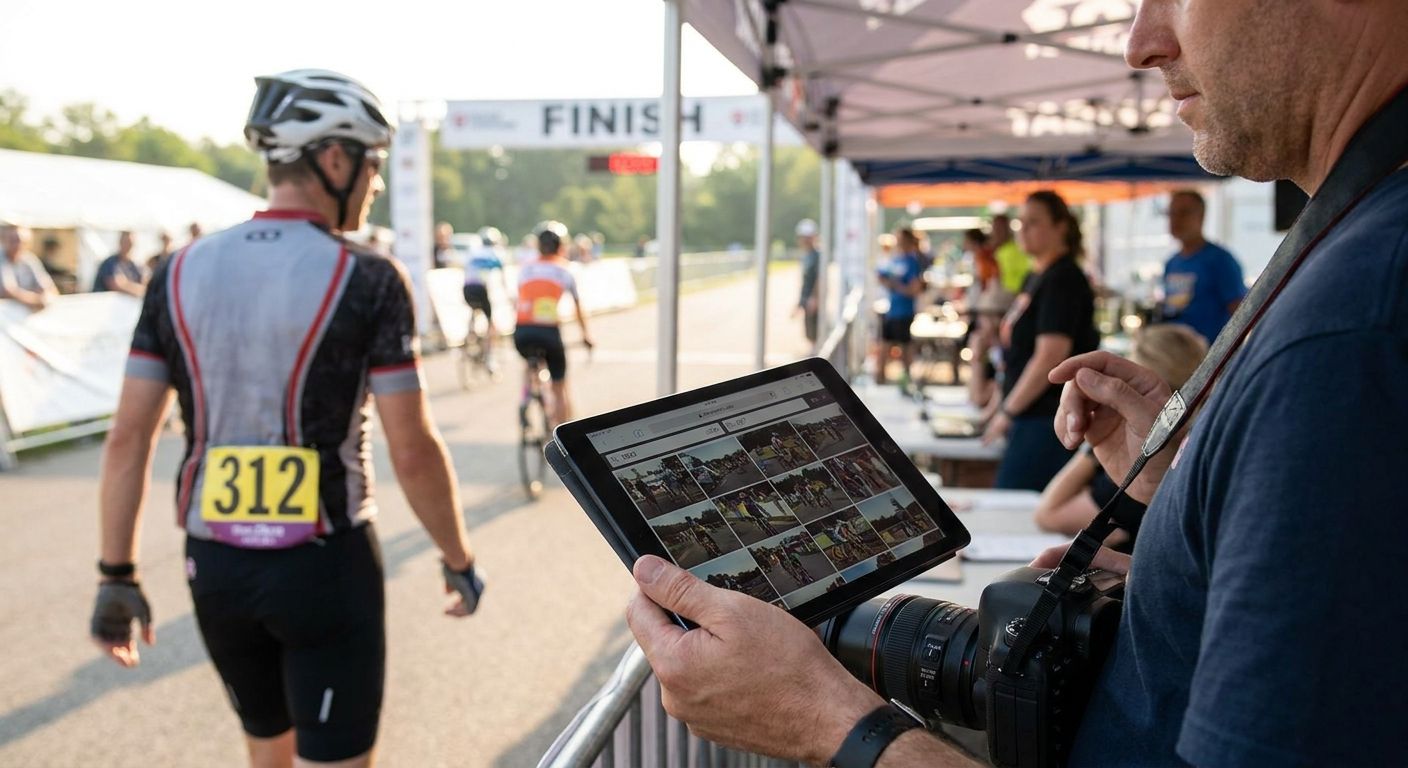
Tag every finish-line and course photo with a rider's bib number using AI bib-recognition (OCR) software, then publish a searchable gallery where each cyclist types their number and pulls every photo tied to it. That's the fast path to deliver cycling race photos by bib number in 2026, and it replaces the old habit of dumping thousands of JPEGs into folders labeled by hour or camera. The catch: OCR alone misses bibs that are muddy, folded, creased on a jersey, or angled away from the lens, so a face-recognition backup or a manual tag pass has to cover what the software can't read.
TL;DR
- AI bib-number OCR tags cycling race photos automatically so riders search their own number instead of scrolling folders.
- Face recognition backs up bib OCR for muddy, folded, or angled numbers the software misses.
- QR codes and WhatsApp links get bib-tagged race photos to cyclists before they leave the venue in 2026.
- Manual folder sorting still works for small club races, but it doesn't scale past a few hundred riders.
Why this matters
A cyclist who finishes a century ride wants their photo before the podium ceremony wraps up, not three days later in a Dropbox link nobody opens. Race photographers who still sort manually lose that window, and a lost window is a lost photo sale. FotoOwl built its gallery around bib-number search paired with face recognition specifically because cycling fields move fast, cameras multiply across a course, and nobody on staff has time to eyeball 15,000 frames on a Sunday night.
The fix isn't a better filing system. It's software that reads the number off the jersey the moment the photo lands, before a human ever opens the folder.
How to deliver race photos to cyclists by bib number
- Shoot for the number, not just the face. Course photographers need at least one angle per checkpoint where the bib is fully visible and unobstructed — a face-only shot gives face recognition something to work with but gives bib OCR nothing.
- Upload straight from the camera to the cloud. Uploading in batches after each checkpoint, rather than waiting until the race ends, means tagging starts hours earlier and the gallery is closer to done by the time riders reach the finish.
- Run automatic bib-number OCR across the full batch. Every frame gets scanned and tagged to a rider number without anyone manually sorting a single image.
- Layer face recognition as backup. For bibs that are muddy, folded, or turned sideways mid-sprint, a tool like the face recognition photo finder for marathon runners fills gaps that OCR alone leaves behind — the same logic applies directly to cycling fields.
- Publish the gallery and share the link. A QR code at the finish line or a broadcast link to registered riders gets the gallery in front of cyclists while they're still standing around drinking electrolyte mix.
- Let riders search their own bib number. They type it, preview every matching photo, and download or buy on the spot — no app install, no waiting on an email.
Bib OCR vs. face recognition vs. manual sorting
| Method | Speed | Handles damaged/angled bibs | Best for | Verdict |
|---|---|---|---|---|
| Bib-number OCR | Tags thousands of images in minutes | Struggles with mud, folds, extreme angles | High-volume road races, gran fondos | Buy |
| Face recognition backup | Runs alongside OCR, minutes | Fills the gaps OCR misses | Any race with multiple course cameras | Buy |
| Manual folder sorting | Hours to days depending on volume | Accurate but slow | Club races under a few hundred riders | Skip for large fields |
Bib-number OCR paired with face recognition wins for any cycling race over a few hundred riders in 2026 — manual sorting still works, but only for the smallest fields where the volume doesn't punish you for doing it by hand.
See bib-number search in action
Check how a FotoOwl gallery pairs bib OCR with face search for race photographers.
Why bib-number matching accuracy varies
No OCR engine reads every bib correctly on the first pass. A handful of conditions push the miss rate up on any given race day:
- Mud and water splashed across the number — common on gravel and cyclocross-adjacent road events.
- Bibs folded or creased against a jersey, especially on riders who pin them last-minute.
- Extreme lean angles during a sprint or climb, where the number faces sideways instead of straight at the lens.
- Low light at early starts or in tunnels/underpasses, which softens the edges OCR needs to read digits.
- Multiple cameras at different distances and angles, some of which never get a clean, straight-on shot of any given rider.
- Riders swapping bibs mid-race — rare, but it happens, and it's the one error a backup face-recognition pass can't fully solve either.
Can cyclists find their race photos without downloading an app?
Yes — a browser-based gallery works from a QR code scan or a shared link, and riders search by bib number directly in the browser with no app install required. That's the setup most 2026 cycling races run, since it removes the biggest drop-off point in the delivery chain.
Do cyclists need their bib number, or can they search by face instead?
Both options work when a gallery has face recognition enabled alongside bib-number search. A rider who forgot their number, or whose number never got tagged cleanly, can upload a selfie and pull the same set of matching photos.
FAQ
What's the best way to deliver cycling race photos by bib number in 2026?
The best approach in 2026 pairs automatic bib-number OCR with a face-recognition backup, so riders search their own number and any bib the software misspells or misses still gets caught. Publishing the gallery same-day, before riders leave the venue, matters more than which single tool does the tagging.
Is face recognition better than bib-number OCR for race photos?
Neither replaces the other — bib OCR is faster for clean, legible numbers, while face recognition catches muddy, folded, or angled bibs that OCR can't read. Running both together covers more of the field than either alone.
How long does it take to tag race photos by bib number?
AI bib-number OCR tags a batch of thousands of images in minutes once the photos are uploaded, compared to hours or days for manual folder sorting. The upload step, not the tagging step, is usually the actual bottleneck on race day.
Can riders search race photos without creating an account?
Yes, most bib-number galleries let riders search and preview photos without signing up, and only ask for contact details or payment at the download or purchase step. This keeps the drop-off rate low on a QR-code link shared at the finish line.
Do I need multiple cameras to capture every rider's bib number?
One finish-line camera only captures the sprint moment for each rider, so races with a full course to cover benefit from checkpoint cameras positioned specifically to catch the bib, not just the face. More angles mean more tagged photos per rider across the ride.
What happens when a bib number is muddy or unreadable?
OCR skips or misreads it, which is why a face-recognition backup or a short manual review pass is still necessary for road and gravel races where mud and water are common. Without that backup, those riders end up with zero tagged photos.
Can I sell race photos directly from the bib-number gallery?
Yes, a bib-number search gallery can double as a sales channel, letting riders buy the photos tied to their own number right from the search results. This works better than a generic photo-selling page because riders aren't scrolling through images that aren't theirs.
Does WhatsApp delivery work for cycling race photos?
Yes, sharing a gallery link over WhatsApp works well for smaller club races or regional series where most registered riders are already reachable through a group or broadcast list. For large open races, a QR code at the finish line usually reaches more riders faster.
One last thing
Most race photographers put their only camera at the finish line and call it coverage. That gets you one bib-legible frame per rider, at best, for a ride that might last three or four hours. Put at least one camera on a climb or a technical section where riders naturally slow down and the bib sits still for a beat — those frames tag cleaner, sell better, and give a cyclist more than one photo to choose from when they search their bib number in the 2026 gallery.