
FotoOwl vs PimEyes: which is better in 2026


Choose Fotoowl if you need to deliver your wedding or event photographs through a face-recognition gallery; choose PimEyes if you want to find publicly accessible web images containing a face. In 2026, the deciding factor is where you need to search: your event collection or images indexed from the web.
TL;DR
- Fotoowl vs PimEyes compares event photo delivery with public-web face search, not interchangeable gallery tools.
- Choose AI Gallery for delivering your own event photographs through face recognition.
- Choose PimEyes for finding publicly accessible web images containing your face.
- Neither tool's facial match proves identity, consent, image ownership or permission to publish.
Why this matters
Finding a photograph and delivering a photography assignment are different jobs. A wedding studio needs to prepare its collection, help people locate relevant photographs and complete client handover. Someone checking where their portrait appears online needs a search engine instead.
The Fotoowl event photo gallery addresses the first job. PimEyes addresses the second through facial reverse-image search. Comparing them only on face recognition hides the difference that determines whether either tool fits your work.
For Indian wedding, school, sports and corporate-event photographers, start with the deliverable in your contract. A gallery for an assignment and a search for public-web appearances require different inputs, processes and follow-up actions.
At a glance
| Dimension | Fotoowl | PimEyes |
|---|---|---|
| Best for | Professional photographers delivering wedding and event collections | People checking public-web appearances of a face |
| Search scope | Photographs uploaded to an event gallery | Images within its public-web search index |
| Standout feature | AI Gallery combines face recognition with photo and video delivery | Facial reverse-image search across indexed web images |
| Result you need | Photographs from your own assignment | Matching web images and their source locations |
| Media workflow | Gallery delivery, client proofing and related studio products | Finding web appearances rather than handing over an assignment |
| Match verification | Review facial matches before relying on them | Review facial matches before relying on them |
| Privacy decisions | Decide what to upload, share and permit recipients to access | Decide whether to submit a face image and how to handle results |
| Pricing model | Confirm billing terms for the products your studio needs | Subscription-based access; check current terms and search limits |
AI Gallery wins for photographers; PimEyes wins for web checking
Best for wedding and event delivery: AI Gallery. You already have the photographs. Your problem is turning that collection into a usable client deliverable, not discovering where a face appears elsewhere online.
Consider an Indian wedding assignment covering the mehendi, sangeet, ceremony and reception. The studio needs to organise its own work, deliver photographs and handle client selections. A public-web face search does not replace those tasks.
Best for checking public-web appearances: PimEyes. You have a reference image and want to locate web images containing a matching face. That is a discovery task, not a gallery-production task.
The limitation runs both ways. An event gallery searches the collection supplied to it; a web search depends on its index. Choose by the collection you need to examine, not by which product uses the more impressive technology label.
PimEyes wins for public-web scope; AI Gallery wins within your event
PimEyes is a facial reverse-image search engine. Its relevant advantage is searching beyond the photographs you personally uploaded into an event collection, within the web images it indexes.
That makes PimEyes the appropriate option when you are checking your own public portrait appearances. It is not a complete inventory of every photograph online, and a missing result does not establish that an image has never been published.
AI Gallery takes the opposite approach. Its face-recognition function works with the photographs supplied for gallery delivery. For an event photographer, that defined collection is the point: recipients need photographs from the assignment you shot.
In 2026, choose the search boundary before comparing features. If the photograph belongs to your event collection, use the gallery workflow. If you are investigating an appearance on an unrelated public website, use the web-search workflow.
AI Gallery wins on delivery features; PimEyes wins on discovery focus
AI Gallery includes photo and video delivery, face recognition, a portfolio builder, a reel generator and Beam camera-to-cloud FTP uploads. Those features support a photographer's production and handover process.
The advantage is breadth within that job. You are not choosing only a face finder; you are choosing a place to deliver the media you produced. The tradeoff is that you still need to prepare the collection and decide what belongs in it.
PimEyes has a narrower purpose: facial search across indexed web images. That focus is useful when you need to investigate where a face appears without building an event gallery first.
The tradeoff is equally clear. Finding a public-web result does not create a client-ready gallery, gather album selections or manage a photography project. Judge the standout feature by the task it completes, not by the number of features listed.
AI Gallery wins for handover; PimEyes wins for locating sources
A gallery result and a web-search result lead to different next actions. In AI Gallery, the relevant photographs belong to the collection you are delivering. Your next task is completing that handover.
A PimEyes result points you towards a web appearance. Your next task is examining the source page, checking the match and deciding whether any follow-up is justified.
For example, a photographer delivering corporate annual-day photographs needs recipients to find images from that event. A photographer checking where their own promotional portrait appears needs to inspect public-web sources. Neither task becomes the other simply because both begin with a face.
Keep these outcomes separate in your 2026 workflow. A located image is not a delivered assignment, and a delivered assignment is not a public-web monitoring system. That distinction prevents a useful search tool from becoming the wrong replacement for your gallery.
The studio platform wins for media workflow, not web investigation
Fotoowl event photo gallery software sits alongside products for other stages of a photography business. Photo Selection handles client proofing, with selections reused for albums and printing. Studio Manager handles leads, quotations, contracts, invoices, projects, teams, schedules, deliverables and payments.
AI Culling is a separate offline desktop application. It rejects duplicate and weak frames, groups similar photographs and ranks them by composition, exposure and blur, followed by a human review before export to Lightroom or the gallery. AI Studio supports generative edits and image-to-video using the photographer's own photographs.
Do not collapse those products into a single gallery feature. Offline culling, proofing, business administration and delivery are distinct stages. Choose only the stages your studio needs.
PimEyes remains the better fit for public-web face discovery. It does not replace the supplied studio workflow merely because it can find facial matches. Its focused search purpose is a strength for investigation and a limitation for assignment delivery.
Neither tool earns an accuracy win without a controlled comparison
Treat a facial match as something to inspect, not proof of identity. A search result can be relevant without establishing that the person shown is definitely the person you intended to find.
For gallery delivery, inspect whether the returned photographs belong to the intended recipient. For public-web search, inspect the image and its surrounding context before drawing conclusions about who appears in it.
Use a controlled check rather than an unsupported accuracy ranking:
- Include photographs where the intended person is clearly visible.
- Include different angles, lighting conditions and group compositions.
- Check returned matches against the original photographs.
- Record both incorrect matches and relevant photographs that were missed.
- Keep human review separate from the software's output.
For a 2026 purchasing decision, compare each tool against its actual job. Success within a prepared event collection does not establish better performance across a public-web index, or vice versa. Neither search scope provides a fair substitute for the other.
Neither tool replaces consent and access decisions
Face recognition answers a retrieval question. It does not answer whether you should upload an image, who should receive it or whether somebody has permission to publish it.
For wedding delivery, agree with your client which photographs belong in the shared collection. For corporate work, confirm the organiser's requirements. For school assignments, establish the school's instructions and the appropriate parent or guardian permissions before sharing children's photographs.
These are workflow recommendations, not claims that either platform automatically enforces your decisions. A matching face does not establish permission to view every photograph containing that face. Review the access controls available to you and test the recipient experience before handover.
For PimEyes, use your own image or an appropriately authorised reference image. Handle the results carefully. Finding a source page does not establish copyright ownership, permission to republish or a lawful reason to contact the person shown.
Both tools require responsible decisions outside the matching function. There is no automatic privacy winner in this comparison.
Pricing: buy for the job, then check the billing terms
Do not compare a gallery requirement with a search subscription as though they purchase the same outcome. Your 2026 buying checklist should begin with the work each tool must complete.
For the studio platform, identify whether you need gallery delivery, client proofing, offline culling, business administration or generative editing. Confirm the current billing structure, included capabilities and applicable usage terms for that combination. Do not assume every named product is included together.
PimEyes uses subscription-based access. Check the current billing period, search limits and the result access included in the option you are considering. A recurring subscription fits repeated searching differently from an occasional investigation.
For either tool, distinguish predictable billing from sufficient usage. Ask what happens when you exceed the relevant limits and what cancelling changes. Assess those terms against your workload rather than against a headline amount.
The right purchase completes the required task. Buying a face-search subscription does not remove the need for event delivery, and buying a gallery does not add public-web discovery.
Final verdict: choose by your next action
Choose Fotoowl if you deliver professional event collections
Named profile: the Indian wedding or event studio. You shoot the assignment, prepare its photographs and videos, deliver a gallery and manage client selections. AI Gallery is the relevant winner because event delivery is the job you need completed.
Before adopting it, run a real handover rehearsal:
- Prepare collection: choose photographs approved for delivery.
- Review matches: inspect results for intended recipients.
- Check permissions: confirm the sharing arrangement with your client.
- Complete handover: test the recipient experience before releasing the assignment.
This rehearsal tests your actual workflow without pretending that a feature list proves delivery quality.
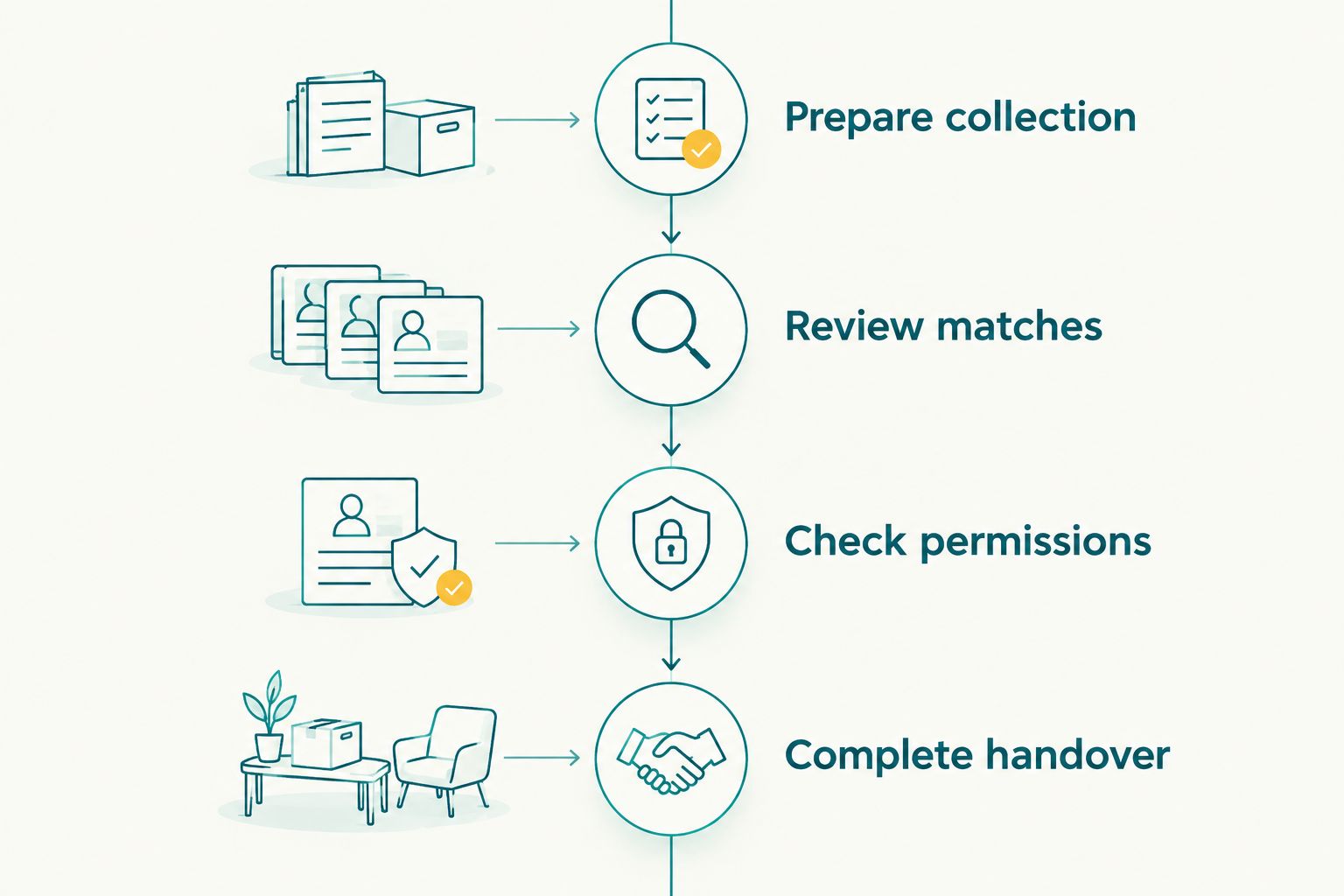
Review matches and permissions before releasing the assignment.
Choose PimEyes if you need to investigate public-web appearances
Named profile: the photographer checking their own public portrait. You want to locate indexed web images containing your face and inspect where they appear. PimEyes is the relevant winner because web discovery is the job you need completed.
Start with a suitable reference photograph. Examine each relevant source result before making an attribution or taking action, and do not interpret an empty result as proof that no web appearance exists.
Keep the investigation separate from client delivery. In 2026, a studio can have both needs without treating the tools as interchangeable or forcing either one to do the other's job.
One-glance scorecard
| Dimension | Winner |
|---|---|
| Best for professional event photographers | AI Gallery |
| Best for checking public-web face appearances | PimEyes |
| Search within your uploaded event collection | AI Gallery |
| Search across indexed public-web images | PimEyes |
| Delivery-focused standout features | AI Gallery |
| Discovery-focused standout feature | PimEyes |
| Client handover result | AI Gallery |
| Locating public-web sources | PimEyes |
| Broader photography studio workflow | Fotoowl |
| Verified matching accuracy | Fotoowl |
| Consent and responsible handling | Neither replaces your decisions |
| Pricing fit | Choose according to the required job and billing terms |
FAQ
Is Fotoowl better than PimEyes for wedding photographers?
Fotoowl is the better fit for wedding photographers who need an event photo gallery and client delivery. PimEyes is the better fit for finding public-web images containing a face, not delivering a wedding assignment.
Can PimEyes replace an event photo gallery?
No. PimEyes is a facial reverse-image search engine for indexed web images, while an event gallery delivers a photographer's supplied collection. Finding a web image does not complete client handover.
Can AI Gallery find photographs of me across the internet?
AI Gallery is for face recognition and delivery within uploaded gallery collections, not public-web face search. Choose PimEyes when your task is locating indexed web appearances of your own face.
Which tool is more accurate at face recognition?
This comparison does not establish an accuracy winner. Review matches against known photographs and assess each tool within its intended search scope rather than treating gallery retrieval and web discovery as identical tests.
How should I compare the cost of these tools in 2026?
Compare the work you need completed and the current billing terms, not just the payment amount. Confirm the studio products you need, and check PimEyes subscription terms, search limits and result access before purchasing.
Is AI Culling an online gallery feature?
No. AI Culling is an offline desktop application that helps reject duplicate and weak frames, group similar photographs and rank images before a human review. It exports to Lightroom or the gallery.
Does a face match mean I can share the photograph?
No. A facial match does not establish consent, copyright ownership or permission to publish. Confirm the appropriate permissions and sharing arrangement separately.
One last thing
The simplest buying test is to finish this sentence: after finding the face, I need to… If the answer is deliver photographs from your assignment, choose the event-gallery workflow. If the answer is inspect where your portrait appears publicly, choose the web-search workflow.
That next action settles the comparison more clearly than a generic face-recognition feature list.