
How to manage overtime charges for wedding photography


Manage wedding photography overtime charges by agreeing the coverage window, billing method and authorised approver before the wedding, then recording approval before extending the shoot. Extra coverage also creates work after the event, so your terms should address editing and delivery—not just time at the venue. For your 2026 bookings, keep the quotation, contract, approval record and invoice consistent.
TL;DR
- Wedding photography overtime charges need agreed coverage hours, an approval process and a clear invoice record.
- Get written approval before extending wedding coverage; a delayed programme is not an approval.
- Fotoowl offers Studio Manager for photographers managing quotations, contracts, schedules, invoices and payments.
- Separate extra shooting time from changes to editing, albums and delivery deadlines.
Why this matters
An overtime discussion becomes difficult when you and the client use different definitions of a finished assignment. You might mean the contracted end time; the family might mean the final ritual, farewell or group photograph. Define the endpoint before anyone books.
For an Indian wedding with several functions, record each coverage window separately. Treat the sangeet, wedding ceremony and reception as named assignments rather than leaving the team to interpret a promise of complete wedding coverage.
Start with your photography contract for event clients, then make the same overtime terms visible in the quotation. A clause buried in the contract is not a substitute for explaining the decision the client will face on the day.
How do you manage overtime charges for wedding photography?
Use a documented sequence: define coverage, explain the extension method, identify the approver, confirm the extension and reconcile the invoice. Keep responsibility with a named studio lead rather than asking every photographer to negotiate separately.
1. Define coverage
Write down the function, venue, coverage start, coverage end and assigned team. State whether setup, travel between venues, waiting time and pack-down sit inside or outside that window. Do not leave those boundaries to a conversation at the venue.
Specify how the clock starts. An agreed arrival time and the actual start of a ceremony are different triggers; choose the one your studio intends to use and explain it before booking.
2. Explain extensions
State how additional coverage is measured and which team members it covers. Explain whether an extension keeps the whole team working or only the photographers named in the approval.
Also define the limit of the extension. Permission to photograph a delayed ritual should not become an open-ended commitment to stay through every activity that follows it.
3. Name approvers
Ask the contracting client to nominate someone who can authorise extra coverage during the event. Record that person's name and contact details with the booking, and make the arrangement clear to your shoot lead.
A wedding planner, relative or venue coordinator can communicate a delay without having authority to approve additional work. Confirm authority instead of inferring it from someone's role.
4. Confirm approval
Before the contracted finish, explain what remains unphotographed and ask whether the authorised person wants to extend coverage. Record the agreed endpoint, team scope and acceptance of the existing overtime terms in writing.
Keep the response with the project. If approval happens through WhatsApp, retain the relevant conversation rather than relying on a photographer's recollection after a long assignment.
5. Reconcile invoices
After the event, compare the approved extension with the shoot lead's time record. Itemise the extra coverage separately from the original package so the client can connect the invoice to the decision they made.
Resolve discrepancies before sending the final invoice. Do not quietly substitute a different team scope, billing method or coverage period from the one the client approved.
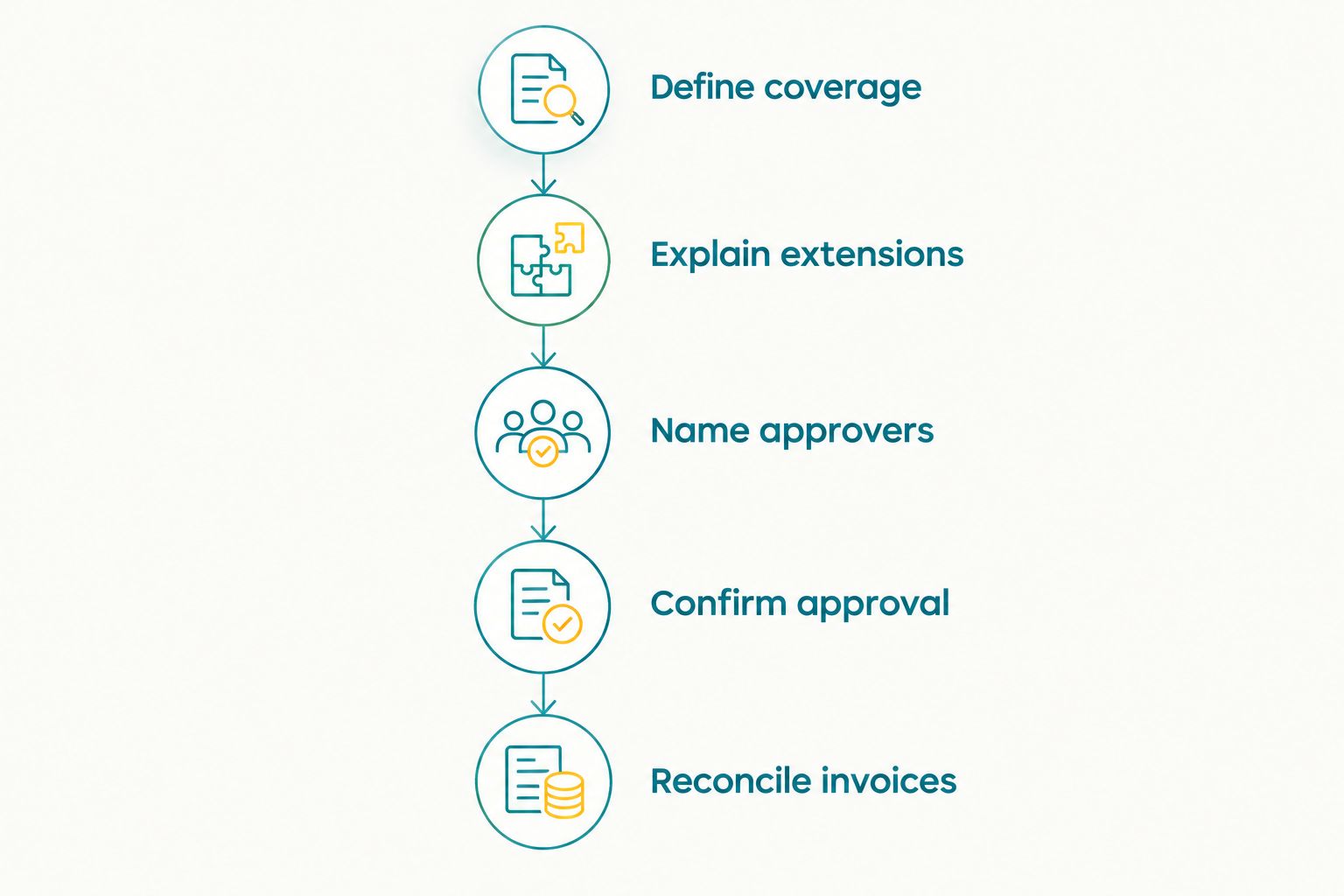
Get approval before extending coverage, then reconcile the invoice against that approval.
Which overtime billing method should you use?
Choose a method your team can explain and record accurately. The following are policy choices, not industry-standard requirements; put the selected approach into your 2026 booking documents rather than choosing it after the event.
| Method | Best for | Advantage | Limitation |
|---|---|---|---|
| Actual elapsed time | Studios keeping precise coverage records | Connects billing directly to recorded extra time | Requires an explicit measurement and rounding rule |
| Agreed time blocks | Studios wanting a simple extension decision | Makes the next coverage commitment clear | Clients need to understand how partial blocks are treated |
| Defined event endpoint | Clients requesting coverage of a specific remaining activity | Connects the extension to an identifiable moment | Needs a time boundary if that activity is delayed |
Choose the billing method before the wedding, not during the overrun. Whatever you select, explain what happens when the client requests a shorter extension than your usual billing unit.
Avoid mixing methods without explaining the change. If the contract uses time blocks, do not present an invoice based on a different interpretation simply because the event finished between blocks.
Actual elapsed time
Use actual elapsed time when your shoot lead can maintain a reliable start-and-finish record. Define the point at which extra coverage begins and how your studio handles any rounding.
The benefit is traceability. The trade-off is administrative discipline: an approximate departure time written down later is a weak basis for a precise invoice.
Agreed time blocks
Use agreed blocks when you want the client to approve a clear next period of coverage. Explain whether another block requires fresh approval and what happens if photography ends before the approved period does.
The benefit is a straightforward decision at the venue. The limitation is potential confusion about unused time, so explain that treatment before the booking is accepted.
Defined event endpoint
Use an event endpoint when the request concerns a specific remaining moment, such as a farewell or family portrait session. Pair the activity with an agreed coverage boundary rather than promising to stay indefinitely.
This approach keeps attention on the photographs the client wants. Its limitation is uncertainty: naming a ritual does not establish when that ritual will finish.
Why wedding photography overtime charges vary
Base your own overtime policy on the work you agree to provide. These factors define its scope; they are not a reason to introduce undisclosed additions after the wedding.
- Team coverage: Specify which photographers, assistants or other contracted team members remain for the extension.
- Remaining assignment: Distinguish coverage of a named ritual from continued coverage of the entire reception.
- Venue movement: State how a requested move between locations affects the agreed coverage window.
- Post-processing: Explain whether the extra material follows the existing editing scope or needs a separate agreement.
- Deliverables: Confirm whether the extension changes only shooting time or also changes promised outputs.
- Schedule changes: Record any agreed revision to the delivery schedule instead of assuming the original deadline automatically changes.
For your 2026 policy, separate the overtime decision from additional album, printing or editing requests. A client approving more time at the venue has not necessarily approved every later change to the project.
What should your overtime clause cover?
Build the clause around decisions your team must make, not a long list of warnings. Have an Indian legal professional review the wording for your business; the checklist below is an operational brief, not a ready-made legal clause.
Your coverage section should identify the booked functions and their start and finish boundaries. Your extension section should explain the billing method, approval authority, team scope, partial-period treatment and agreed payment process.
Then address exceptions. State how your studio handles delays, requested breaks, venue changes and an extension request that your team cannot accept. Avoid promising unlimited additional coverage merely because an overtime clause exists.
Keep quotation and contract wording aligned
A quotation that promises coverage until the celebrations end creates a different expectation from a contract with a fixed finish. Replace vague descriptions with the same coverage boundaries in both documents.
For 2026 bookings, check the proposal, contract and event brief together before sending them. Make sure a later schedule revision updates the working brief without silently changing the commercial agreement.
Separate studio delays from client requests
Do not treat every late finish as client-requested overtime. If your team starts late or needs to repeat work because of its own error, review the circumstances before adding anything to the invoice.
Record the reason for an overrun alongside the time. That creates a clearer basis for deciding whether the extension belongs on the client's bill or should be absorbed by your studio.
How do you discuss overtime during the wedding?
Keep the conversation factual and private. Tell the authorised person when contracted coverage ends, identify the important moments still outstanding and explain the available extension under the agreed terms.
Present a decision, not a threat. If the client declines, confirm the finish and help prioritise the remaining photographs within the booked window. Do not promise to capture everything when the schedule no longer supports it.
If someone asks you to continue while approval is pending, return to the named approver. Your shoot lead should know the studio's escalation process before arriving at the venue.
What if nobody responds?
Follow the communication and finish process established in the booking documents. Keep a record of your attempts to reach the approver, and do not treat silence as a new written approval.
Avoid resolving an unclear policy through an improvised argument with the family. Review ambiguous cases with the studio owner before issuing an invoice, then correct the policy for future assignments.
How should you record wedding photography overtime?
Keep the coverage agreement, event brief, approval message, actual finish and final invoice together. Your record should let someone who was not at the wedding understand why the additional work happened and who authorised it.
Fotoowl's Studio Manager is best for wedding photography studios that want quotations, contracts, schedules, invoices and payments in a photographer-focused CRM. It also manages projects, teams and deliverables, making it relevant to the administration surrounding an extended shoot.
The limitation is operational: software does not establish the client's authority or replace a clear agreement. You still need to explain the terms, obtain approval and enter accurate information. Do not assume an overtime timer or automatic calculation unless you have confirmed that capability.
Use Fotoowl's photography CRM to manage the booking administration, while your studio owns the overtime policy. Before adopting any workflow, check how you will retain approval messages and reconcile them with the final invoice.
Can I charge overtime when the wedding runs late?
Wedding photography overtime charges should follow the agreed coverage and extension terms, not the delay alone. Confirm the client's decision before continuing beyond the booked window; the cause of a delay and permission to extend are separate questions.
Should overtime include extra editing?
Extra editing should be addressed in your overtime terms rather than assumed to be included or excluded. Explain whether additional coverage follows the existing editing scope, and agree separately to changed outputs or deadlines.
Can a wedding planner approve extra coverage?
A wedding planner should approve extra coverage only when the contracting client has given that authority. Record the arrangement before the wedding so your shoot lead knows whose acceptance to request.
FAQ
How do I explain wedding photography overtime charges to a client?
Explain wedding photography overtime charges when you present the coverage window, not for the first time at the wedding. Show how extensions are measured, who can approve them and how extra coverage appears on the invoice.
Should I offer a grace period for a delayed wedding?
Offer a grace period only if you want it to be part of your studio's policy. Define its boundary and explain what happens after it ends; do not leave the team to invent a different allowance at each wedding.
Can a relative ask my photography team to stay longer?
A relative can request extra coverage, but your team should seek acceptance from the authorised approver. Record that person's authority before the event rather than assuming every family member can change the booking.
What should I put on an overtime invoice?
Identify the function, approved extra coverage, applicable billing method and team scope on the overtime invoice. Keep the original package and the extension distinguishable, and check the invoice against the approval record.
Should I keep photographing while the client decides?
Follow the process agreed in your booking documents while the client decides. Do not assume that continued shooting creates approval for additional charges; escalate the decision to your studio lead.
Can I refuse to extend wedding photography coverage?
Do not promise an extension your team cannot provide. Explain any availability or scheduling limits in advance and communicate clearly when an extension request cannot be accepted.
Does Fotoowl automatically calculate wedding photography overtime?
Do not assume Fotoowl automatically calculates wedding photography overtime. Studio Manager manages quotations, contracts, schedules, invoices and payments; confirm any specific calculation or time-recording requirement before relying on it.
One last thing
Record the missed moment, not just the extra time. When you raise an extension request, name the photographs still outstanding so the client understands the practical choice between finishing as booked and continuing coverage.
Before your next 2026 wedding, give the shoot lead a brief containing the finish boundary, authorised approver and escalation contact. A clear decision process belongs at the venue, not only in the studio's contract folder.