
How much does print fulfillment cost for event photo sales?

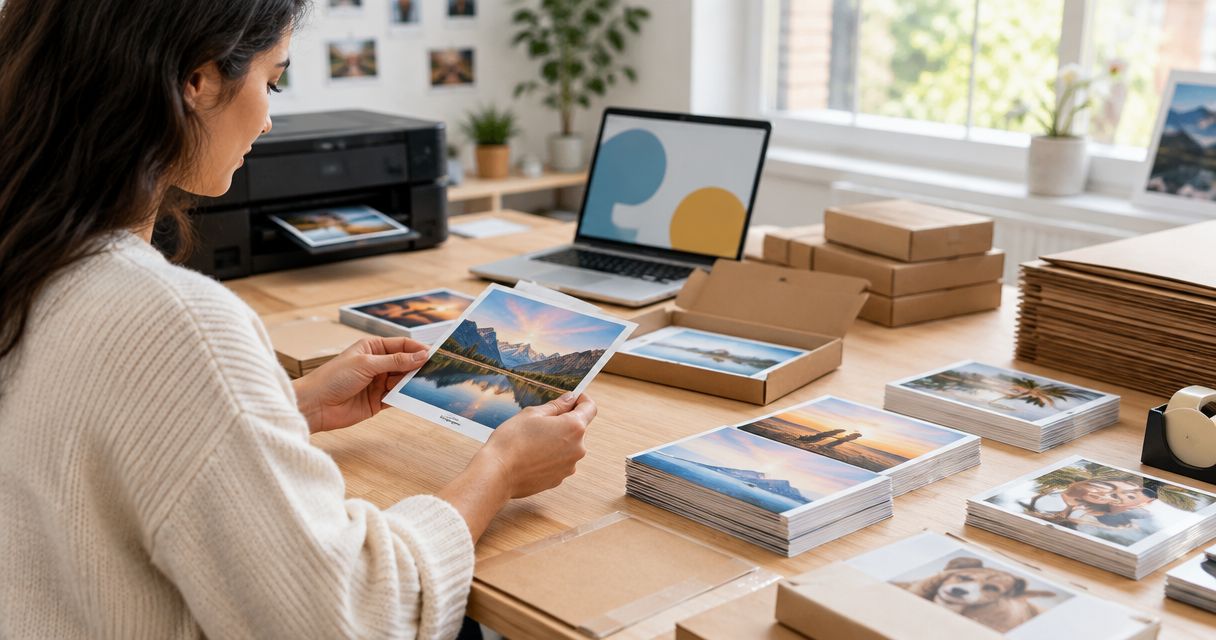
Print fulfillment cost for event photos is the total of lab production, packaging, delivery, applicable transaction charges, and your studio’s handling work—not just the print itself. For your 2026 budget, calculate the cost per completed order from a written lab quote and your actual workflow. Include replacement handling and applicable taxes before deciding what each sale contributes to your business.
TL;DR
- Print fulfillment cost event photos: calculate the complete order, not just the lab’s print charge.
- Compare lab-direct delivery with studio dispatch using identical print specifications and destination details.
- Fotoowl suits professional event photographers managing galleries; physical print fulfillment needs a separate lab assessment.
- Keep production, shipping, payment processing, and studio handling separate in your order worksheet.
Why this matters
A print sale creates work after the buyer chooses an image. Someone must confirm the file, check the crop, pass instructions to production, and resolve delivery problems. Your calculation needs to follow that whole journey.
For Indian wedding, school, and sports photographers, start by deciding whether orders go to individual households or a shared collection point. That decision changes the dispatch work you need to quote. Before comparing providers, map how to integrate a print lab with your event photo gallery so you know which handoffs need manual attention.
A production-only quote is not a complete fulfillment budget. Keep the buyer’s payment, your supplier’s invoice, and your studio’s remaining contribution separate.
How much does print fulfillment cost for event photo sales?
Your print fulfillment cost is the sum of the charges required to produce and complete that particular order. For a 2026 comparison, ask each provider to quote the same print specifications, quantity, packaging instructions, and delivery destination.
Use this breakdown rather than treating a lab’s headline print charge as the whole answer:
| Cost component | What to include | What to confirm |
|---|---|---|
| Print production | Ordered prints, paper, finish, and any mounting | Whether file preparation or correction is included |
| Packaging | Sleeves, backing, protective packaging, and dispatch materials | Whether packaging is included or billed separately |
| Delivery | Shipment to the buyer or your studio | Destination, parcel details, and responsibility for failed delivery |
| Transaction charges | Applicable payment and selling-platform deductions | Which charges apply to the order |
| Studio handling | File checks, order entry, communication, and dispatch work | Which tasks your team still performs |
| Exceptions | Reprints, address corrections, and replacement dispatches | Who pays when something goes wrong |
| Tax treatment | Applicable taxes shown on supplier and service invoices | Whether quoted amounts include tax |
Order fulfillment cost = production + packaging + delivery + applicable transaction charges + studio handling + exception costs. Treat taxes according to your accountant’s guidance; do not automatically count a recoverable tax as a permanent expense.
Keep fixed software overhead separate from variable order costs until you allocate it consistently. Otherwise, you risk counting the same expense twice or overlooking it entirely.
Choose the right denominator
Cost per print and cost per order answer different questions. Divide print-production expenditure by the number of prints to understand production. Divide the complete fulfillment expenditure by completed orders to understand what it takes to serve a buyer.
For mixed-size orders, retain the production breakdown by size rather than averaging everything together. A blended average hides which items and dispatch arrangements absorb your margin.
Lab-direct delivery: best for avoiding studio repacking
With lab-direct delivery, the lab sends the finished order to the buyer. The main operational benefit is that your studio does not need to receive and repack every parcel. The trade-off is that you do not physically inspect that parcel before it reaches the customer.
Best for: photographers who want the lab to handle physical dispatch and can establish clear production and support responsibilities.
Before choosing this route, confirm the delivery coverage, packaging, tracking handoff, and complaint process. Do not assume that a lab accepting an order means your gallery automatically transfers it there.
Ask who handles a rejected file or uncertain crop. Also establish whether production waits for approval or follows the submitted instructions. Those decisions affect both your workload and responsibility for an incorrect print.
Studio dispatch: best for checking orders before handover
With studio dispatch, you receive the prints, inspect them, and arrange collection or onward delivery. You control the final check and how you group orders. You also take responsibility for receiving, sorting, packing, and handing them over.
Best for: studios that need a physical quality check or must organise prints by family, class, team, or event booking.
Count both movements when the lab sends prints to your studio and your studio sends them onward. Include staff handling even when the work happens between editing assignments rather than during a dedicated dispatch shift.
For school or sports orders, establish who will distribute labelled packages at a shared collection point. Consolidating a shipment does not remove the sorting and handover work; it assigns that work somewhere else.
Compare fulfillment routes on the same basis
| Route | Best for | Main advantage | Main drawback | Budget check |
|---|---|---|---|---|
| Lab-direct delivery | Orders sent to individual buyers | Avoids studio receiving and repacking | No studio inspection before buyer delivery | Confirm packaging, dispatch, and exception handling |
| Studio dispatch | Orders requiring inspection or grouped handover | Gives your team a final physical check | Adds studio handling and possible onward shipping | Count receiving, sorting, packing, and handover |
Neither route wins on cost without a like-for-like quote. Compare the complete workflow rather than assuming fewer studio tasks always means a smaller supplier bill.
Why print fulfillment cost varies
The useful question is not whether a provider is inexpensive in isolation. It is whether its quote covers the exact order you intend to sell. Check these factors before accepting a 2026 fulfillment arrangement:
- Print specifications: Size, paper, finish, borders, and mounting define what the lab must produce. Compare matching specifications rather than similarly named options.
- Order composition: Record the quantity of each size and the number of separate buyer orders. Prints and parcels are different units of work.
- Delivery destination: Give the provider the actual destination details and ask for the applicable delivery terms. Do not extrapolate a local quote to every Indian PIN code.
- Packaging requirements: Confirm what protects the print and whether your chosen presentation needs additional materials or handling.
- Division of labour: Identify who checks files, confirms crops, enters orders, answers buyers, and follows up on dispatch.
- Exception responsibility: Establish how the provider treats production defects, transit damage, incorrect addresses, and photographer-supplied file errors.
Get these answers in writing. A quote is easier to compare when exclusions sit beside inclusions, not in a separate conversation your team must remember later.
How do you calculate your own fulfillment cost?
Build your 2026 worksheet around an actual order specification. You need supplier charges and a record of your studio’s work, not an assumed industry average.
Define the order
Write down the file reference, print size, quantity, paper, finish, delivery destination, and handover method. Keep the specification unchanged when requesting competing quotes.
Common dimensions such as 4 × 6 inches, 5 × 7 inches, and 8 × 10 inches describe different print formats. They do not describe identical crops. Check the selected image against the ordered proportions before approving production.
Collect the quote
Request an itemised response covering production, packaging, dispatch, applicable taxes, and exclusions. Ask whether the quote depends on a minimum order or a particular grouping of prints.
Keep the quote’s date and scope with your worksheet. A previous event’s invoice is useful history, but it does not establish the terms of a new job.
Assign responsibilities
Name the person responsible for file checking, crop approval, order submission, dispatch follow-up, and buyer support. If your studio performs a task, record it rather than treating it as invisible work.
This also exposes gaps. An order should not sit unprocessed because the photographer expects the lab to confirm the crop while the lab expects an approved file.
Check the margin
Subtract the complete order cost from the corresponding sales revenue on a consistent tax basis. Keep any broader business overhead allocation visible rather than mixing it into unrelated supplier charges.
Do not label the remainder as final business profit if shooting, editing, equipment, and other operating expenses still need to be covered. It is an order-level contribution, not your studio’s complete financial result.
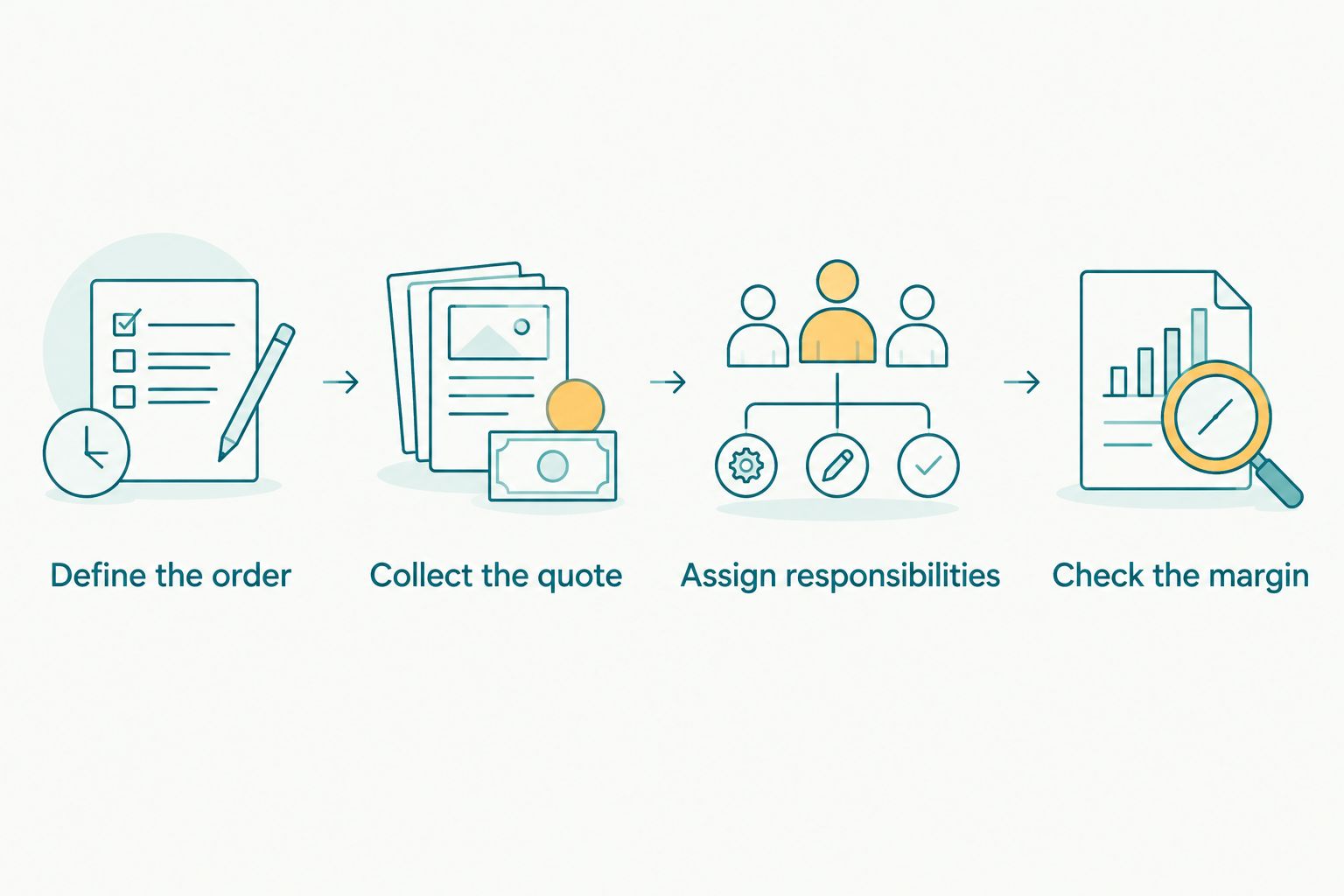
Calculate the complete workflow before treating a print sale as profitable.
Does a photo gallery subscription cover printing and delivery?
A photo gallery subscription is not evidence that physical printing and delivery are included. Confirm each service explicitly before promising a buyer an end-to-end print order.
Fotoowl is best for professional wedding and event photographers who need face-recognition galleries. Its AI Gallery supports photo and video delivery. That digital-delivery role is distinct from the lab production and shipping calculation in this guide.
The benefit is a gallery workflow built for professional event photography; the limitation for this decision is that gallery functionality alone does not establish print-lab terms. Assess Fotoowl against your gallery needs, then assess the physical fulfillment arrangement against your order specification.
Keep Fotoowl’s software role separate from any lab responsibilities you agree. Confirm order transfer, payment handling, production approval, and buyer support individually instead of assuming an automatic connection.
Is bulk delivery cheaper than individual shipping?
Bulk delivery is not automatically cheaper overall. It changes the shipment structure, while sorting and final distribution still need an owner.
Compare a shared delivery destination with separate household dispatches using the same underlying print orders. Include the work required to label, organise, and hand over each buyer’s package before choosing the shared route.
Who pays when an event print needs replacing?
The agreed terms determine who pays for a replacement. Separate production defects, transit damage, incorrect order details, and supplied-file errors because they have different causes.
Before taking orders, document the evidence needed for a complaint and who authorises a reprint. Tell buyers how to report a problem without promising a supplier policy you have not confirmed.
FAQ
How much should I budget for event photo print fulfillment in 2026?
Budget from an itemised lab quote plus your studio’s handling work. Include production, packaging, delivery, applicable transaction charges, and the agreed treatment of exceptions rather than using the print charge alone.
Is print fulfillment cost the same as the lab’s print charge?
No. The lab’s print charge covers production as specified, while the complete order calculation also needs any packaging, delivery, transaction charges, and studio work that apply.
Should I measure fulfillment cost per print or per order?
Use cost per order to assess the complete buyer transaction and cost per print to examine production. Keep size-specific production charges visible when an order contains different print formats.
Is lab-direct delivery better than sending prints from my studio?
Lab-direct delivery is best for avoiding studio receiving and repacking; studio dispatch is best for a physical check before handover. Compare matching quotes and account for the work your team retains under each route.
Does a gallery automatically send paid orders to a print lab?
Do not assume that a gallery automatically transfers paid orders to a lab. Confirm the connection, supported order details, approval process, and responsibility for failed transfers before relying on it.
Should I include staff time in print fulfillment costs?
Yes, include the studio work required to complete the order. Record file checks, crop confirmation, order entry, packing, dispatch coordination, and buyer support wherever your team performs them.
How do I handle GST when comparing print fulfillment quotes in India?
Ask whether each quote includes GST and request the relevant invoice details. Have your accountant confirm the treatment for your business, including whether any input tax credit applies, before calculating margin.
One last thing
Approve the crop, not just the image. A photograph selected from a gallery still needs to fit the proportions of the ordered print. Check faces, hands, text, and important details near the edges before submitting it.
Make that check part of your 2026 order approval process. A clean handoff tells the lab exactly what to produce and gives your team a clear record when reviewing a complaint.