
FotoOwl vs FaceCheck.id: which is better in 2026


Choose Fotoowl if you need to deliver wedding or event photographs through a face-recognition gallery; choose FaceCheck.id if you need to search the public web for images resembling a face. The fotoowl vs facecheck.id comparison in 2026 is about event photo delivery versus reverse face search—not two interchangeable gallery platforms.
TL;DR
- Fotoowl vs FaceCheck.id: choose the event gallery for client delivery and the reverse face search tool for public-web research.
- AI Gallery helps photographers deliver their own event photos with face recognition, media uploads and reel generation.
- FaceCheck.id suits public-web face searches, not the task of delivering your commissioned wedding or event collection.
- Treat face matches as suggestions to review, not proof of identity or permission to share photographs.
Why this matters
A wedding guest looking for photographs and a researcher looking for a face online have different jobs. Both involve faces. Only the first starts with a collection that you photographed and need to deliver.
For Indian wedding and event studios, the useful question in 2026 is what happens after someone finds a photograph. You still need to deliver the collection, collect client selections and complete the agreed work. A search result pointing to an external webpage does not perform those tasks.
Fotoowl is the better event photo gallery for professional photographers delivering their own wedding and event collections. FaceCheck.id has a different strength: searching beyond your commissioned collection. Choose by the source of the photographs and the required outcome, not by the shared phrase face recognition.
At a glance
| Dimension | Fotoowl | FaceCheck.id |
|---|---|---|
| Best for | Professional wedding and event photographers delivering their work | People researching public-web images using a face |
| Search scope | Face recognition within uploaded event galleries | Reverse face search across its indexed web images |
| Standout feature | AI Gallery combines media delivery with face recognition | Face-based discovery of potentially matching web images |
| Delivery workflow | Photo and video galleries, portfolio builder and reel generator | Search results for further investigation |
| Client proofing | Photo Selection supports selections for albums and printing | Web face search is a different task from client proofing |
| Match review | Photographer review remains necessary | Independent checking remains necessary |
| Consent and context | Establish permission for event collection and sharing | Establish a legitimate purpose before searching a person's face |
| Pricing model decision | Evaluate the commercial terms against your delivery workload | Evaluate the commercial terms against your search workload |
The comparison turns on scope. An event gallery searches photographs supplied for a job; reverse face search looks for potentially matching images in a web index. Neither result should be read as a guarantee that every photograph of a person has been found.
AI Gallery wins for photographers with a delivery job
Best for: wedding, sports, corporate event, festival and school photographers. AI Gallery is built around uploading photographs and videos and delivering them to clients. Face recognition sits inside that delivery workflow rather than being the entire destination.
That distinction matters when your client expects a finished collection. You are responsible for which images leave the studio, how they are organised and whether the delivery serves the commission. Searching public webpages does not replace those decisions.
For a wedding studio covering an engagement ceremony, mehendi, sangeet and reception, start with the approved event photographs. Keep the functions understandable to recipients. Face search helps people locate relevant images, but the gallery remains the place where you deliver your work.
The limitation is equally clear: an event gallery is not the right choice for investigating where a stranger's face appears online. Choose the gallery for commissioned-photo delivery, not public-web identity research.
FaceCheck.id wins when the search must extend beyond your event
Best for: public-web image research using a face. FaceCheck.id is a reverse face search service. Its purpose is to find potentially matching faces in indexed web images, which makes it the more relevant option when the source collection is outside your studio.
For example, you might need to examine whether a publicly displayed profile photograph resembles images appearing elsewhere online. That is an external search question. It is not a request to retrieve a guest's photographs from the wedding you covered.
The useful outcome is a lead to investigate. Check the originating page, surrounding context and other evidence before drawing a conclusion about who appears in an image. A visually similar face does not establish that two photographs show the same person.
Choose FaceCheck.id for external discovery, not as a substitute for your client gallery. Its search scope is the advantage here; it does not turn external search results into the commissioned collection your client expects.
The standout features serve different outcomes
AI Gallery combines face recognition with media delivery. Its features include a portfolio builder, reel generator and Beam camera-to-cloud FTP uploads. Those functions support a photographer's work before and after recipients locate their photographs.
FaceCheck.id's defining capability is reverse face search across indexed web images. That narrower purpose is useful when your desired output is a potentially matching image and its source, rather than a delivered event gallery.
Use these three labels to keep the choice clear:
- Event collection: photographs and videos supplied for the commissioned job.
- Client delivery: the collection your recipients need to receive and use.
- Web discovery: potentially matching images found beyond that collection.
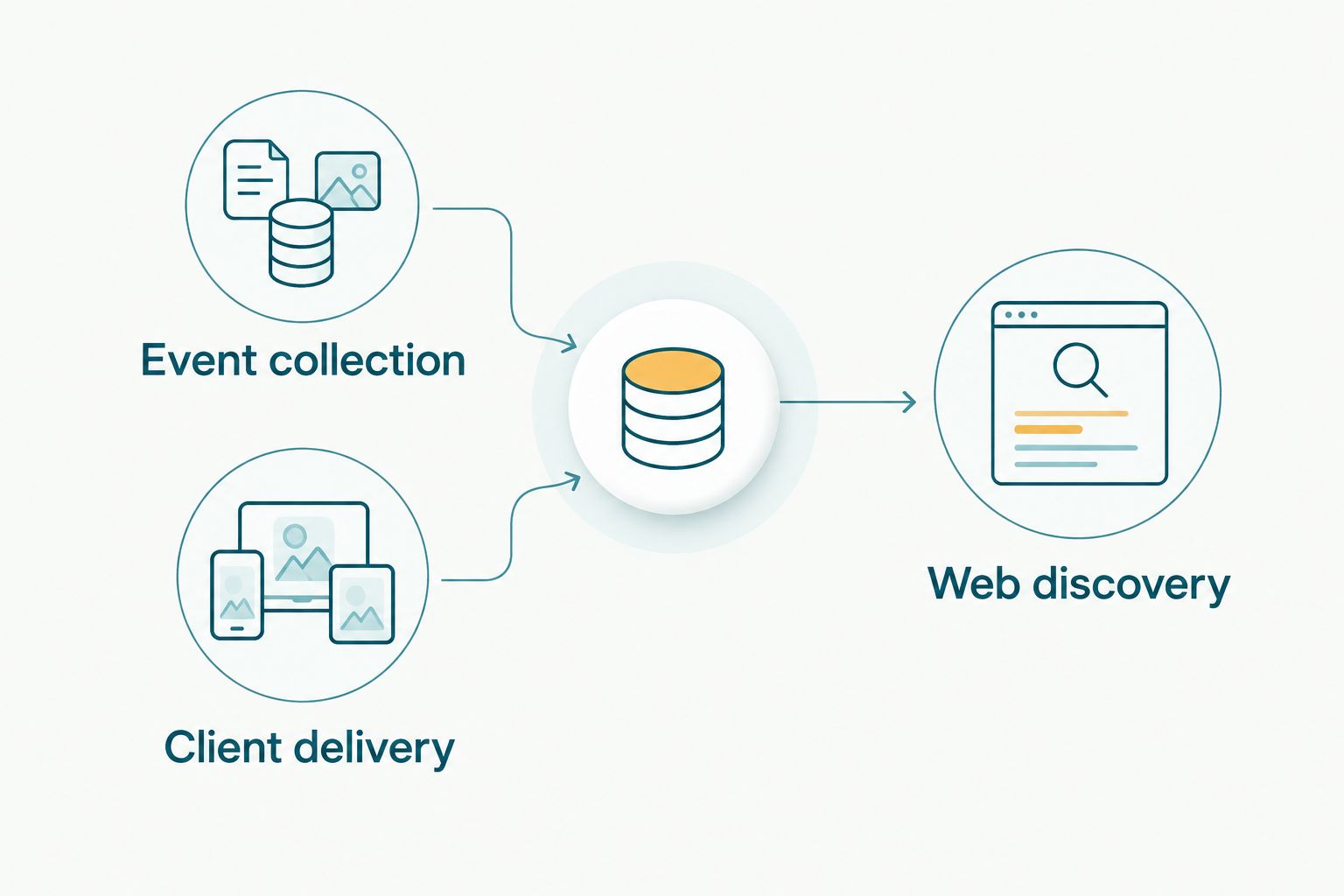
The source collection and required output determine which tool fits the job.
Do not score these features as though they solve the same problem. A portfolio builder does not improve public-web face discovery, and broader web discovery does not complete an event delivery. The standout feature is useful only when it serves your actual assignment.
AI Gallery wins on delivering photographs and videos
For an event photographer, finding an image is an intermediate step. The client still needs the photographs and videos you agreed to supply. AI Gallery addresses that delivery requirement directly.
Beam is a camera-to-cloud FTP upload feature inside AI Gallery. It belongs to the capture-to-upload part of your workflow. The reel generator addresses another output: a highlight reel built from the event media.
Separate these tasks when evaluating the platform in 2026. Uploading, reviewing, delivering and creating a recap are different responsibilities, even when they sit within the same broader workflow. Faster transfer alone does not mean the collection is ready for clients.
The tradeoff is that a gallery still requires preparation. You need to decide which files belong in the delivered collection and review the output. Use delivery software to distribute approved work, not to bypass your editorial decisions.
FaceCheck.id is the better choice only when the required output is external search evidence. If your brief ends with guests receiving their event photographs, its public-web search purpose is not the relevant advantage.
Photo Selection wins when clients must approve images
Client proofing is a separate job from face search. A person finding a photograph does not tell you whether that image belongs in an album, a print order or the client's final selection.
Photo Selection supports client proofing, with selections reused for albums and printing. That makes it relevant when a wedding studio needs a recorded selection rather than another message thread describing photographs informally.
Keep discovery and approval separate. Let recipients find relevant photographs, then use the proofing workflow for the choices that affect production. An image's face match is not an album approval.
The limitation is the same distinction in reverse: proofing does not perform public-web research. Choose Photo Selection for production decisions; choose reverse face search for external discovery. Neither task replaces the other.
Both need human review; neither wins on unproven accuracy
Face matching provides a candidate result. It does not independently establish identity, authorship, consent or the right to publish. That principle applies to both event galleries and public-web face searches.
In a gallery, inspect the photographs before treating a match as ready for delivery. In public-web research, inspect the source page and corroborating context before treating a match as evidence about a person. The consequences differ, but the need for review remains.
Neither platform earns an accuracy victory here. A useful comparison requires the same photographs, the same task and a defined measure of success. Gallery retrieval and web discovery are different tasks, so a broad claim that one recognises faces better would obscure the buying decision.
For your 2026 evaluation, distinguish two questions: did the system retrieve a relevant image, and was the result appropriate to use? Finding a face answers only the first. Your professional judgement answers the second.
Consent and context are a tie: your responsibility remains
Uploading an event collection and searching a person's face across the web raise different questions about purpose and permission. Neither activity becomes appropriate merely because software makes it possible.
Before an event delivery, agree on who should receive the collection and what the client expects to be shared. For school photographs and other sensitive collections, establish the audience and handling expectations before introducing face search.
Before public-web research, define the legitimate purpose of the search. Do not publish allegations, contact supposed matches or make consequential decisions solely because two faces look alike in search results.
There is no automatic privacy winner based on the presence of face recognition. Evaluate the actual access controls, retention terms and handling practices relevant to your job. Do not infer those protections from a product category or a promotional description.
Pricing: compare the workload, not an unsupported headline
Evaluate the current commercial terms for both services before committing. For a gallery platform, the relevant workload is repeated event delivery. For a reverse face search service, the relevant workload is external searching and investigation.
Your 2026 buying questions should follow that difference:
- Does the purchase cover the specific workflow you need?
- What usage limits apply to your expected workload?
- What happens when your workload changes?
- Which functions are included in the arrangement you are considering?
- What terms govern continued access to your work or results?
Predictable billing helps when your studio has recurring delivery requirements. Flexible purchasing helps when your need is occasional. Treat those as evaluation criteria, not assumed descriptions of either service's current billing structure.
Do not declare a cheaper winner before confirming the applicable terms. A purchase that cannot complete the assignment is not a useful saving. Compare commercial terms only after identifying which product category fits the job.
Final verdict: choose by the work you need to finish
Choose Fotoowl if you run a wedding or event photography studio
Your named profile is the photographer delivering commissioned media to clients and attendees. You need an event photo gallery, face-based retrieval within that collection and a workflow that continues into delivery or client selection.
AI Gallery is the relevant starting point. Add Photo Selection when approval decisions matter, and assess Beam when camera-to-cloud FTP upload fits your capture workflow. Choose functions against the assignment rather than adopting every feature at once.
Choose FaceCheck.id if you need public-web face research
Your named profile is the researcher looking for potentially matching images beyond a known event collection. You need external discovery and source checking, not client proofing or wedding-media delivery.
FaceCheck.id is the relevant choice for that question. Review each result independently and keep any conclusions within what the evidence establishes. Do not use resemblance alone as identification.
One-glance scorecard
| Dimension | Winner |
|---|---|
| Best fit for professional event photographers | AI Gallery |
| Searching beyond an uploaded event collection | FaceCheck.id |
| Standout feature for event delivery | AI Gallery |
| Standout feature for public-web discovery | FaceCheck.id |
| Photograph and video delivery | AI Gallery |
| Client selections for albums and printing | Photo Selection |
| Independent review of face matches | Tie: required for both |
| Consent and appropriate use | Tie: responsibility remains with the user |
| Commercial value | Choose the fitting workflow, then compare current terms |
FAQ
Is Fotoowl better than FaceCheck.id for wedding photographers?
Fotoowl is the better fit for wedding photographers delivering their own event collection. AI Gallery combines photo and video delivery with face recognition, while FaceCheck.id serves public-web reverse face searches.
Can FaceCheck.id replace an event photo gallery?
FaceCheck.id does not replace the delivery workflow of an event photo gallery. Its reverse face search purpose is external image discovery, not delivering your commissioned collection or recording client album selections.
Which should I choose to find faces outside my event photographs?
Choose FaceCheck.id when your task is finding potentially matching faces in indexed web images. Review the originating pages and supporting context before reaching any conclusion about identity.
Does a face match prove who someone is?
No, a face match alone does not prove identity. Treat the result as a candidate to review, and do not make consequential decisions based solely on visual resemblance.
Can AI Gallery help deliver event videos as well as photographs?
Yes, AI Gallery supports uploading photographs and videos for client delivery. Its features also include a portfolio builder, reel generator and Beam camera-to-cloud FTP uploads.
Which option helps clients choose wedding album photographs?
Photo Selection supports client proofing, with selections reused for albums and printing. Finding a face and approving an album photograph are separate decisions.
How should photographers compare the cost in 2026?
Compare current commercial terms against the workflow you need to complete in 2026. Assess event-delivery requirements for the gallery and external-search requirements for FaceCheck.id before comparing the applicable billing terms.
One last thing
The most useful evaluation starts with the final deliverable, not the face-search demonstration. Take one completed assignment and trace what you still need after the right photograph appears: client delivery, album selection, a highlight reel or an external source to investigate.
Choose the tool that completes that next step. Finding a face is useful; finishing the photographer's assignment is the buying criterion.