
How long does it take to deliver event photos to clients?


There is no fixed time to deliver event photos to clients. The answer is the deadline you agree with the client for the final, edited set; a preview or live gallery is a separate deliverable. In 2026, put both deadlines in writing before the event so an early selection is never mistaken for the finished job.
TL;DR
- How long does it take to deliver event photos to clients? Until the agreed deadline for the final edited set.
- A preview gallery does not replace final delivery; define each deliverable and its deadline separately.
- Fotoowl AI Gallery suits event photographers who need client galleries with face recognition, but editing still needs a review step.
- Confirm who approves the photos before you promise a release date.
Why this matters
Your client might mean selected highlights, every edited image, or photos ready for attendees to find. Those requests create different workloads. If your contract says only “photos delivered,” you have left the most useful part of the deadline undefined.
A wedding client waiting for the finished set and a corporate organiser waiting for event highlights can both ask for photos quickly. Your response should name the deliverable, its reviewer and its release deadline. The event photo culling workflow is a useful starting point when selection is holding up delivery.
How long does it take to deliver event photos to clients?
Deliver the final edited set by the deadline in your agreement. There is no single turnaround that applies to weddings, sports events, conferences and school shoots. In 2026, give each client a deadline tied to a clearly named deliverable, rather than offering an unqualified promise to send the photos quickly.
| Deliverable | What the client receives | What must happen before release | Best for | Limitation |
|---|---|---|---|---|
| Selected preview | A limited set of reviewed images | Initial selection and any agreed edits | Clients who need an early look | It is not the complete final set |
| Event gallery | Images made available through a gallery | Selection, gallery preparation and any required approval | Events where clients or attendees need to find their photos | A gallery is only as complete as the images released to it |
| Final edited set | The images covered by the agreed delivery scope | Culling, editing, review and delivery checks | The client’s finished handover | It takes longer than releasing a small selection because more work must be completed |
Use this sequence to set a deadline you can defend:
- Confirm scope. Record which events, functions or sessions you are covering, which images are included, and whether video is a separate deliverable.
- Cull frames. Remove duplicates and weak images before estimating the remaining editing work. If you use an automated first pass, retain a human review before export.
- Review selects. Check the images that represent the event and identify any approval the client must provide before publication.
- Prepare the gallery. Organise the approved images for the people who need access. Keep an early selection distinct from the final set.
- Release files. Check the agreed deliverable, recipient and access method before you tell the client it is complete.
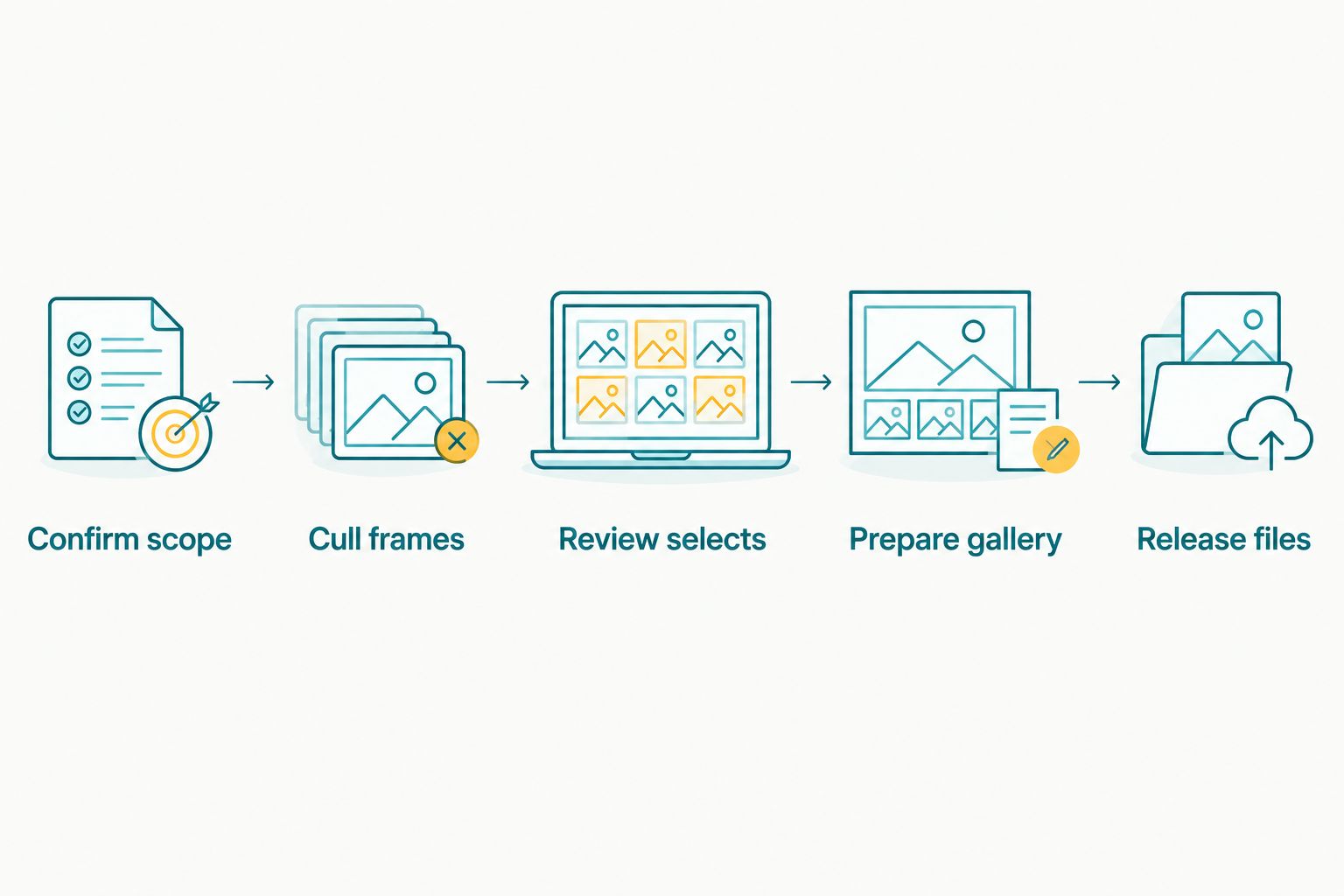
A delivery deadline must account for the review and release steps, not just the shoot.
The sequence is a planning tool, not a claim that every event takes the same amount of time. For a 2026 booking, work backwards from the deadline only after you know the coverage scope and who has to sign off. If the client asks for an earlier release, agree which images will be ready then and which remain part of final delivery.
What counts as delivery?
Delivery happens when the client can access the agreed photos in the agreed form. Uploading files to your workspace is not the same as telling the client where the approved set is. Sending a preview is not the same as completing an album selection or handing over all edited images in scope.
Write the deliverable in terms a client can recognise: selected highlights, a client gallery, an approved image set, or another clearly identified handover. Then state who receives it and whether the deadline depends on a client selection or approval. This keeps your 2026 schedule tied to work you can track rather than to an ambiguous message saying the photos are almost ready.
For multi-function Indian weddings, identify each covered function when you define the handover. A selection from one function should not be described as delivery of the entire wedding. The same principle applies to a corporate event with separate sessions or a sports event with different teams: name what is included each time you release a set.
Why event photo delivery time varies
These are the factors to settle before you commit to a 2026 delivery date:
- Coverage scope. More functions, sessions or locations create more images to assess and organise. Confirm what your team is expected to deliver, not just what it will photograph.
- Culling and editing. Removing duplicates and weak frames is different from finishing the selected images. A tool-assisted first pass does not remove the need to check the result.
- Client selections. If the client chooses images for albums or printing, their selection is a separate step. Say whether the final handover waits for that choice.
- Approvals. Corporate organisers and other event clients might need to review images before wider release. Identify the approver and the point at which approval is required.
- Gallery organisation. A searchable attendee gallery and a small set sent to one client have different preparation needs. Decide how people will find the right images.
- Upload method and connection. Camera-to-cloud transfer can move files earlier in the workflow, but it does not finish culling, editing or approval. Plan the release around the full process.
The delivery deadline is a workflow commitment, not a camera-upload promise. You can move files during an event and still owe the client a later reviewed set. Treat those as distinct stages in every 2026 proposal.
Should you send previews before the final gallery?
Send previews when the client has a specific use for an early selection and you have agreed what that selection includes. Mark it as a preview in the delivery message. State that the final edited set will follow under its own deadline.
This approach helps when an event organiser needs approved highlights while your team continues work on the wider collection. It also protects your edit: you do not have to present unreviewed frames as finished photographs merely because files are available. The drawback is that a preview creates another handover to select, review and explain. Include that work when you set the schedule.
If you offer an event gallery, decide whether the first release is a partial gallery or the completed deliverable. The client should not have to infer completeness from the number of images they see. Say what has been published and what remains outstanding.
Where Fotoowl fits in the delivery workflow
Fotoowl AI Gallery is best for event photographers who need to deliver client galleries with face recognition; it does not replace their final image review. Photographers can upload photos and videos and use the gallery for client delivery. That makes it relevant after you have decided which images are ready to release.
The platform also has distinct tools for other stages. AI Culling is an offline desktop application that rejects duplicate and weak frames, groups similar images and ranks them for a second human pass before export. Photo Selection handles client proofing, including selections reused for albums and printing. Beam supports camera-to-cloud FTP uploads within AI Gallery. None of these steps, on its own, establishes when a client’s final edited set is complete.
For a 2026 event, choose the part of Fotoowl that matches the bottleneck. If images are piling up before editing, focus on culling and review. If approved photos are ready but difficult to distribute, focus on gallery delivery. The limitation is clear: even with upload and gallery tools, you still need to set the scope, finish the edit and communicate the deadline.
How do you write a delivery deadline into a client agreement?
Name the deliverable first, then the deadline and any required client action. Keep preview delivery, final photo delivery and album or print selections separate. If approval affects release, state who provides it and whether the deadline is measured before or after that approval.
Avoid a sentence that promises “all photos” without defining what “all” means. The finished set can differ from every frame captured at the event. Your agreement should tell the client what selection and editing they are buying, while your handover message should identify what you have actually delivered. In 2026, use the same terms in both places.
Can you deliver event photos during the event?
Yes, you can release selected photos during an event if you have a workflow to transfer, review and approve them. That is a live or partial release, not automatic completion of the final edited set. Tell the client which images are available now and what follows later.
Do not equate camera-to-cloud upload with publication. A transferred frame still needs a decision about whether it belongs in the client-facing selection. This distinction matters when an attendee gallery is visible while coverage is still under way.
When is a gallery ready to share with attendees?
Share an attendee gallery when the images intended for that release have been reviewed and the right people have the agreed access. If more photos will be added, describe the gallery as a partial release. If approval is required, get it before inviting attendees.
A wedding gallery can serve a different audience from a corporate event gallery or a school photo collection. Define the recipient and release scope instead of treating a working upload folder as the final handover. That decision gives you a clear answer when someone asks whether delivery is complete.
FAQ
How long does it take to deliver event photos to clients?
The final set is due by the deadline agreed with the client; there is no universal turnaround. Set a separate deadline if you also promise previews or a live gallery.
Does sending a preview count as delivering the event photos?
No, a preview counts only as delivery of the agreed preview. The final edited set remains due under its own deadline unless the agreement says otherwise.
Can I upload event photos before I finish editing them?
Yes, uploading and final delivery are separate steps. Review and approve the images before presenting them as the finished client set.
Should wedding photos and corporate event photos have the same deadline?
No, set a deadline for each job’s agreed scope and approval process. A multi-function wedding and an event needing approved highlights can involve different deliverables.
What delays final event photo delivery?
Culling, editing, client selections, approvals and gallery preparation can all affect the deadline. Identify the required steps before you commit to a date.
Does camera-to-cloud upload mean clients receive finished photos immediately?
No, camera-to-cloud upload moves files into the workflow; it does not complete selection, editing or approval. Describe any early release as a preview unless it meets the agreed final scope.
How do I tell a client that a gallery is not complete yet?
Call it a partial gallery and specify which images or event sections are included. Tell the client that the remaining agreed photos will follow by the final deadline.
One last thing
Before you promise a faster turnaround, ask whether the client actually needs finished photos or a small approved selection for immediate use. That answer changes the deliverable, the review workload and the deadline you should put in writing. In 2026, the clearest delivery promise is the one that names all three.