
Photo Gallery for Temple Festival Photographers (2026)

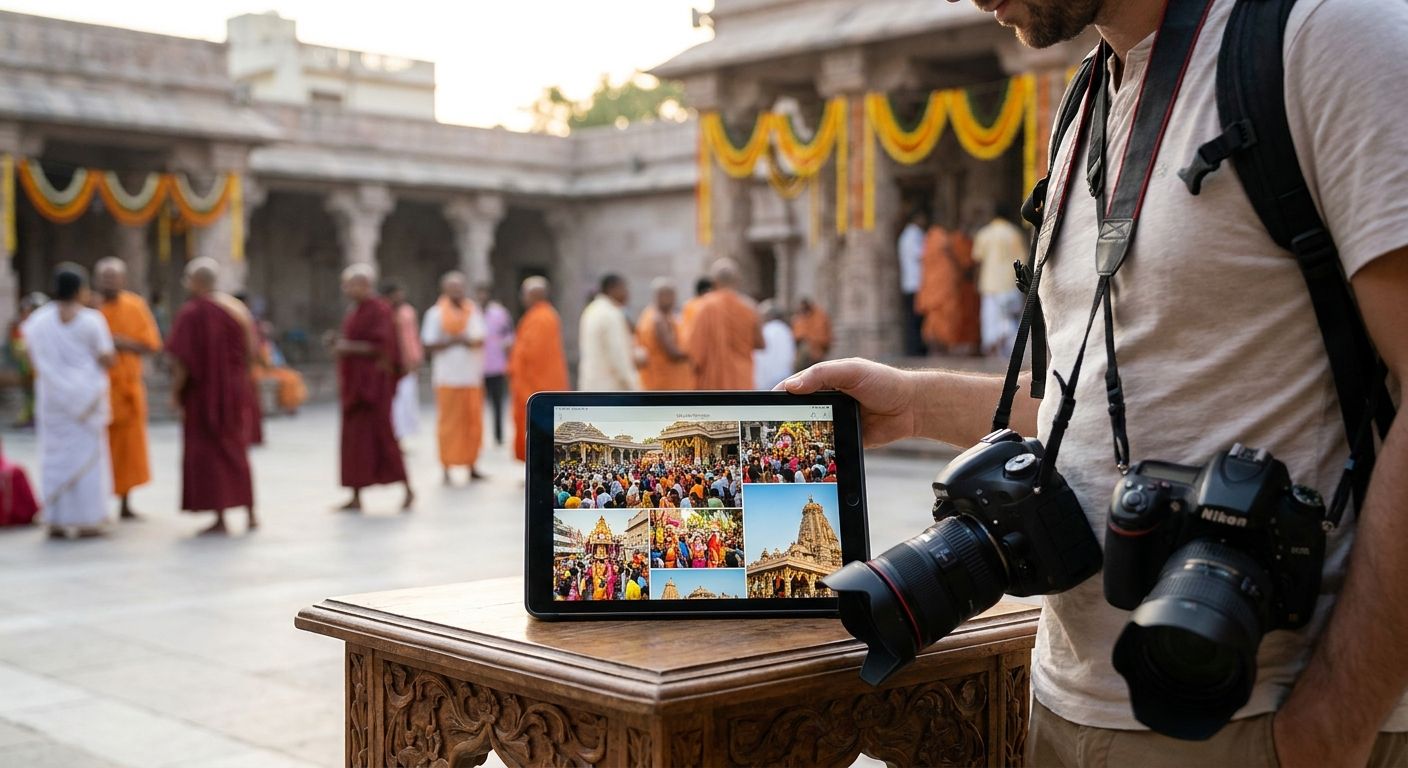
Temple and religious festival photography breaks every rule that normal event photo software is built around: no reliable Wi-Fi, crowds in the tens of thousands, and clients who want their darshan photo on WhatsApp before they've left the queue. A gallery built for weddings or corporate headshots will choke on that in 2026.
TL;DR
- An AI photo gallery for temple festival photographers needs offline-first upload and face recognition search to work at scale — generic gallery tools do not. Buy purpose-built, skip the rest.
- Foto Owl's face search and Beam upload handle low-connectivity temple grounds where normal cloud sync fails.
- QR-code distribution at temple gates beats app downloads for pilgrims who won't install anything new mid-festival.
- Multi-day festivals need multi-photographer gallery coordination, not a single shared folder — that setup breaks past day two.
Why this matters
A wedding gallery serves 150 guests over one evening with venue Wi-Fi. A temple festival gallery serves 5,000 to 50,000 pilgrims over several days, in a location where cell towers get overloaded by noon. The 2025 Maha Kumbh Mela in Prayagraj drew an estimated 660 million visitor-attendances over 45 days according to Uttar Pradesh government figures — an extreme case, but every regional temple festival photographer deals with a smaller version of the same crowd-and-connectivity problem every season.
The software that works for a 200-person birthday shoot does not survive that math. Upload queues stall, face search timeouts pile up, and by the time photos are ready the pilgrims have already left town.
Who this is for
This guide is for photographers and photo teams shooting temple festivals, religious processions, mela crowds, and multi-day devotional gatherings — anywhere the client base is thousands of pilgrims rather than a guest list. If you're currently emailing Google Drive links or texting individual photos one at a time, you're leaving money and reputation on the table. An AI photo gallery for temple festival photographers needs to survive patchy 4G, sort tens of thousands of faces automatically, and let pilgrims grab their own photo without downloading an app.
What to look for in a gallery for temple and religious festival photographers
Face recognition search at real scale
With thousands of faces in a single festival gallery, manual tagging is not an option. Face recognition search lets a pilgrim upload a selfie and pull their own photos from a shared pool in seconds, cutting the retrieval work down from hours of scrolling to one search.
Offline-first capture and delayed sync
Temple grounds and rural festival sites routinely lose signal during peak crowd hours. A gallery that only works with a live connection means lost shoots and delayed delivery — capture needs to work offline and sync automatically once signal returns.
WhatsApp and no-download delivery
Most pilgrims will not install a new app for a one-time event. Delivery through WhatsApp or a simple web link removes that friction entirely and gets photos in front of people while they're still on-site.
QR-code distribution at gates and processions
A QR code posted at the temple gate or along the procession route lets thousands of people self-serve into the gallery without a single staff interaction — critical when your team is three photographers and the crowd is 20,000 people.
Multi-day, multi-photographer coordination
Most temple festivals run 3 to 10 days, sometimes longer, with multiple photographers rotating shifts. The gallery needs to merge everyone's uploads into one searchable pool without duplicate chaos by day three.
See the platform built for crowd events
Face search, offline upload, and WhatsApp delivery in one gallery.
Top picks for temple festival photo delivery
Face recognition guest search — the crowd solver. With one selfie upload, a pilgrim searches a gallery of 10,000+ photos and gets only their own matches back in seconds. This is the single feature that turns an unmanageable crowd into a self-service operation. Buy.
Offline-first upload and sync — the temple-ground reality check. Photos captured with no signal queue locally and sync the moment a connection appears, instead of failing silently. Any festival site without dependable 4G needs this, and most do. Buy.
WhatsApp and Beam delivery — the phone-first handoff. Pilgrims get their photos through a link or chat thread they already use, with zero app install. It costs a little more in bandwidth per send than a batch upload, but conversion to actual photo pickup is far higher. Consider.
QR-code photo booths at temple gates — the crowd-control workhorse. A single QR code sharing setup at the entrance replaces a manned photo desk and scales to any crowd size without adding staff. It needs a stable printed sign and decent lighting to scan reliably. Consider.
Multi-day gallery with photographer coordination — the season-long backbone. Multiple photographers upload into one merged, deduplicated pool across a 5-to-10-day festival instead of five separate folders nobody wants to sort later. Buy.
What to avoid
- Generic wedding gallery tools — built for a 150-guest list with stable venue Wi-Fi, they buckle under a 10,000-person crowd and no signal.
- App-only delivery — pilgrims will not install a new app for a one-day visit, and forcing it kills your pickup rate.
- Manual tagging workflows — sorting thousands of faces by hand is a multi-week job that misses the window when people actually want their photos.
If your gallery needs a data connection to open, it doesn't work at a temple festival.
Verdict comparison table
| Criteria | Why it matters at temple scale | Verdict |
|---|---|---|
| Face recognition search | Turns 10,000+ photo pools into instant self-service | Buy |
| Offline-first upload | Signal drops are routine at festival grounds | Buy |
| WhatsApp/no-app delivery | Pilgrims won't install apps for a one-day event | Consider |
| QR-code distribution | Replaces staffed photo desks at scale | Consider |
| Multi-photographer merge | Multi-day festivals need one unified gallery | Buy |
FAQ
What's the best photo gallery for temple festival photographers in 2026?
A gallery built around offline-first upload, face recognition search, and no-app delivery is the best fit for temple festival photographers in 2026, since generic wedding or corporate tools fail under crowd size and weak signal.
Is face recognition search accurate enough for a crowd of thousands?
Face recognition search built for event crowds is designed to match a single selfie against thousands of photos in seconds, which is the scale temple festivals require. Accuracy depends on photo lighting and crowd density but works far faster than manual sorting.
How do pilgrims get their photos without an app?
QR codes at the gate or a WhatsApp/web link let pilgrims access their own photos through a browser, no download required. This matters because most festival attendees won't install a new app for a single event.
Does the gallery work without internet at the temple grounds?
An offline-first gallery captures and queues photos locally, then syncs automatically once a connection is available. This is essential for temple grounds and rural festival sites where 4G congestion is common during peak crowds.
How long should a temple festival gallery stay open after the event?
Most religious festivals run 3 to 10 days, and the gallery should stay accessible for at least a few weeks after so pilgrims who couldn't find signal on-site can still retrieve their photos.
Can multiple photographers upload to the same festival gallery?
Yes, a multi-day festival needs a gallery that merges uploads from several photographers into one deduplicated pool, rather than separate folders that get impossible to search by day three.
How much does an AI photo gallery for events cost in 2026?
Pricing varies by platform and event scale, so check current plans directly on the provider's site rather than relying on a fixed number, since crowd size and feature needs change the math.
One last thing
The photographers who do best at temple festivals aren't the ones with the best cameras — they're the ones whose gallery survives a dead phone signal at 2pm on the busiest day. Build the delivery system around that failure point first, and the rest of the shoot takes care of itself in 2026.