
School Sports Day Photography Best Practices 2026

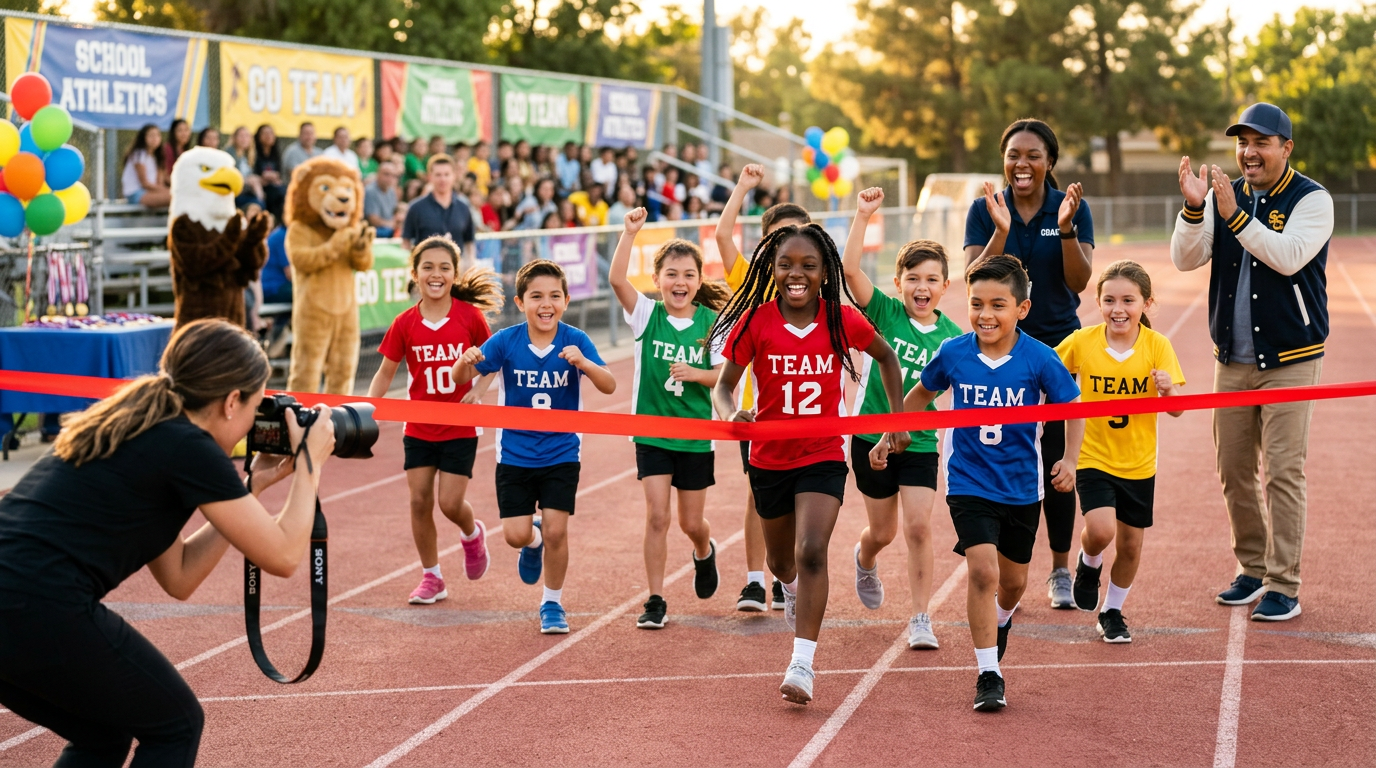
School sports day photography in 2026 — capturing energy, emotion, and community in every frame.
Quick Answer
Great school sports day photography comes down to three things — preparation, the right gear, and a workflow that gets photos into families' hands the same day. This guide covers all three, including how AI-powered delivery tools are transforming how photographers work school events in 2026.
In This Article:
- Understanding School Sports Day Photography
- Essential Gear and Settings
- Planning and Managing Your Time
- Capturing Action, Emotion, and Group Shots
- Enhancing School Spirit Through Your Lens
- Overcoming Common Challenges
- Trending Techniques and Styles for 2026
- Delivering Photos After the Event
- Conclusion
Capturing the vibrant energy of school sports day photography is one of the most rewarding — and demanding — assignments in event photography. You are covering dozens of simultaneous events, hundreds of moving subjects, and an audience of parents who all want to see their child's exact moment of triumph. The margin for error is small, and the emotional stakes are high.
Whether you are shooting your first school sports day or refining a workflow you have used for years, the best practices in 2026 look meaningfully different from even two or three years ago. AI-powered culling, same-day photo delivery, and smarter gear choices have raised the bar — and the expectations of schools and parents alike. This guide gives you everything you need to meet them.
1. Understanding School Sports Day Photography
At its core, school sports day photography is about capturing fast-moving athletes across a variety of events — from sprints and relays to field competitions and team games. But it is also about telling a story: documenting milestones and building a visual narrative that families and schools will cherish for years.
You are not just photographing athletic performances. You are capturing joy, determination, and community pride. That means balancing quick reflexes with thoughtful positioning, knowing which moments deserve your focus, and understanding the rhythm of the day before it begins.
Know the Sports and Key Moments
Before the event, spend time learning about the sports taking place. Familiarise yourself with the rules, typical emotional highlights, and the moments that repeat across events.
- Track events: Key shots happen at the start, during tight competition, and at the finish line. Position yourself to capture facial expressions, not just bodies in motion.
- Field events: Long jump and shot put offer great opportunities at the moment of takeoff or release, as well as the athlete's reaction immediately after — relief, elation, or focused composure.
- Team events: School sports days often use modified rules, so adapt your timing and positioning to capture exciting plays rather than assuming standard formats.
Researching the schedule and sport formats beforehand helps you anticipate moments rather than merely react to them — and that anticipation is what separates a good image from a great one.
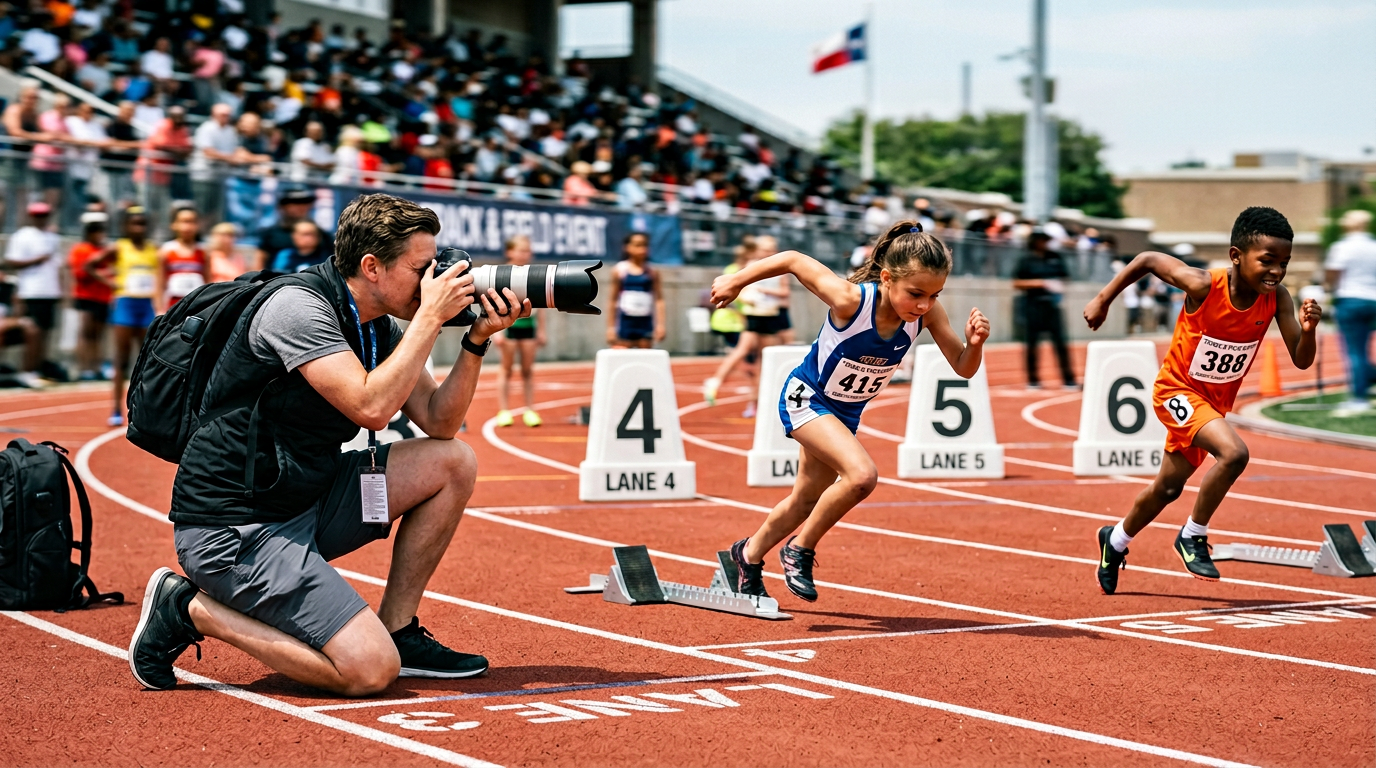
Positioning at trackside before the race begins — anticipation is the school sports day photographer's most important skill.
2. Essential Gear and Settings for School Sports Days
Bringing the right equipment and knowing your settings can make or break your shoot. You need gear that is portable enough for quick repositioning between events but powerful enough to deliver sharp, well-exposed images across varying lighting conditions throughout the day.
Recommended Equipment
- DSLR or mirrorless camera with fast autofocus and burst mode of at least 10 frames per second
- 70–200mm f/2.8 lens for capturing distant action with subject separation
- 24–70mm f/2.8 lens for group shots, ceremonies, and environmental portraits
- Fast memory cards with high write speeds to prevent buffer lag during burst shooting
- Extra batteries — essential for full-day coverage in cold or hot conditions
- Monopod to stabilise long-lens shots during extended coverage without carrying a tripod
Camera Settings Cheat Sheet
| Sport Type | ISO | Shutter Speed | Aperture | Focus Mode |
|---|---|---|---|---|
| Track Events | 400–1600 | 1/500s to 1/1000s | f/2.8 to f/4 | Continuous AF |
| Field Events | 200–800 | 1/250s to 1/500s | f/4 to f/5.6 | Single-Shot AF |
| Team Sports | 800–3200 | 1/500s to 1/1000s | f/2.8 to f/4 | Continuous AF |
| Ceremonies | 200–400 | 1/125s to 1/250s | f/5.6 to f/8 | Single-Shot AF |
Lighting Tips
Most school sports days take place outdoors in natural light. Soft morning light works well for portraits and warm-up shots. Harsh midday sun creates unflattering shadows directly beneath faces — compensate by shooting from a lower angle or using fill flash selectively. Late afternoon gives the most cinematic, warm-toned light and is ideal for finish-line and podium shots.
If your event includes covered areas or indoor segments, adjust white balance carefully and raise ISO rather than slowing your shutter — motion blur at 1/250s is harder to fix in post than noise.
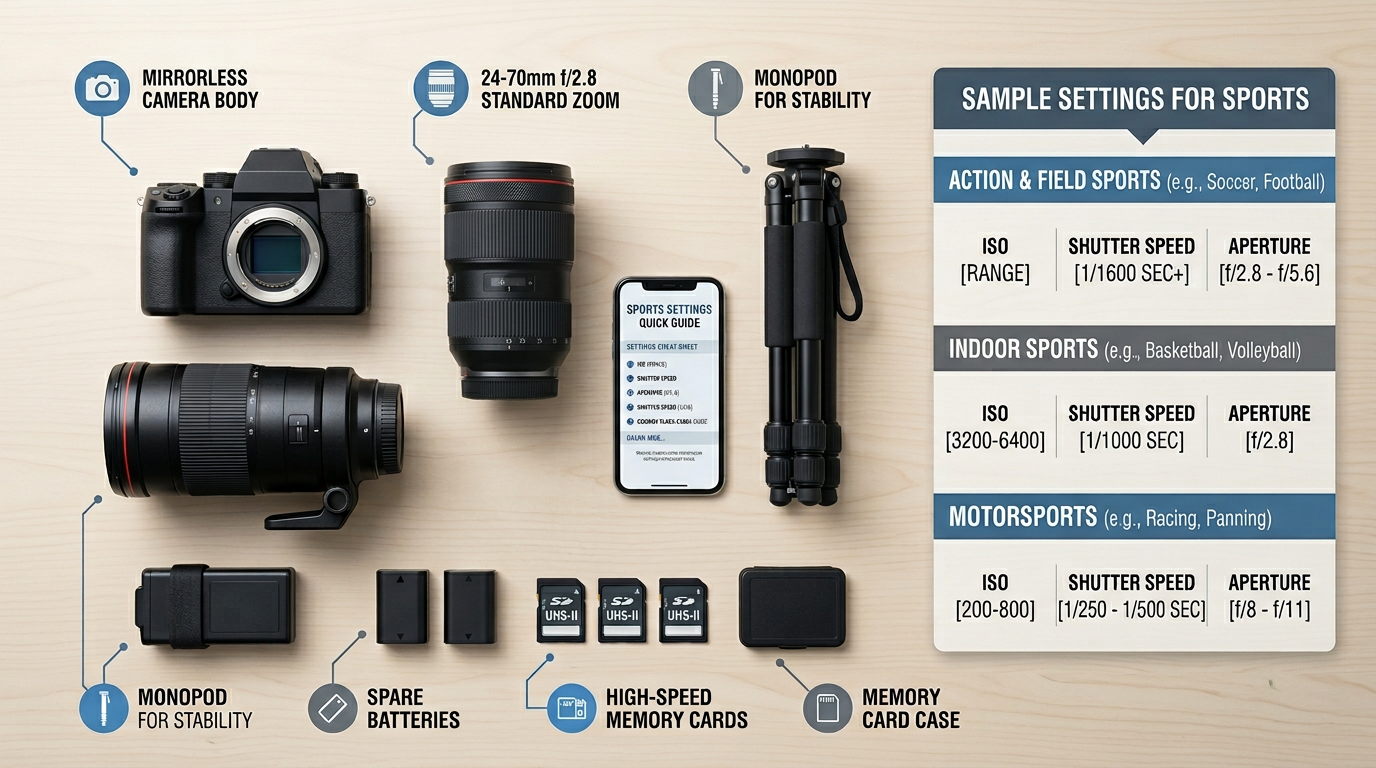
The right gear laid out before the day starts — preparation makes the difference between missing moments and owning them.
3. Planning and Managing Your Time Effectively
Covering multiple simultaneous events in a limited window requires deliberate planning. Without a clear schedule and positioning strategy, you will spend the day reacting and missing the shots that matter most.
Preparing Before Event Day
- Get a detailed schedule and venue map from the school coordinator as early as possible
- Identify must-shoot athletes, events, and ceremonies — confirm these with the school
- Plan your position for each event to maximise angles and light direction throughout the day
- Coordinate with event staff about photographer access, restricted zones, and any policy around photographing minors
- Charge all batteries fully the night before, format memory cards, and pack a backup lens
During the Event
- Stick to your timeline but stay flexible — school events run late, merge unexpectedly, or add unscheduled moments
- Allocate roughly 15–20 minutes per individual track or field event and 30–45 minutes for team sports and relay finals
- Use gaps between events to move positions, check exposure settings for changing light, and clear memory cards if needed
- Communicate with the event coordinator regularly — schedule changes happen and you want to hear about them first
Good communication and genuine flexibility are your most underrated assets on a multi-event day. The photographers who deliver the best results are almost always the ones who spent the most time talking to organisers before they picked up their cameras.
4. Capturing Action, Emotion, and Group Shots
The heart of school sports day photography is dynamic action shots paired with genuine emotional moments — from the focused intensity at the start line to the unguarded celebration at the finish.
Action Shot Techniques
- Use burst mode to capture the peak of each movement — the moment of maximum extension in a long jump, the split second a sprinter breaks the tape
- Practice panning at shutter speeds of 1/125s to 1/250s to convey motion blur in the background while keeping your subject sharp — highly effective for cyclists or sprinters
- Anticipate, don't just react — watch for patterns in how athletes prepare, and pre-focus on the spot where the decisive moment will happen
- Prioritise expressions as much as body position — a face full of effort or joy tells the story faster than a technically perfect action frame
Group and Portrait Shots
Organise group shots during natural pauses — lunch breaks, trophy presentations, or the time immediately after an event concludes. Keep backgrounds clean and use even light. For individual portraits, shoot athletes when relaxed but energised, such as during warm-ups or after cool-downs when they are still in the moment but no longer under pressure.
Engaging Athletes and the Audience
Friendly interaction helps young athletes relax in front of the camera. Learning names, showing enthusiasm for their event, and giving brief positive feedback after shots creates trust — and that trust opens up more candid, authentic moments throughout the day.
Do not overlook the audience. Parents, teammates, and coaches reacting to events — hands over mouths, arms raised, tears on cheeks — provide powerful emotional context that makes a photo story feel complete.
5. Enhancing School Spirit Through Your Lens
The best school sports day photography goes well beyond capturing athletic action — it reflects the identity and pride of the school itself. Actively look for school colours, mascots, team banners, and the small traditions that make each institution unique.
The moments of collective spirit — huddles before a race, team chants, the quiet solidarity of athletes warming up together — are often the ones families treasure most in the years that follow. These images sit alongside the action shots in albums and on classroom walls precisely because they capture something action shots cannot: the feeling of belonging.
Frame these moments generously. Give them space in your shooting plan, not just the gaps between events.
6. Overcoming Common Challenges
School sports days are unpredictable environments and every experienced photographer has stories of things going wrong. The difference is in how prepared you are for the most common ones.
Weather changes: Check the forecast the night before and the morning of the event. Carry a weather-sealed bag for your gear and a rain sleeve for your camera body. If the day turns overcast, treat it as a gift — flat, diffused light is more forgiving for portraits and group shots than harsh sun. Adjust your white balance and exposure accordingly and keep shooting.
Crowd interference: Spectators constantly drift into your frame, especially at finish lines and podiums. Arrive at each position early enough to claim the angle you need, and communicate clearly but politely with parents if they step into your line of sight. A low shooting position (kneeling or prone) often naturally separates your subject from crowd clutter.
Young subjects losing focus: Children at school events are tired, distracted, and not always cooperative. Patience is the skill no camera bag can carry. The most authentic moments — the ones families actually want — tend to happen precisely when children forget there is a photographer present. Stop directing, start observing, and wait.
Photography permissions: Confirm the school's policy on photographing minors before the event, not during it. Get written confirmation of what is permitted, ensure you know which children (if any) have opt-out restrictions, and keep this documentation accessible throughout the day.
7. Trending Techniques and Styles for 2026
The technical and stylistic landscape for school sports day photography has shifted noticeably in 2026, driven by advances in both camera hardware and AI-powered post-processing tools.
AI-assisted culling: Tools that automatically identify sharp, well-exposed frames and eliminate duplicates have cut post-shoot editing time by 50–70% for many photographers. Platforms like Lightroom's AI masking and third-party culling tools mean you can move from 2,000 raw frames to a curated delivery set in under an hour.
Natural, film-influenced colour grading: The heavily processed, high-contrast edits of the early 2020s have given way to warmer, more organic tones with restrained saturation. Parents and schools now consistently prefer images that look real rather than stylised — this also ages better in printed albums.
Drone photography for establishing shots: Where permitted by school policy and local regulations, a brief drone sequence at the start of the day provides context shots — the full field, the crowd layout, the scale of the event — that individual ground-level shooting cannot replicate.
Behind-the-scenes and environmental storytelling: The most sought-after coverage in 2026 goes beyond the podium moments. Schools increasingly want images that document the preparation, the nerves, the team conversations, and the quiet moments between events — content that tells the full story of the day, not just the results.
Same-day digital delivery expectations: This is the most significant shift of all. In 2026, parents and schools expect photos to be available digitally within hours, not days. AI-powered event photo platforms have made this technically achievable even at high volume — and schools that receive same-day delivery are now the ones that rebook and refer consistently.
8. Delivering Photos After the Event
Shooting the day is only half the job. How you deliver photos has become as important to your reputation as how you shoot them.
The traditional workflow — shoot, cull over several days, upload to a shared gallery, send a link — is no longer competitive for school events. Parents expect to see photos while the memory is fresh. Schools are increasingly selecting photographers who can promise same-day or next-morning delivery.
AI-powered photo delivery platforms like Foto Owl AI have made this workflow genuinely achievable. Upload your culled images after the event, and the platform's face recognition engine — 99.8% accurate — automatically matches each child to their photos and builds individual personalised galleries. Parents receive a WhatsApp notification with a direct link to their child's images only, with no manual sorting required from you.
For school events with 200, 500, or 1,000 attendees, this changes the economics of the job entirely. What previously required hours of manual organisation after a full day of shooting now takes minutes. Families get their photos the same evening. The school gets a result they can share immediately. And you have time to move on to your next booking.
The Creator Pass plan gives photographers 10,000 free photos per year with lifetime access — a practical starting point for testing AI delivery on school event work before committing to a paid plan.
Deliver every child's photos the same day — automatically.
Foto Owl AI's face recognition builds personalised galleries for every student and sends WhatsApp delivery without any manual sorting.
Start Free Trial10,000 photos per year · No credit card required
9. Conclusion
School sports day photography in 2026 rewards the photographers who prepare thoroughly, understand the rhythm of the day, and build a post-shoot workflow that matches how fast families now expect to receive their photos.
The fundamentals have not changed — positioning, anticipation, gear, light. But the photographers building lasting relationships with schools are the ones who have added same-day AI delivery to a technically strong shooting practice. That combination is what turns a single booking into a multi-year contract.
Start with the gear and settings guide above. Build your shot list before the day. And when the event is done, let technology handle the distribution — so you can focus on doing it all again next week.
Have questions about gear, workflow, or same-day delivery for your next school sports day? Drop them in the comments below — we'd love to help you find the right fit.