
Photography Business Taxes in India: GST, ITR & Accounting Guide 2026

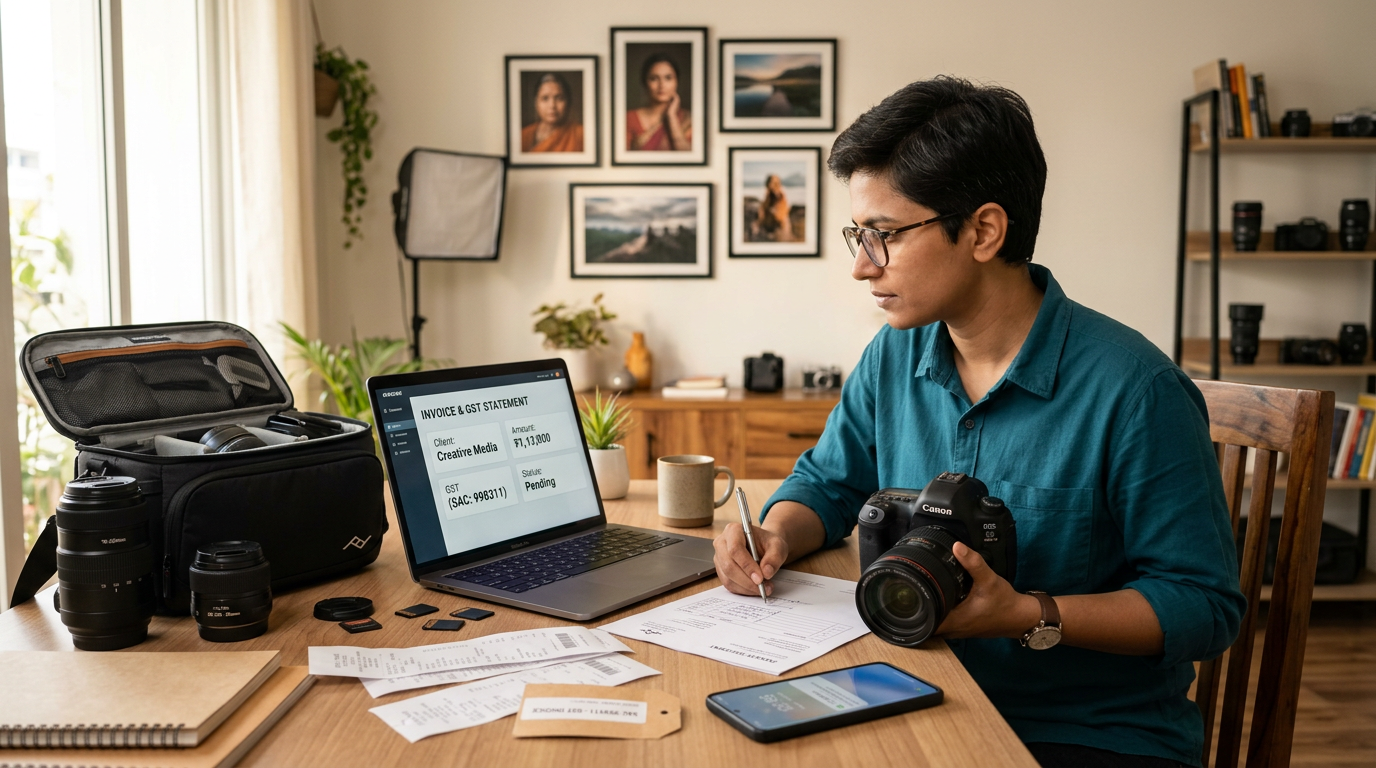
Freelance photographer reviewing GST invoice and camera gear on a laptop.
Quick Answer
Freelance photographers in India must register for GST once turnover crosses ₹20 lakhs, file ITR-4 using Section 44ADA presumptive taxation (50% of gross receipts treated as profit), and can claim deductions on gear, software, and home office expenses. Read on for the complete 2026 breakdown — with the old vs. new tax regime explained.
Disclaimer: This guide is for general informational purposes. Tax laws change frequently — for your specific situation, consult a qualified Chartered Accountant familiar with the creative industry.
In This Article:
- Understanding GST for Photography Services
- How to Register for GST as a Photographer
- Filing ITR — Old Regime vs New Regime
- Common Tax Deductions Photographers Should Know
- Accounting Tips for Photography Businesses
- GST Compliance & Billing Basics
- FAQ
- Your 2026 Tax Planning Checklist
The wedding wrapped at midnight. You've backed up 4,000 photos, packed your gear, and driven two hours home — and now your CA is calling about a GST notice you missed. Sound familiar?
Managing photography business taxes in India is one of the most overlooked parts of running a photography business. With GST rules, income tax requirements under the old and new regimes, and shifting thresholds, it is easy to fall behind. But understanding the basics — and building a simple compliance routine — can save you both money and stress.
This guide walks you through everything relevant to freelance photographer taxes in India for 2026: GST registration and invoicing, ITR filing, deductions, and the accounting habits that keep your business clean and profitable.
1. Understanding GST for Photography Services
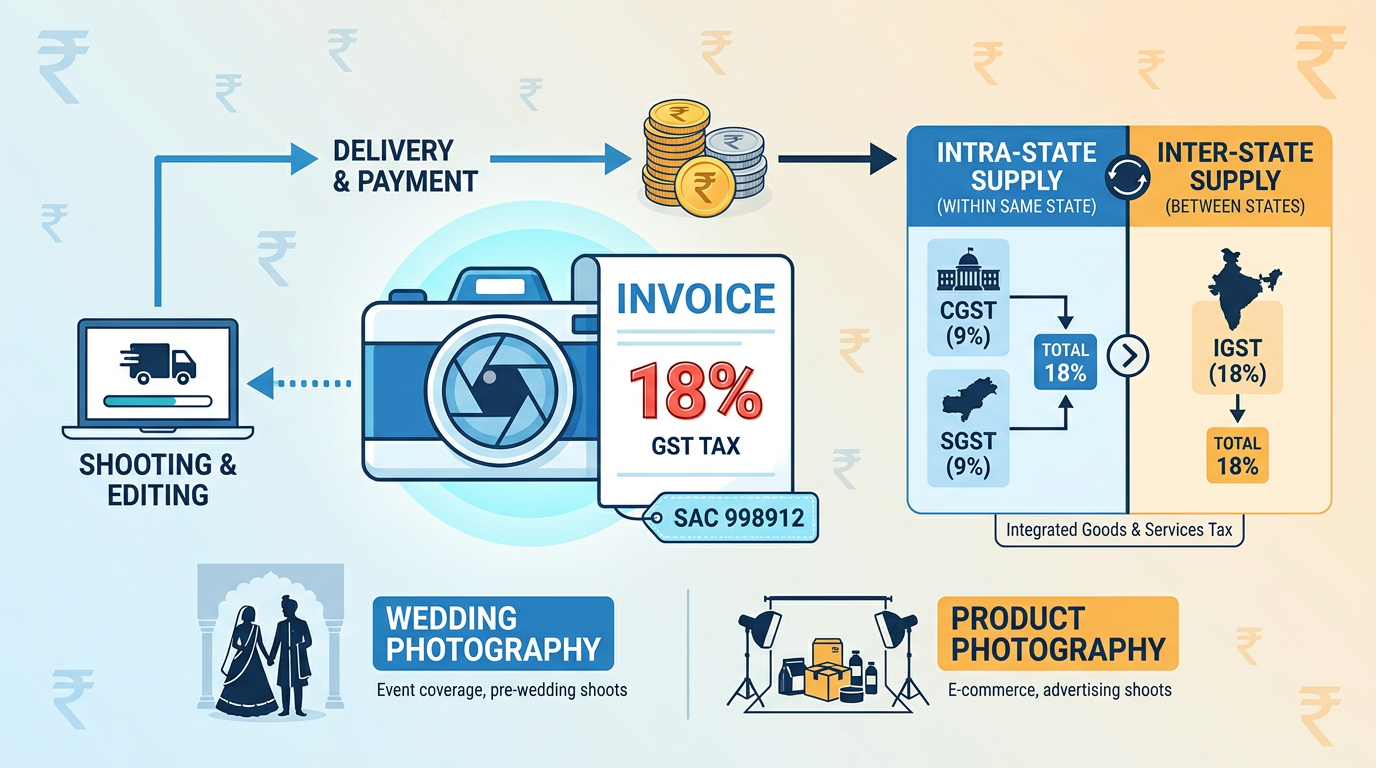
18% GST applies to photography services in India under SAC code 998912.
What Is GST and Why Does It Apply to Photographers?
GST (Goods and Services Tax) is India's unified indirect tax system. Photography is classified as a service under GST law, which means you are liable to charge GST on your invoices once your turnover crosses the mandatory threshold — or if you choose to register voluntarily.
GST Rates and SAC Codes for Photographers
Photography services fall under the 18% GST slab. Here is what each code covers:
| Service | SAC Code | GST Rate |
|---|---|---|
| Photography services | 998912 | 18% |
| Videography services | 998911 | 18% |
| Photo processing and printing | 998913 | 18% |
The 18% rate applies to your entire service package — shooting, editing, and digital delivery are all part of the same supply.
When Is GST Registration Mandatory?
- Annual turnover exceeds ₹20 lakhs (₹10 lakhs for northeastern and special category states)
- You supply services to GST-registered businesses, regardless of turnover
- You provide inter-state services
- You import goods or services
Should You Register Voluntarily Before ₹20 Lakhs?
Yes — in many cases. Voluntary registration lets you claim Input Tax Credit (ITC) on business purchases: cameras, lenses, editing software, cloud storage subscriptions, and studio rent. If your annual gear and software spend is significant, the ITC recovery alone can offset your compliance costs.
Other practical benefits of voluntary registration:
- Larger corporate clients and event companies often require a GSTIN on invoices
- Builds credibility as a professional entity
- Simplifies inter-state billing
How GST Affects Your Pricing
Once registered, every invoice must include 18% GST. For example:
| Service Fee | GST (18%) | Total Invoice Amount |
|---|---|---|
| ₹50,000 | ₹9,000 | ₹59,000 |
| ₹1,00,000 | ₹18,000 | ₹1,18,000 |
Many photographers absorb GST instead of passing it on — this directly erodes profit. Build GST into your pricing structure from the start, not as an afterthought.
2. How to Register for GST as a Photographer

Documents and steps needed to register for GST as a photographer in India.
Documents You Need Before Applying
Gather these before opening the GST portal to avoid a mid-application interruption:
- PAN card
- Aadhaar card
- Bank account details and a cancelled cheque
- Business address proof (electricity bill, rent agreement)
- Recent passport-size photo
- Registered email address and mobile number
Step-by-Step GST Registration
- 1
Prepare all documents listed above
- 2
Visit gst.gov.in and select New Registration
- 3
Fill in your business details and verify via OTP
- 4
Upload scanned document copies
- 5
Application reviewed — 3 to 7 working days
- 6
GSTIN (15-digit number) allotted on approval
Common mistakes that delay approval:
- Name mismatch between PAN and Aadhaar
- Blurry or incorrectly oriented scanned documents
- Not responding to queries from the GST officer within the given window — the application lapses if you miss the reply deadline
3. Filing Income Tax Returns — Old Regime vs New Regime
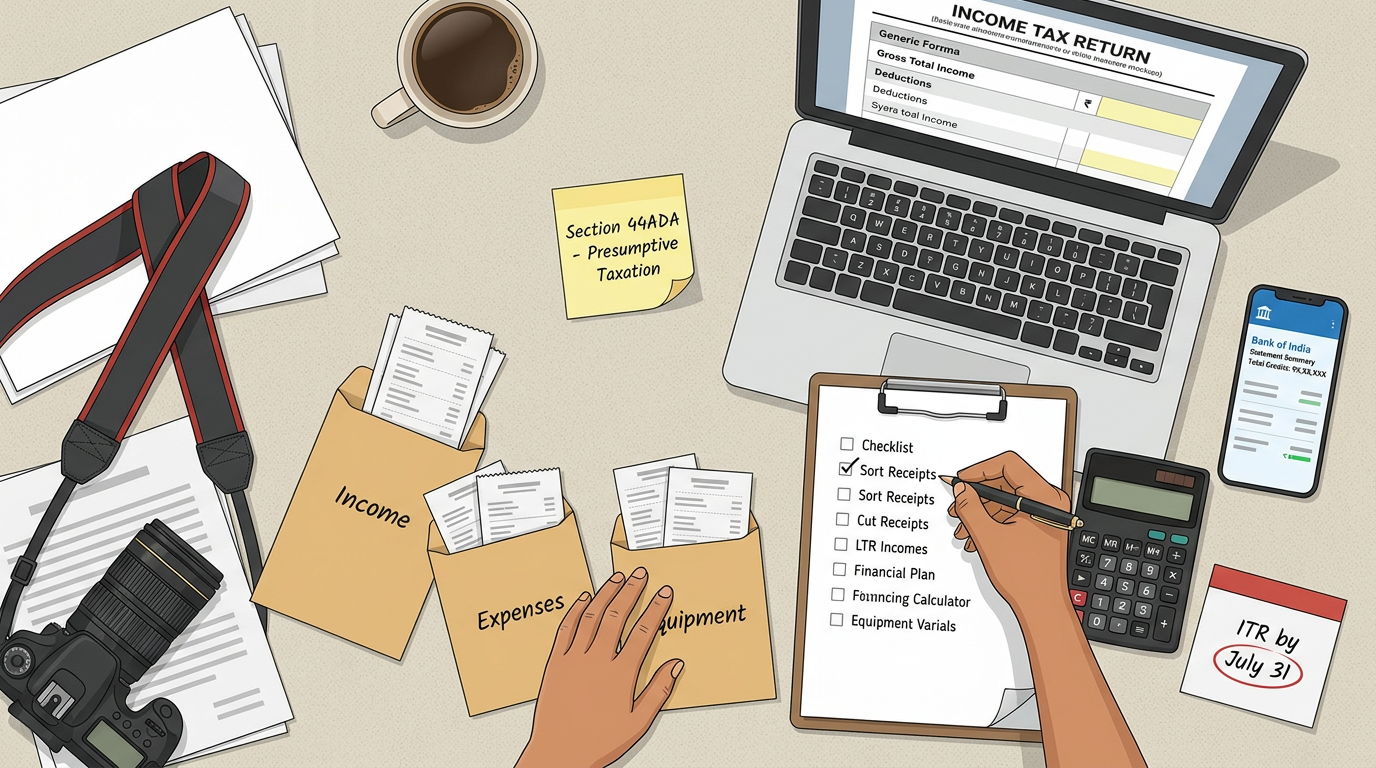
ITR filing under Section 44ADA — the presumptive taxation route most freelance photographers use.
The Most Important Choice You Will Make This Year: Old Regime or New Regime?
From FY 2023-24 onward, the new tax regime became the default for all taxpayers. You can still opt for the old regime, but you must do so explicitly when filing. This choice directly affects which deductions you can claim.
| Old Tax Regime | New Tax Regime (Default from FY 2023-24) | |
|---|---|---|
| Section 80C deductions | ✅ Available | ❌ Not available |
| Section 80D (health insurance) | ✅ Available | ❌ Not available |
| Section 24 (home loan interest) | ✅ Available | ❌ Not available |
| HRA exemption | ✅ Available | ❌ Not available |
| Standard deduction | ✅ ₹50,000 | ✅ ₹75,000 (FY 2024-25 onward) |
| Tax slabs | Higher | Lower |
Which is better for photographers? It depends on your investment and insurance commitments. If you have significant 80C investments (PPF, ELSS, LIC) and pay health insurance premiums, the old regime's deductions may result in a lower net tax. If you have few such commitments, the new regime's lower slab rates often win. Run the numbers both ways or ask your CA before filing.
Which ITR Form Should You Use?
- ITR-4 (Sugam): Suitable for most freelance photographers with gross receipts up to ₹75 lakhs (revised under the Finance Act 2023 — the old ₹50 lakh limit no longer applies). Uses presumptive taxation under Section 44ADA — no detailed books of accounts required.
- ITR-3: Required if you maintain full books of accounts, run a registered business entity, or want to claim actual depreciation on equipment.
Understanding Section 44ADA — Presumptive Taxation for Photographers
Under Section 44ADA, 50% of your gross receipts is deemed your taxable profit. The remaining 50% is tax-exempt — no separate proof of expenses required. That deemed profit is then taxed at your applicable income tax slab rate.
Example: Gross receipts of ₹10,00,000 → Deemed profit = ₹5,00,000 → Tax payable at your applicable slab on ₹5,00,000.
Important caveat on depreciation: If you file under ITR-4 using Section 44ADA, you cannot claim separate depreciation on cameras or equipment. The 50% expense exemption is deemed to already cover all business costs including equipment depreciation. To claim actual depreciation (15% per year on camera equipment), you must maintain books of accounts and file ITR-3 instead. Choose one path — you cannot combine both.
Step-by-Step ITR Filing for Photographers (2026)
- 1
Gather payment receipts, expense bills, bank statements, and GST returns (if registered)
- 2
Login at incometax.gov.in and select your ITR form (usually ITR-4)
- 3
Report gross receipts under business income
- 4
Choose old or new tax regime — this locks in your deduction eligibility
- 5
Claim Section 44ADA presumptive taxation (50% deemed profit)
- 6
Add other income sources — workshops, interest, rental income
- 7
Claim eligible deductions (80C, 80D, etc. only under old regime)
- 8
Submit and verify online via Aadhaar OTP or net banking
- 9
Save a copy of ITR-V for your records
Key Filing Deadlines for AY 2026-27 (FY 2025-26)
| Deadline | Date |
|---|---|
| ITR filing (no audit required) | July 31, 2026 |
| Audit cases | October 31, 2026 |
| Revised return filing | December 31, 2026 |
4. Common Tax Deductions Photographers Should Know
Legitimate expense claims reduce your taxable income. The deductions available to you depend on whether you are filing under the old or new regime and whether you are using presumptive taxation (ITR-4) or maintaining full books (ITR-3).
Equipment & Gear — ITR-3 Only
If you file ITR-3 and maintain books, you can claim depreciation on:
- Cameras, lenses, tripods, lighting gear
- Memory cards, external hard drives, monitors
- Studio equipment and backdrops
Depreciation rate: 15% per year on the Written Down Value (WDV) of equipment.
Example (ITR-3 route): A ₹1,00,000 camera body depreciates by ₹15,000 in Year 1. If you are in the 20% tax slab, this saves approximately ₹3,000 in tax.
Reminder: If you file ITR-4 under Section 44ADA, equipment depreciation is already factored into the 50% deemed expense exemption. Do not attempt to claim it additionally.
Software & Subscriptions — Available Under Full Books
- Adobe Lightroom, Photoshop, Capture One subscriptions
- Cloud storage services
- Workshop and training course fees
- Website hosting, portfolio platform costs, and marketing spend
Business Operations
- Client meeting expenses and documented travel costs (retain all receipts)
- Business-use portion of your phone and internet bill
- Equipment insurance and professional liability cover
- Studio rent and associated utilities, if you operate a dedicated studio space
Home Office — Proportionate Claim
If you work from a dedicated home workspace, you can proportionately claim home expenses (rent, electricity) as a business expense under full books. Measure the workspace area as a percentage of total home area and apply that percentage to monthly bills.
Chapter VI-A Deductions — Old Regime Only
| Deduction | What It Covers | Limit |
|---|---|---|
| Section 80C | PPF, ELSS, LIC, ELSS, EPF | ₹1,50,000/year |
| Section 80D | Health insurance premiums | ₹25,000–₹1,00,000 depending on age |
| Section 24(b) | Home loan interest | ₹2,00,000/year (self-occupied) |
These deductions are not available under the new tax regime. Factor this into your regime choice.
5. Accounting Tips for Photography Businesses

A simple accounting setup for freelance photographers — tracking income, expenses, and GST monthly.
Clean books make tax season predictable rather than painful. You do not need a complex system — just a consistent one.
Recommended Accounting Tools
| Software | Approx. Cost | Best For |
|---|---|---|
| Tally Prime | ₹18,000–54,000/year | Established studios with full bookkeeping needs |
| Zoho Books | ₹1,200–2,400/month | Freelancers needing mobile-first GST invoicing |
| ClearTax Business | ₹999–4,999/month | GST filing, compliance, and return automation |
| QuickBooks | ₹750–2,500/month | Multi-client billing and expense tracking |
Note: Wave's free tier availability for Indian users has changed in recent years — verify current pricing and India support before choosing it.
A Simple Monthly Routine That Actually Works
- Weekly: Log all income received and expenses paid; retain digital copies of every receipt
- Mid-month: Reconcile your bank statement against your accounting records
- End of month: Generate GST invoices for any outstanding client payments; prepare your GSTR-1 and GSTR-3B returns if you are registered
- Quarterly: Review profitability, compare against the same period last year, and set aside advance tax if your annual liability is likely to exceed ₹10,000
Separate Your Business and Personal Finances
This is the single most impactful habit you can build. Open a dedicated current account for your photography business and route all client payments and business expenses through it. This makes reconciliation effortless and provides clean documentation if you are ever audited.
6. GST Compliance & Billing Basics
What Your GST Invoice Must Include
Every invoice you raise as a GST-registered photographer must contain:
- Sequential invoice number and date
- Your business name, address, and GSTIN
- Client name, address, and GSTIN (if they are GST-registered)
- Service description and SAC code (998912 for photography)
- Taxable value of the service
- GST breakup: CGST + SGST (for intra-state) or IGST (for inter-state)
- Total invoice amount including GST
Filing GST Returns
| Return | Frequency | What It Covers |
|---|---|---|
| GSTR-1 | Monthly or quarterly | Outward supplies (sales) |
| GSTR-3B | Monthly | Summary return with tax payment |
| GSTR-9 | Annual | Annual reconciliation |
Quarterly filing (QRMP scheme) is available for taxpayers with turnover up to ₹5 crores — this reduces your monthly compliance burden.
GST for International Clients
Services exported to clients outside India are zero-rated under GST — you charge 0% GST on the invoice. To avoid paying GST upfront and claiming a refund later, file a Letter of Undertaking (LUT) before the start of each financial year. The LUT must be renewed annually — it lapses on March 31 each year regardless of when you filed it. Missing this means your exports will attract GST until you renew, creating a refund claim process.
Documents to maintain for export invoices:
- FIRC (Foreign Inward Remittance Certificate) from your bank
- Copy of the export invoice
- Proof of service delivery (email thread, delivery confirmation)
7. FAQ
Do freelance photographers pay income tax in India? Yes — if your total annual income from all sources exceeds ₹2.5 lakhs (₹3 lakhs under the new regime for individuals below 60). Above this threshold, you are required to file an ITR and pay tax at applicable slab rates.
When does GST registration become mandatory for a photographer? When your aggregate turnover in a financial year exceeds ₹20 lakhs. For photographers operating in northeastern and special category states, the threshold is ₹10 lakhs. You can also register voluntarily below these limits to claim input tax credit.
What GST rate applies to photography services? 18% GST applies to photography services under SAC code 998912. Videography (998911) and photo printing/processing (998913) are also taxed at 18%.
Can I claim depreciation on my camera equipment? Only if you file ITR-3 and maintain full books of accounts. Under ITR-4 (Section 44ADA presumptive taxation), depreciation is already factored into the 50% deemed expense exemption — you cannot claim it separately.
Which ITR form should I use as a freelance photographer? Most freelance photographers use ITR-4 under Section 44ADA, which allows presumptive taxation with gross receipts up to ₹75 lakhs (revised from the older ₹50 lakh limit). If you maintain detailed accounts or your income exceeds this threshold, use ITR-3.
What penalties apply if I miss GST or ITR deadlines? For ITR: Late filing fees under Section 234F can reach ₹10,000 (₹1,000 if your total income is under ₹5 lakhs), plus interest under Section 234A on unpaid tax at 1% per month. For GST: Late fees of ₹50 per day (₹20 per day for nil returns) per return, capped at ₹10,000 per return, plus potential penalties up to 100% of the tax amount in cases of deliberate non-compliance.
Is the new tax regime mandatory, or can I still use the old one? The new regime is the default from FY 2023-24, but you can opt for the old regime at the time of filing by explicitly selecting it. For freelancers filing ITR-4, you can switch between regimes every year. For those filing ITR-3 as business income, the switch rules are more restrictive — consult your CA.
What is a LUT and when does a photographer need to file one? A Letter of Undertaking (LUT) is required if you export services to international clients and want to invoice at 0% GST without paying tax upfront and claiming a refund. File it at the start of each financial year (before April 1) on the GST portal. It must be renewed annually — it does not carry over automatically.
8. Your 2026 Photography Tax Planning Checklist
April–June (start of financial year):
- Check whether your FY 2024-25 turnover requires GST registration
- Renew LUT if you have international clients (before April 1)
- Choose your tax regime for FY 2025-26 and plan investments accordingly
- Set up or update your accounting software and invoice templates
Monthly through the year:
- Log all income and expenses weekly; reconcile bank statements monthly
- File GSTR-1 and GSTR-3B if GST-registered
- Issue GST-compliant invoices to all clients
- Pay advance tax quarterly if projected annual liability exceeds ₹10,000
January–July 2026 (filing season):
- Gather all payment receipts, expense bills, and bank statements
- Compile GST returns filed during the year (for cross-reference)
- File ITR-4 or ITR-3 before July 31, 2026
- Keep signed ITR-V and acknowledgement for your records
- Verify Form 26AS for TDS deducted by clients
For international work:
- Maintain FIRC certificates for all foreign remittances
- Keep export invoices with SAC codes and LUT reference numbers
- File GSTR-9 annual return by December 31, 2026
Spend less time on admin, more time behind the lens
Foto Owl AI automates your entire post-event photo delivery workflow — face recognition, personalized guest galleries, and WhatsApp delivery in minutes. Join 200,000+ photographers who've already made the switch.
Start Free Trial10,000 photos per year · No credit card required
Tax compliance is not the most exciting part of being a photographer — but it is one of the most important. Understanding the difference between old and new regimes, knowing when to register for GST, filing the right ITR form, and building a monthly accounting routine will keep your business clean, your profits protected, and your focus where it belongs: on your craft.
For situations beyond this guide — multi-entity setups, foreign income, audit responses, or significant asset purchases — always work with a Chartered Accountant who understands the creative industry. Tax law evolves every budget, and personalised advice pays for itself.
Have a specific tax question about your photography business? Drop it in the comments below — we'd love to help you find clarity.