
How to Handle Difficult Photography Clients: Scripts and Boundaries


Clear communication starts at the first consultation — not after a conflict has already begun.
How to Handle Difficult Photography Clients: Scripts and Boundaries
Quick Answer
Difficult photography clients become manageable with three things in place: a detailed contract, professional scripts for common scenarios, and the confidence to enforce your boundaries consistently. Prevention — setting expectations clearly before the shoot — is almost always more effective than reactive de-escalation after something has gone wrong.
In This Article:
- Why Do Photography Clients Become Difficult?
- Setting Clear Boundaries With Your Clients
- Scripts to Handle Difficult Clients Effectively
- Protecting Your Business Professionally
- Managing Expectations Before Problems Arise
- Real-World Scenarios and How to Handle Them
- Frequently Asked Questions
- Conclusion
Running a photography business means you will occasionally face difficult photography clients. Whether it is unrealistic expectations, communication gaps, or personality clashes, managing these situations professionally is essential to protecting your time, your work quality, and your business reputation. The good news: most client conflicts are entirely preventable — and the ones that aren't can almost always be de-escalated with the right words and the right systems.
1. Why Do Photography Clients Become Difficult?
Understanding the root cause behind a difficult client interaction is the first step toward resolving it well. Most friction does not come from bad intent — it comes from misaligned expectations, poor communication, or external pressures the client is carrying into the project.
Here are the most common reasons clients become challenging:
- Unrealistic Expectations: Many clients arrive with ideas shaped by heavily edited social media content or the work of photographers with entirely different styles and budgets. When reality doesn't match the image in their head, frustration follows.
- Communication Gaps: Unclear scope, verbal agreements, or ambiguous timelines create room for misunderstanding on both sides. What you assumed was obvious often isn't.
- Financial Pressure: Budget constraints can push clients to question pricing after the fact, request extras they didn't pay for, or delay payments in ways that strain the relationship.
- Personality Conflicts: Sometimes people simply don't work well together. This is not a failure — it is useful information that helps you refine your client selection process over time.
- External Stress: Weddings, corporate events, and family milestones come loaded with emotional stakes. Clients under pressure often become more demanding, less patient, and harder to satisfy — even when your work is excellent.
These difficulties don't just cause frustration in the moment. Left unmanaged, they can reduce your creative output, create scope creep that erodes profitability, and damage your public reputation through negative reviews.
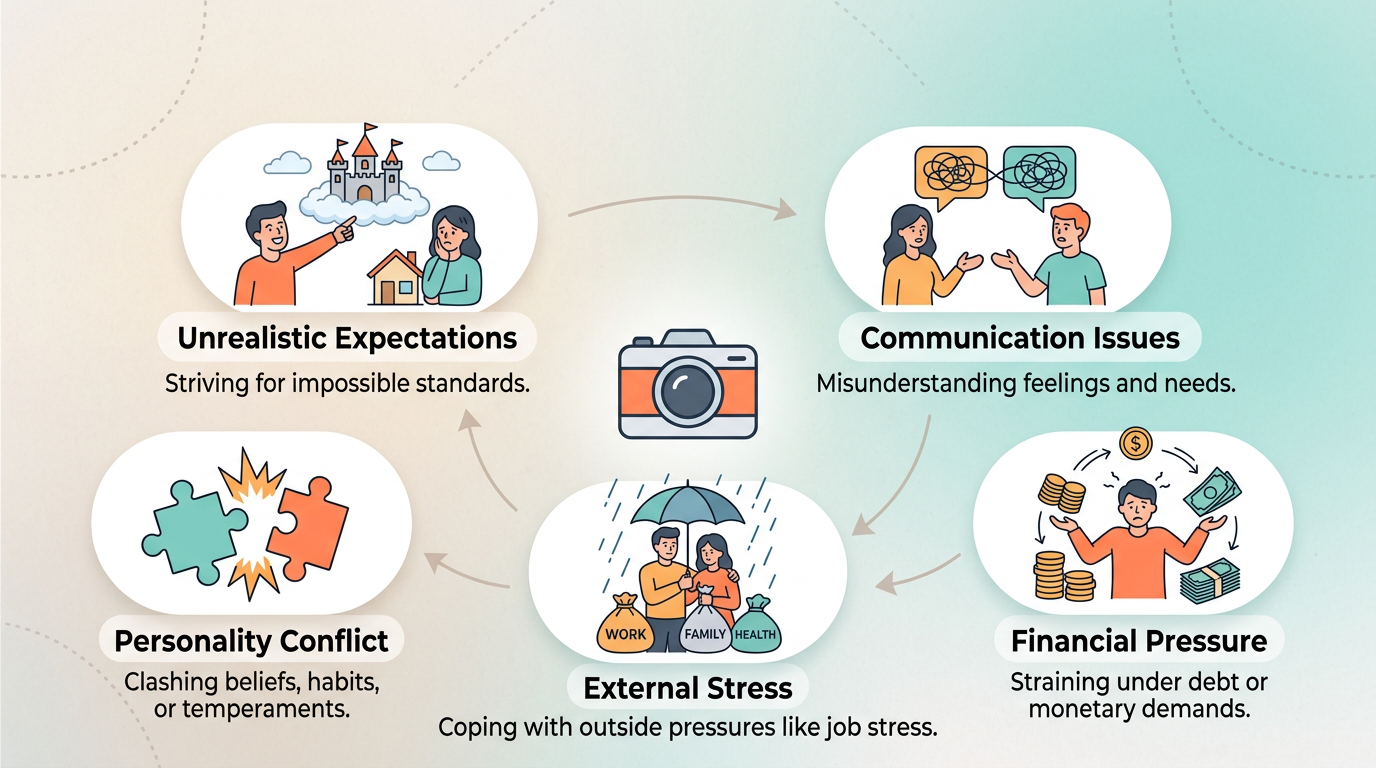
Most client conflicts trace back to one of five root causes — and most are preventable with the right onboarding process.
2. Setting Clear Boundaries With Your Clients
Boundaries are not a way to push clients away — they are the professional framework that makes a healthy working relationship possible. Photographers who establish clear boundaries early consistently report fewer disputes, faster payments, and more repeat business.
How to Communicate Boundaries Without Awkwardness
The key is to present your boundaries as standard professional practice, not as personal rules you're imposing on this particular client.
-
Introduce Boundaries During the Initial Consultation: Frame them as part of how your studio operates for all clients. "We respond to all messages within 24 hours on business days" lands very differently from "Please don't message me on weekends."
-
Put Everything in Writing: Boundaries only protect you when they're documented. Include them in your contract, your welcome packet, and your FAQ document. If it's only verbal, it didn't happen.
-
Explain the Why: Clients are more likely to respect a boundary they understand. Limiting revision rounds isn't about being inflexible — it's about protecting the timeline you promised them. Framing it this way shifts the narrative.
The Key Boundaries Every Photographer Needs
Communication boundaries: Define your business hours, your expected response time, and your preferred channels. If you don't want clients calling your personal number at 10 PM, your contract needs to say so clearly.
Project scope boundaries: Specify the exact number of edited photos, the number of revision rounds, the delivery timeline, and the cost structure for anything that falls outside the original agreement. Vague scope is the single biggest source of photographer burnout.
Personal interaction boundaries: Be explicit about limits on social media contact, personal requests, or access to your editing process. These feel minor until they aren't.
Sample boundary statement for your welcome packet:
"To provide the best service to every client, we respond to emails within 24–48 hours on business days (Monday–Friday, 9 AM–6 PM). For urgent matters, please use the studio contact line listed in your contract. Weekends are reserved for shooting and editing unless a prior arrangement has been made."

A signed contract is the foundation of every professional client relationship — not a formality, a protection.
3. Scripts to Handle Difficult Clients Effectively
Having a set of ready-made scripts means you're never caught off-guard in a tense moment. These aren't rigid lines — they're starting frameworks you can adapt to your voice and the specific situation.

Having your response ready before a difficult conversation begins is the difference between reacting and responding.
Scripts for the Most Common Difficult Situations
Declining an unreasonable request:
"I appreciate the idea — it's a great one. However, this falls outside what we agreed to in the original package. I'd be happy to put together a separate quote so this gets the attention it deserves."
Addressing a complaint with empathy:
"I hear you, and I want to make sure we get this right. A lot of clients have felt the same way at this stage in the process — once the final edits are complete, the full vision comes together. Let me walk you through where we are and what's coming next."
Enforcing your editing timeline:
"Our standard editing process takes [X days] because we give every image the attention it deserves. I'll send you a delivery confirmation by [specific date]. You'll have everything before [client's stated deadline]."
Handling scope creep directly:
"That's a great idea, and I want to do it well. Because it goes beyond what we originally scoped, I'll put together a separate quote so neither project gets shortchanged. I'll send it over today."
De-escalating an aggressive tone:
"I want to resolve this — and I'm committed to doing that. When we're both in a calm space, we can work through the details properly. Are you available for a call tomorrow at [time]?"
Emergency de-escalation when a client is very upset:
"I hear that this is important to you, and I take that seriously. Let me make sure I fully understand what you need so I can find the right solution. Can you walk me through exactly what you're seeing?"
4. Protecting Your Business Professionally
Good client management is partly about people skills — and partly about having the right legal and documentation infrastructure in place so that if things do go wrong, you have something to stand on.
Build a Contract That Works as Hard as You Do
A comprehensive contract should clearly define scope of work, deliverables, timelines, payment schedule, cancellation and refund policy, and the dispute resolution process. It should also specify what happens in the event of circumstances beyond your control — weather, venue access, illness. Many photographers use Photo Selection as part of their proofing workflow, which creates a natural paper trail of client approvals at the selection stage — another useful layer of documentation.
Keep thorough records of all client communications, especially anything involving changes to the original scope or verbal agreements. If a client says "let's just do 10 more shots quickly" on the day of the shoot, follow up with a written confirmation the same evening.
Knowing When to Walk Away
Not every client relationship is worth preserving. There are situations where ending the engagement professionally is the right decision for your business, your other clients, and your own wellbeing.
Watch for these signals:
- Repeated boundary violations despite clear, documented communication
- Abusive, threatening, or demeaning behaviour
- Ongoing payment issues or attempts to renegotiate after delivery
- Demands that are pulling time and attention away from your other clients
If you need to exit a contract, do so professionally and with reference to your terms:
"After careful consideration, I believe we may not be the right fit for what you need. I want to refer you to someone who can serve you better, and I'll process your deposit refund as outlined in our agreement."
5. Managing Expectations Before Problems Arise
The most effective client management happens before the shoot even begins. A strong onboarding process that sets the right expectations upfront prevents the vast majority of difficult client situations from ever developing.

A simple timeline chart or package comparison table does more to align expectations than a long email explanation.
Use a detailed intake form. Before any booking is confirmed, ask clients to fill out a questionnaire about their vision, references, expected deliverables, and how they plan to use the photos. This surfaces mismatches early — before money has changed hands.
Show your portfolio as a calibration tool. Clients often don't know how to describe what they want in photography terms. Showing them a curated selection of your work and asking "does this feel like what you're imagining?" quickly reveals alignment or misalignment.
Educate clients on your workflow. Many clients have never worked with a professional photographer. A simple one-page guide explaining your process, your editing timeline, and what "final delivery" means in practice sets expectations before confusion can develop.
Be upfront about pricing at every stage. Hidden costs are one of the fastest ways to sour an otherwise good working relationship. Put every potential additional charge — extra hours, travel, rush editing, reprints — in the contract and the welcome packet.
Use visual comparison aids. A simple timeline chart showing your delivery stages, or a table comparing your three packages side by side, does more to align expectations than a long email explanation. Visual clarity reduces misinterpretation.
6. Real-World Scenarios and How to Handle Them
Understanding principles is useful. Seeing how they play out in specific situations is more useful. Here are three realistic scenarios photographers encounter regularly — and how applying the right approach changes the outcome.
Scenario 1: The Last-Minute Venue Change
Situation: Two days before a corporate event, the client informs you the venue has changed to a location 40 minutes further away. No prior discussion of travel costs or logistics.
What goes wrong without boundaries: You absorb the extra travel time and cost, begin the event already frustrated, and the relationship starts on a strained note.
What goes right with boundaries: Your contract includes a travel clause. You acknowledge the change promptly, confirm you can accommodate it, and send a brief addendum noting the travel fee as per your contract terms. The client is not surprised — it's in the paperwork they signed. You arrive professionally, on time, and without resentment.
Key takeaway: Anticipate common logistical changes in your contract before they happen. A clause you never need to invoke still protects you.
Scenario 2: Portrait Session Scope Creep
Situation: A family portrait session booked for 90 minutes is approaching the two-hour mark. The client keeps asking for "just a few more setups" with no indication of wrapping up.
What goes wrong without boundaries: You keep shooting, then spend days in post-production on a session you were only paid for 90 minutes of. Resentment builds and you undercharge.
What goes right with a clear script: At the 80-minute mark, you pause naturally and say: "We've got some beautiful shots today — I want to give you a heads-up that we're about 10 minutes from the end of our booked time. If you'd like to continue with a couple more setups, I can add an additional 30 minutes for [your rate] — just let me know and I'll note it." The client either wraps up or upgrades. Either outcome is professional.
Key takeaway: Scope conversations go better mid-session than after the invoice is sent. Build natural pause points into longer sessions so you can check in without it feeling like an interruption.
Scenario 3: The Complaint After Delivery
Situation: You deliver a full wedding gallery and the client responds saying they expected "more candid moments" and feels the gallery is "too posed."
What goes wrong without documentation: You spend hours reworking selects based on feedback that was never captured in writing. Every revision opens the door to further requests. The job becomes open-ended.
What goes right with documentation and a script: You refer back to the intake form and the shot list agreed to pre-shoot. You respond: "I want to make sure we get to a place you're happy with. Looking back at what we agreed, the brief was [X]. I've delivered [Y photos] that align with that brief. I'd love to understand which specific moments feel missing so I can check my full take — there may be selects in the unedited batch that match what you're describing." This positions you as responsive without accepting blame for a brief that wasn't set correctly.
Key takeaway: A detailed pre-shoot brief signed off by the client is your single most valuable protection against post-delivery complaints. Make it standard — not optional.
Deliver photos to every guest before they leave the venue
Foto Owl AI's AI face recognition handles sorting, matching, and WhatsApp delivery automatically — so you can focus on shooting, not admin.
Start Free Trial10,000 photos per year · No credit card required
7. Frequently Asked Questions
How do I stay calm when a client is being aggressive toward me?
The most effective approach is to listen actively without interrupting, acknowledge the emotion without validating the aggression, and then redirect to the problem. "I can see this is really frustrating. Let's focus on what we can do to resolve this" is more effective than defending yourself. If the conversation is escalating, it is entirely professional to say you'll follow up in writing once you've had a chance to review the situation.
What should I do if a client repeatedly ignores my stated boundaries?
Start by documenting the boundary violation in writing — a calm, factual email referencing the relevant clause in your contract. If the behaviour continues after one clear warning, you are within your rights to assess whether the relationship is sustainable. Most photographers who are reluctant to enforce boundaries find the situation worsens, not improves, over time.
How should I respond when a client demands a discount after the work is done?
Acknowledge the conversation without immediately agreeing or refusing. "I'd like to understand what's driving this — can you tell me more about what felt off?" If the concern is legitimate, there may be a fair resolution. If it is simply an attempt to pay less for work already delivered, refer calmly to your contract terms and the agreed payment schedule. Offering a goodwill gesture on a future booking is sometimes worth more than a discount on the current invoice.
Can I legally terminate a contract with a difficult client?
Yes, provided your contract includes a termination clause — which it should. Most well-drafted photography contracts include language covering termination by either party, the handling of deposits already paid, and the deliverables owed at the time of termination. If a client's behaviour constitutes harassment or makes it impossible to fulfil the contract safely, document everything and seek legal advice specific to your jurisdiction before taking action.
How do I handle a client who contacts me outside business hours constantly?
The first time it happens, don't respond until your next business hours — and when you do, gently note your availability: "Just so you're aware, I'm generally offline after 7 PM — I'll always get back to you within 24 hours on business days." If it continues, your next client communication contract should include an explicit availability clause. Most clients will respect a boundary they've been clearly told about.
What's the best way to handle a client who leaves a negative review unfairly?
Respond publicly, briefly, and professionally. Acknowledge that you're sorry they had a disappointing experience, note that you take feedback seriously, and invite them to contact you directly to discuss. Never argue the specifics publicly — it rarely improves the situation and can make you look defensive to potential future clients. If the review contains factually false statements, most platforms have a dispute process worth exploring.
8. Conclusion
Handling difficult photography clients is not about winning confrontations — it is about building systems strong enough that most conflicts never develop in the first place. Clear contracts, documented scope, a professional onboarding process, and a set of ready-made scripts give you the structure to stay calm, stay professional, and protect your business regardless of the situation.
The photographers who consistently report the fewest client problems are not necessarily the most talented or the most experienced. They are the ones who invested early in the right boundaries, the right paperwork, and the right words for difficult moments.
Start with one change today — update your contract, draft one of the scripts above, or add a boundary statement to your welcome packet. Each small system you put in place removes one more source of unnecessary stress from your working life.
Have a difficult client situation you're not sure how to navigate? Drop it in the comments below — we'd be glad to help you think through the right approach.