
Guest Photo Consent and Data Privacy: India's DPDP Act Compliance in 2026

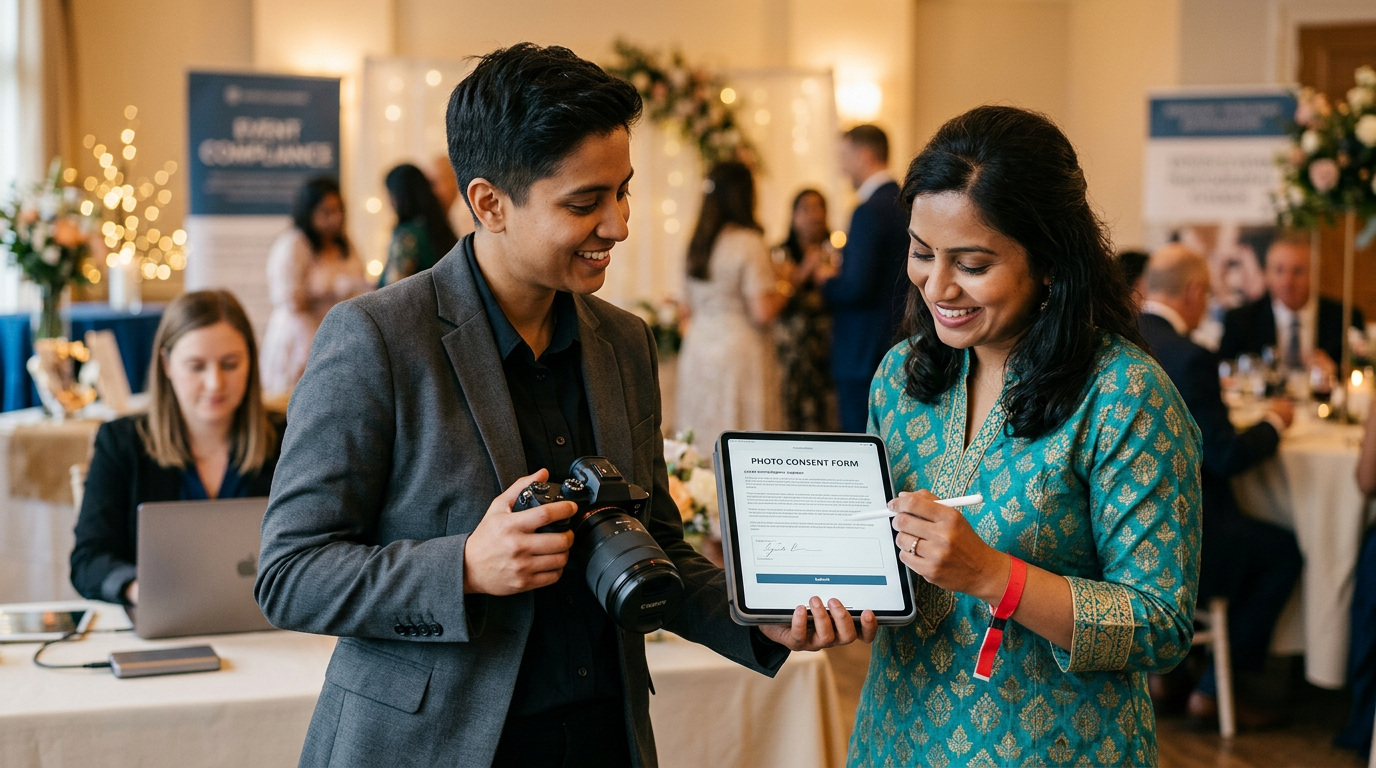
Collecting guest photo consent at check-in is the simplest way to stay on the right side of India's DPDP Act.
Quick Answer
Under India's DPDP Act, 2023 — operationalised by the DPDP Rules notified in November 2025 — event photographers are usually "Data Fiduciaries" responsible for how guest images are collected, stored, and shared. Get clear (ideally written) guest photo consent before using identifiable photos commercially or publicly, store those records securely, and honour withdrawal requests promptly. Serious non-compliance can attract penalties of up to ₹250 crore.
In This Article:
- What Is the DPDP Act, and Who Does It Affect?
- What Counts as Personal Data in Your Photos?
- When Do You Need Guest Photo Consent?
- How Should Consent Be Given?
- Best Practices for Managing Photo Consent
- What Happens If You Don't Comply?
- Illustrative Scenarios and Tips
- FAQs on the DPDP Act and Photography
- Conclusion
India's Digital Personal Data Protection Act, 2023 (DPDP Act) — brought to life by the DPDP Rules notified in November 2025 — is changing how event photographers and businesses handle guest photos and personal data. Its obligations are being phased in through 2026 and into 2027, which makes 2026 the year to get your guest photo consent and privacy practices in order.
This guide helps photographers, event organizers, and the teams around them understand their responsibilities, so you can manage consent and data privacy correctly. If your work involves images that identify guests, knowing these rules isn't just good practice — it protects your business, your reputation, and your clients.
What Is the DPDP Act, and Who Does It Affect?
The DPDP Act is India's first comprehensive data privacy law, designed to safeguard personal data in the digital era. For photographers, it means clearer expectations around how you capture, store, and share images of identifiable individuals — and a real consequence for getting it wrong.
Who Is a Data Fiduciary, a Data Principal, and a Data Processor?
- Data Fiduciary: Usually the photographer or studio — the party that decides why and how personal data (the photos) is collected and used.
- Data Principal: The individuals in your photos, who hold rights over how their data (their images) is handled.
- Data Processor: If you process images strictly on a client's instructions without independent control over the data, you may instead act as a Data Processor.
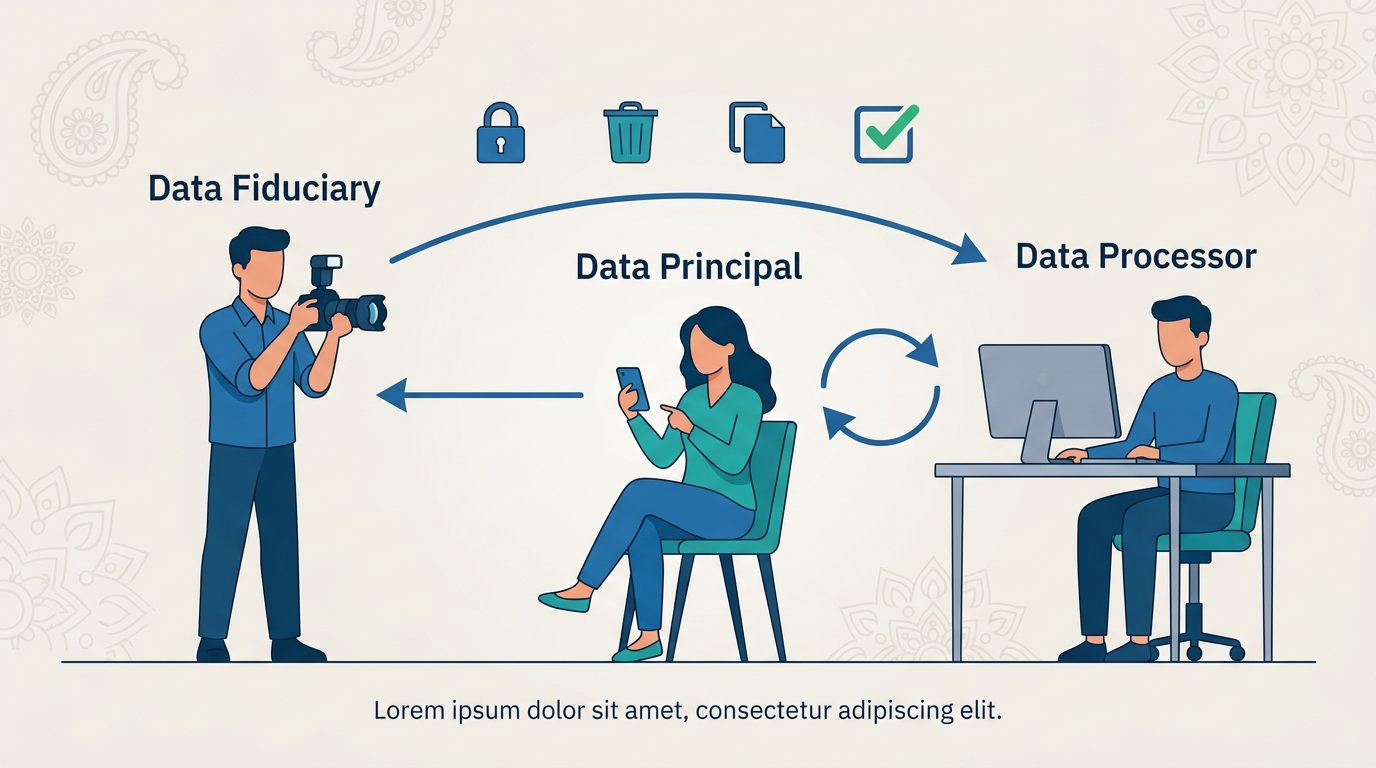
Knowing your role — Data Fiduciary, Data Principal, or Data Processor — determines which obligations apply to you.
What Counts as Personal Data in Your Photos?
Personal data covers far more than a recognizable face. It includes anything that can identify someone directly or indirectly.
Examples of Personal Data in Photos
- Clear facial features
- Name tags, badges, or personal items visible in the frame
- Location tags, timestamps, or GPS metadata
- Distinctive physical traits such as tattoos or jewellery
- Background elements that hint at someone's identity
Even when people aren't obviously identifiable, embedded metadata can turn a photo into personal data under the Act.
| Regular Photos | Data-Rich Photos |
|---|---|
| Crowd shots with unrecognizable faces | Close-up portraits with clear facial features |
| Venue images without people | Photos showing name badges or personal items |
| Landscape shots without people | Photos embedded with GPS/location data |
When Do You Need Guest Photo Consent?
Consent generally matters when you photograph identifiable individuals and then use those images in ways such as:
- Private events like weddings, corporate functions, or parties
- Commercial use, such as marketing or promotional content
- Public sharing, including social media or your website
- Portfolios featuring identifiable people
- Long-term storage of photos that carry personal details
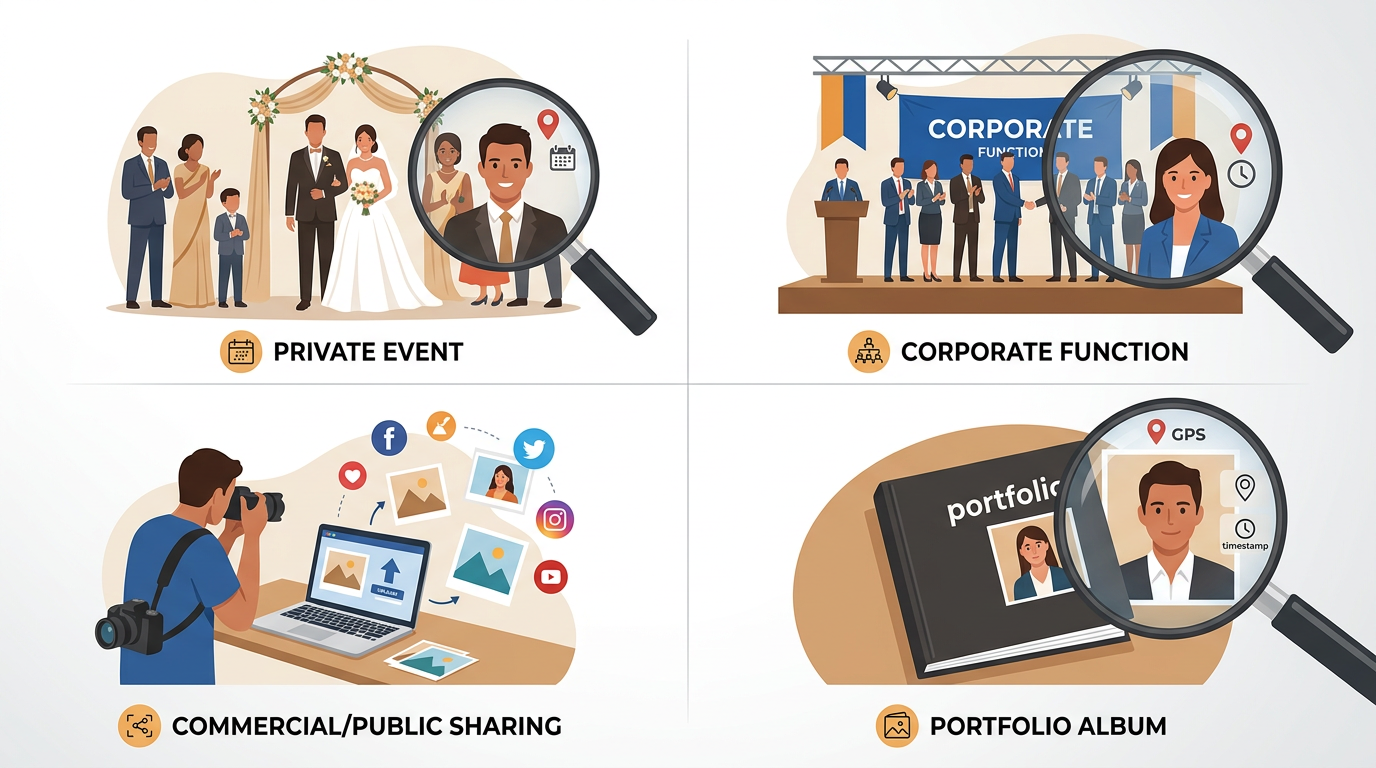
Weddings, corporate events, social posts, portfolio use — each is a moment where guest photo consent comes into play.
When Might Consent Be Treated Differently?
- Photography in the legitimate public interest or for news reporting — but still approached with care
- Legally mandated documentation or court evidence
- Situations where consent genuinely cannot be obtained — and only under careful legal guidance
Special Cases
- Children under 18: Verifiable consent must come from a parent or guardian.
- Vulnerable groups: Extra care and enhanced consent protocols may be needed.
- Cultural or religious sensitivities: Require respectful handling and, often, clearer notice and opt-out.
How Should Consent Be Given?
While the DPDP Act recognises different forms of consent, written consent is strongly recommended for photographers because it creates a clear, defensible record.
Why Choose Written Consent?
- Clear records protect you if a question ever arises
- It defines exactly how and where photos can be used
- It is easy to manage and review during an audit
- It helps avoid disputes about what was agreed
Digital Consent Tools
Many photographers now collect consent instantly at events using a quick digital form — a tablet at the registration desk or a QR code guests scan on their own phones. This keeps the process smooth, timestamped, and searchable.
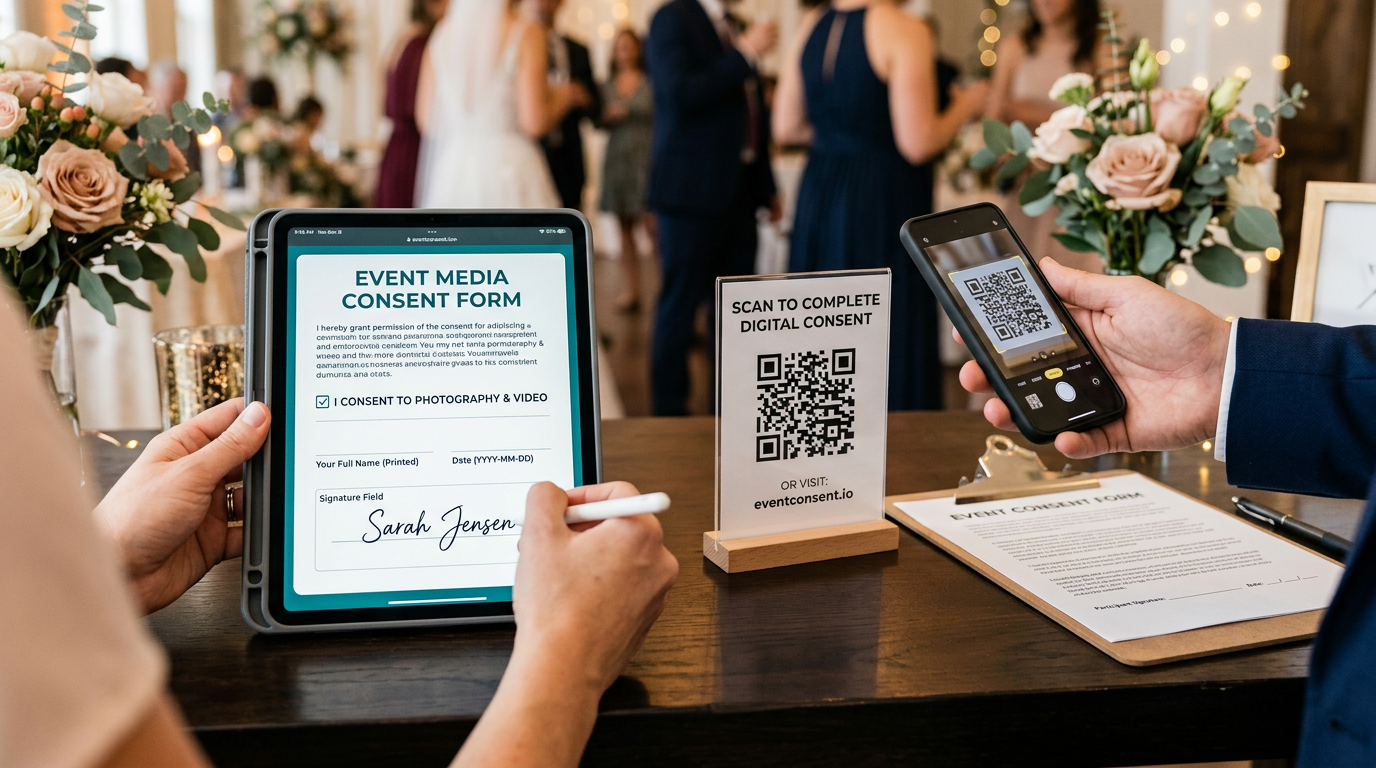
A QR code at check-in turns consent into a 20-second, fully logged step.
Best Practices for Managing Photo Consent
What Every Consent Record Should Capture
- The individual's name and contact details
- Which photos (or which event) the consent covers
- How you intend to use the photos (social media, portfolio, marketing)
- How long the consent is valid
- How the person can withdraw consent later
A Simple Event Workflow
- 1
Before the event: prepare consent forms and brief your team
- 2
During the event: collect consent at check-in via QR code or tablet
- 3
After the event: match photos to consent records and set a retention schedule
Storing Consent
| Storage Method | Pros | Cons | Best For |
|---|---|---|---|
| Digital Consent Systems | Secure, searchable, automated | May require some tech setup | Photographers with large volumes |
| Cloud Document Storage | Accessible, backed up | Recurring costs, privacy concerns | Mid-size businesses |
| Physical Paper Filing | Full control | Needs space, risk of loss | Small studios |
Delivery matters as much as storage. Platforms that send each guest their own encrypted gallery link — rather than one shared album everyone can browse — make this far easier, since people only ever access their own photos. Foto Owl AI is ISO 27001 certified and GDPR aligned, giving you a privacy-first foundation to build compliant delivery on top of.
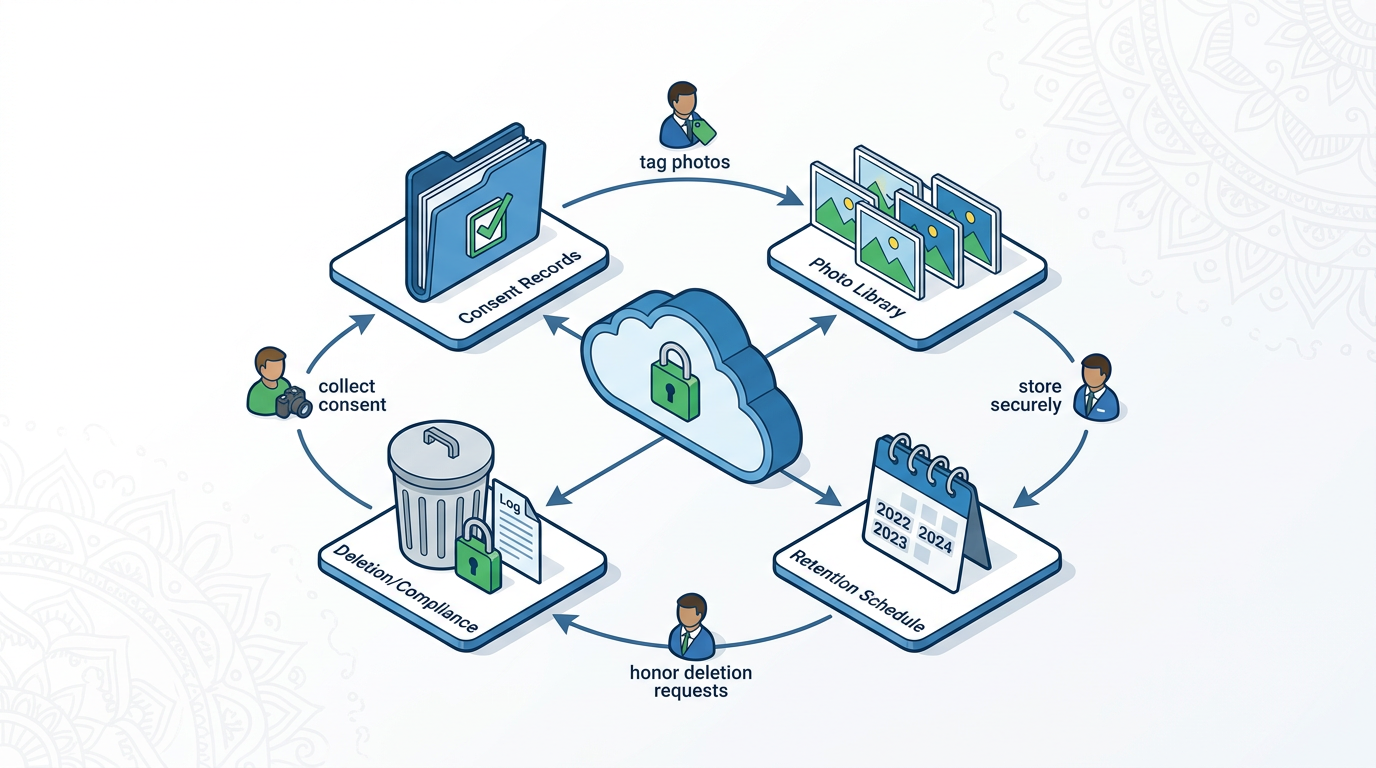
The full data lifecycle — from consent record to photo library to retention schedule to secure deletion.
Capture consent at check-in with a QR code that opens a short digital form. It timestamps each agreement, links it to the guest, and gives you a searchable record you can produce instantly if anyone ever asks.
Sample Consent Statement:
"I consent to [Photographer Name] capturing and using my photo for [specified uses such as portfolio, social media, marketing]. I understand I can withdraw my consent at any time by contacting [email/phone], and my image will be removed within [timeframe]."
What Happens If You Don't Comply?
Ignoring the DPDP Act's requirements can lead to significant penalties and other setbacks, including:
- Penalties of up to ₹250 crore for serious violations
- Damage to your professional reputation
- Costly legal challenges and disputes
- Restrictions on how you operate
- Knock-on effects on insurance or client contracts
Responding to Data Principal Requests
Be ready to:
- Provide copies of photos on request
- Correct inaccuracies in stored data
- Delete photos when asked
- Honour consent withdrawals promptly
Illustrative Scenarios and Tips
The following are illustrative situations — not specific cases — that show how these rules play out in everyday event work.
- A wedding photographer posts reception photos on social media without checking guest permissions, then has to take several down after complaints. A quick check-in consent step would have avoided it.
- A corporate client asks that an employee's photos be deleted after that person withdraws consent — and the photographer can act fast because every image is tied to a consent record.
- A sports-event photographer balances open public photography with honouring individual privacy requests at the finish line.
Handling Complaints About Unauthorized Photos
- Respond quickly and politely
- Review your consent logs
- Remove the photos if needed
- Record your response and tighten your process to prevent a repeat
Cultural Sensitivity at Indian Events
- Be mindful of family dynamics and privacy expectations at weddings
- Respect religious restrictions on photography during specific ceremonies
- Offer clear notice and an easy opt-out for guests
FAQs on the DPDP Act and Photography
Q: What exactly is the DPDP Act? A: It is India's Digital Personal Data Protection Act, 2023, operationalised by the DPDP Rules, 2025. It regulates how personal data — including identifiable photos — is collected and used, and it gives individuals rights over their data.
Q: Can someone take action if their photo is used without permission? A: Yes. A Data Principal can complain to the Data Protection Board of India, which can investigate and impose penalties on non-compliant Data Fiduciaries. It isn't a typical civil lawsuit, but the regulatory and financial consequences are real.
Q: Can I photograph people at public events? A: Generally yes, but you should obtain consent where individuals are identifiable — especially if the photos will be used commercially or shared publicly.
Q: How do I get guest photo consent? A: Prepare a clear consent statement, collect agreement before or right after photographing, store the record securely, and honour any withdrawal request.
Q: Is written consent necessary for every photo? A: Not always, but it offers the strongest protection. A single event-level consent form is acceptable when the intended use is clearly stated.
Q: How long should I keep consent records? A: The Act ties retention to the purpose of processing — keep data only as long as you genuinely need it. Many businesses retain consent records for a few extra years for audit safety.
Q: What about consent for children? A: Verifiable parental or guardian consent is mandatory for anyone under 18.
Deliver event photos privately and at scale
Foto Owl AI sends every guest a personal, encrypted gallery link backed by ISO 27001-certified, GDPR-aligned security — so each person sees only their own photos. A privacy-first foundation for compliant delivery.
Start Free Trial10,000 photos per year · No credit card required
Conclusion: Compliance as a Competitive Edge
The DPDP Act asks photographers to be more deliberate about how they collect, store, and use guest photos. It can feel like extra work, but the photographers who handle it well earn client trust and stand out in a crowded market.
To stay ahead, build clear consent procedures, use secure storage and delivery, brief your team on the basics, respond quickly to privacy requests, and review your process regularly. Treat compliance as an investment in your brand — not a burden — and it becomes one more reason clients choose you.
This guide is general information, current as of 2026, reflecting the DPDP Act, 2023 and the DPDP Rules, 2025. It is not legal advice — consult a qualified data-protection professional or lawyer for guidance on your specific situation.
Have questions about consent and data privacy for your own events? Drop them in the comments below — we're happy to help.